
MPURank: Decoding Social Hotspots via Tripartite Graph Iteration
MPURank: A Social Hotspot Tracking Scheme Based on Tripartite Graph and Multimessages Iterative Driven
The paper introduces MPURank, a social hotspot tracking scheme that utilizes a tripartite "message-path-user" graph and a multi-message iterative driving algorithm. By modeling topics as simultaneous cross-dissemination events, it achieves SOTA results in identifying influential users, critical propagation paths, and high-popularity messages.
TL;DR
In the hyper-connected world of social media, tracking "hotspots" requires more than just identifying popular users. MPURank introduces a sophisticated tripartite graph framework that simultaneously ranks Messages, Paths, and Users. By moving beyond traditional single-node attributes and adopting a circular iterative scoring mechanism (inspired by the HITS algorithm), it achieves superior accuracy in identifying the true drivers of viral topics, reaching an impressive 90% node coverage within the top 5% of ranked users.
Problem & Motivation: The "Concurrent User" Challenge
Most prior work in information tracking treats topics as a series of isolated retweets or follows a single-source propagation model. However, the reality of Web 2.0 (Microblogs, etc.) is far more complex:
- User Concurrence: A single user often participates in multiple messages belonging to the same broad topic.
- Path Complexity: Messages travel through specific "paths" of influence; ignoring these paths leads to a superficial understanding of how a hotspot actually evolves.
The authors' insight is that Messages (the 'What'), Paths (the 'How'), and Users (the 'Who') are deeply interdependent. A message is popular because it follows a critical path; a path is critical because influential users facilitate it.
Methodology: The Tripartite Graph Engine
The core of MPURank is the construction of a Topic Tripartite Graph .
1. Extraction and Analysis
First, the system builds a "Message Retweeting Relationship Tree." Unlike simple degree counts, it evaluates the breadth (number of first-layer retweets) and depth (the reach into the second layer and beyond). These are quantified as a "drive factor":
2. The Iterative Scoring Scheme
The breakthrough is the circular iterative process. Each element (Message, Path, User) is given an initial score which is then updated through forward and reverse iterations across the tripartite layers.
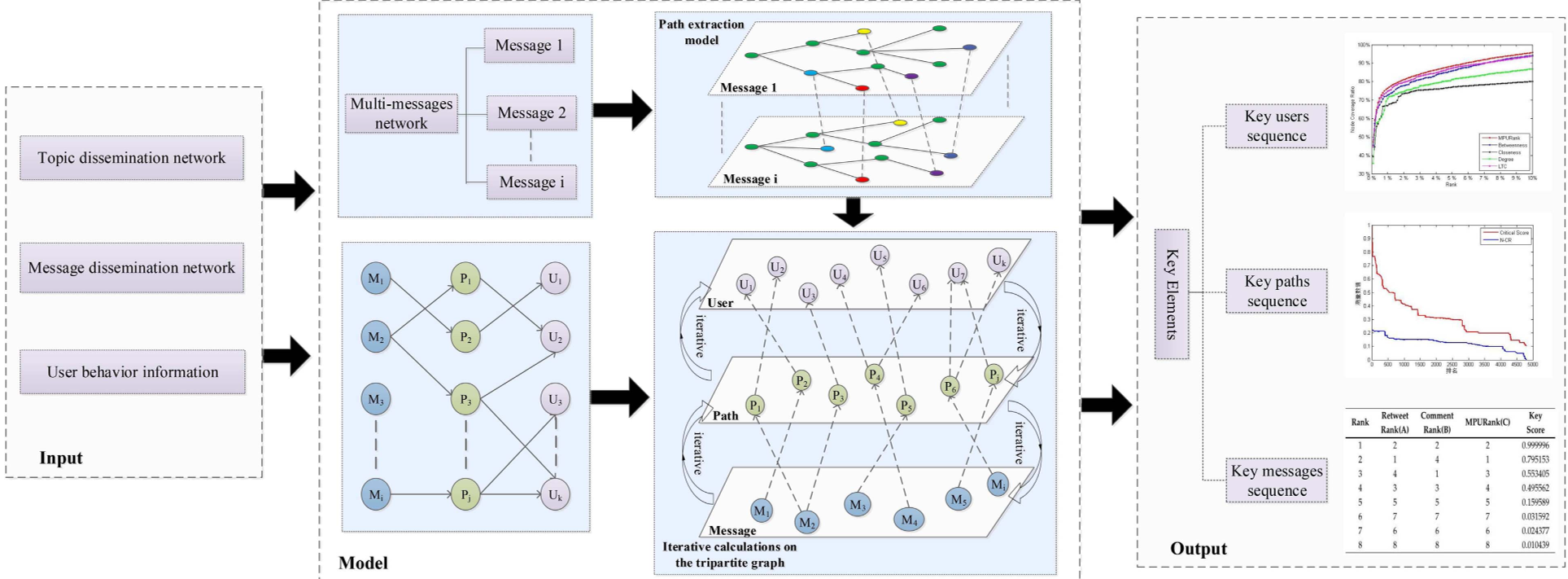 Fig 1: The MPURank Tracking Framework, showing the transition from raw social data to the tripartite iterative engine.
Through weighted matrices (Message to Path) and (Path to User), the importance of a path is derived from the popularity of the messages it carries, and the criticality of a user is derived from the importance of the paths they occupy.
Experiments & Results: Real-World Validation
The authors tested MPURank on a high-stakes dataset from Sina Microblog involving entertainment star "hotspots." The dataset included 8 separate messages, over 8,200 users, and 4,800 propagation paths.
Superior Coverage
When compared against classic metrics like Degree Centrality, Betweenness, and the recent Local Triangle Centrality (LTC), MPURank demonstrated a much sharper "capture rate."
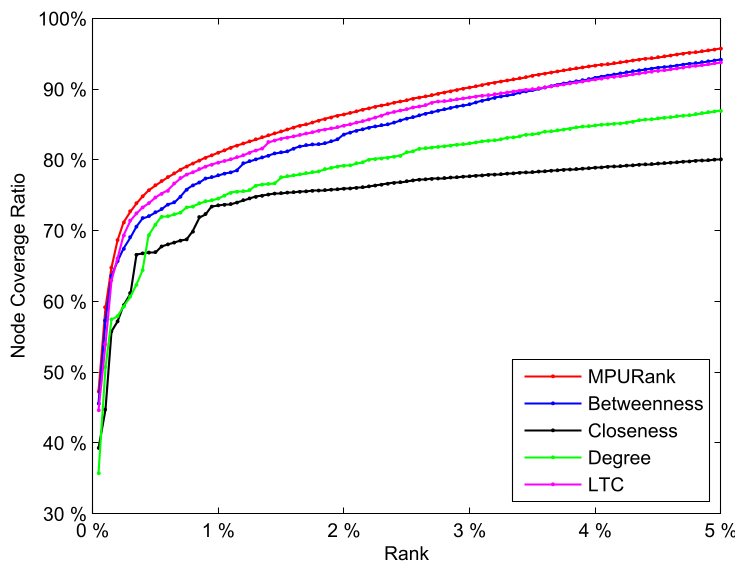 Fig 2: Comparison of Node Coverage Ratio (N_CR). MPURank (red line) consistently stays above baselines, especially for the top-ranked nodes.
The correlation of Paths and Nodes
The research confirms that user propagation ability is highly correlated with the number of traveled paths (Spearman's correlation > 0.8). This validates the author's decision to include Path as a first-class citizen in their graph model.
Critical Analysis & Conclusion
Takeaway: MPURank is a powerful tool for public opinion mining. Its ability to rank three different elements at once rather than providing an "isolated ranking" provides a holistic view of social event dynamics.
Limitations:
- While the time complexity is acceptable for specialized topics, the initial tripartite graph construction on a global social network scale (hundreds of millions of nodes) would still require significant hardware resources.
- The model assumes a "retweet" behavior; its performance on "influence-only" platforms (like Instagram or TikTok, where explicit path structures are harder to extract) remains to be seen.
Future Outlook: This work paves the way for more automated false information control systems that can track not just the source of a rumor, but the specific "poisoned" paths through which it spreads.