
Securing the Stream: An MST-Based Information Flow Model for OSN Privacy
An MST-based information flow model for security in Online Social Networks
This paper proposes an Information Flow security model for Online Social Networks (OSNs) using a Minimum Spanning Tree (MST) approach. By applying Kruskal's algorithm to social graphs weighted with user credibility and connection strength, the method identifies and prunes "weak" nodes and edges to prevent data leakage to adversaries or unknown users.
TL;DR
Social media privacy is often broken not by your friends, but by your friends' actions. This paper introduces a sophisticated security model that treats an Online Social Network (OSN) as a weighted graph. By identifying the Minimum Spanning Tree (MST)—effectively the most vulnerable links in your social circle—and pruning nodes that fall below a credibility threshold, the authors create a "trusted network" that automatically prevents sensitive information from leaking to potential adversaries.
Background: The Invisible Leak
Most OSN users understand that their direct friends can see their posts. However, the "privacy gap" occurs at distance > 1. When a friend likes or shares your photo, it becomes visible to their network—people you may not know or trust. Previous solutions either blocked too much (cutting off friends) or were too complex for the average user to manage.
The researchers' insight is elegant: Privacy is a graph problem. To solve it, we must quantify trust and then find the path of least resistance for data leakage.
Methodology: Quantifying Trust and Pruning Weakness
1. The Trust Calculus
The authors define trust as a probability scale (0 to 1). They use four primary metrics derived from large-scale user studies:
- User Credibility (): Based on Total Friends () and Age of User Account (). Profiles that are too young or have very few friends are penalized.
- Connection Strength (): Based on Mutual Friends () and Friendship Duration ().
2. The MST Strategy
Unlike traditional security models that look for the strongest paths, this model uses Kruskal's Algorithm to find the Minimum Spanning Tree. In this context, the MST represents the "weakest" infrastructure of the network.
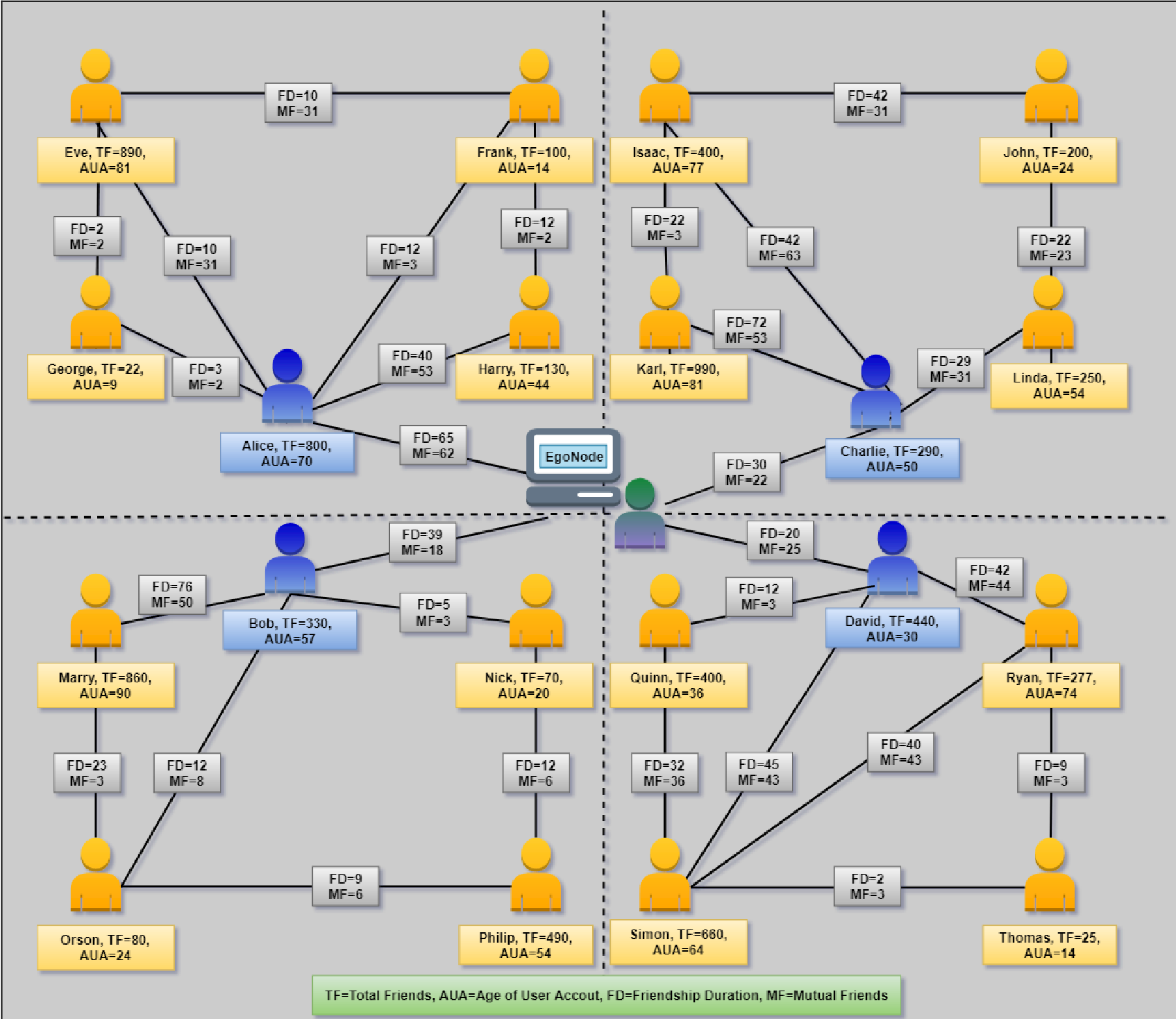
The algorithm follows a strict logic:
- Generate the full social graph centered on the "Ego-user."
- Extract the MST (the set of edges with the lowest trust values).
- Iterate through MST edges: if removing an edge disconnects a user whose credibility is below a Minimal Trust Value (MTV), that user is permanently pruned from the flow of information.
Experimental Validation: Does it Align with Human Intuition?
To validate the model, the authors conducted a survey of 282 users to establish ground-truth "Sharing Willingness."
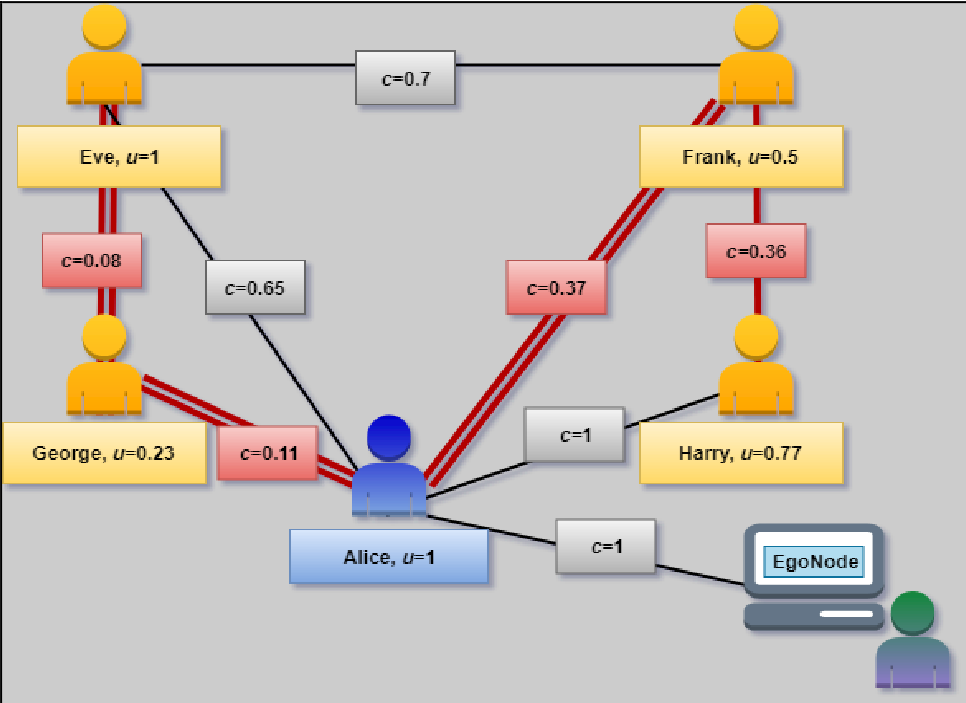
The results (as shown in the table above) demonstrated that the model correctly identified "George," "Thomas," and "Nick" as high-risk nodes. These users had the lowest calculated trust scores () and were precisely the individuals real-world participants were least willing to share data with.
Critical Insight & Future Outlook
The brilliance of using MST is that it targets the bottlenecks of trust. By focusing on the weakest edges, the model ensures that the remaining sub-graph is robust.
Limitations:
- The "New User" Problem: Legitimate new users with young accounts () or few mutual friends () might be incorrectly flagged as adversaries (the "cold start" problem of trust).
- Static vs. Dynamic: While the paper mentions temporal aspects, a real-time implementation would need to handle the extreme volatility of OSN connections.
Takeaway: This research moves us closer to "set-and-forget" privacy, where the network itself understands who is trustworthy, protecting users from the unintended consequences of their social interactions.