
MEC-Assisted D2D: Orchestrating the Next Generation of Localized Live Streaming
Multi-Access Edge Computing-Assisted D2D Streaming for Proximity-Based Social Networking
This paper proposes an MEC-assisted D2D live streaming architecture designed for proximity-based social networks. It introduces a hierarchical offloading mechanism combining Multi-access Edge Computing (MEC) for discovery/caching and Wi-Fi Direct for multi-hop D2D content sharing, complemented by a novel Multi-hop D2D Rate Adaptation (MDRA) heuristic.
TL;DR
Live streaming is the fastest-growing segment of mobile data traffic, often leading to massive redundancy in cellular networks. This paper presents a dual-layer solution: ETSI MEC (Multi-access Edge Computing) to handle discovery and regional caching, and Multi-hop D2D (Device-to-Device) networking via Wi-Fi Direct to share streams locally. The breakthrough is the MDRA heuristic, which prevents the "weakest link" in a D2D chain from causing playback freezes for the entire group.
The Proximity Paradox: Why Current Networks Struggle
When a stadium of people watches the same live replay, the mobile core network transmits the same data packets thousands of times to the same geographic area. While D2D communication seems like the obvious choice to offload this, it faces two "hard" engineering problems:
- Discovery Fatigue: Finding nearby peers via broadcast is slow and drains batteries.
- The Bottleneck Effect: In a multi-hop stream (A -> B -> C), if the link between B and C is weak but A's link to the tower is strong, C will experience constant buffering because A is requesting quality levels B-to-C cannot support.
Methodology: Hierarchical Intelligence
The authors propose a system divided into an MEC App and a User App.
1. MEC-Assisted Discovery and Caching
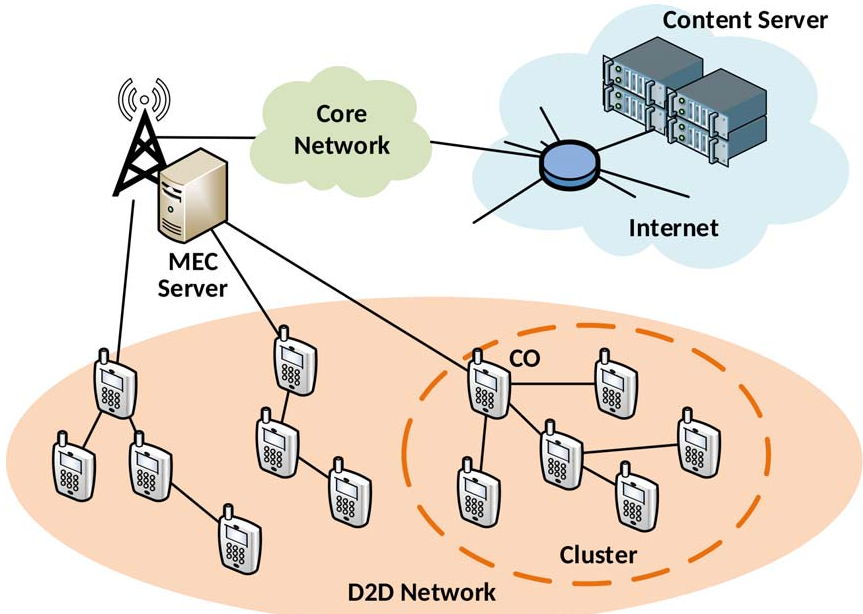
Instead of devices blindly searching for each other, the MEC server (located at the base station) acts as a local registry. It knows who is watching what and where they are. This reduces discovery latency and energy consumption by providing a "matchmaking" service via the GET_INFO request.
2. Multi-hop D2D Formation
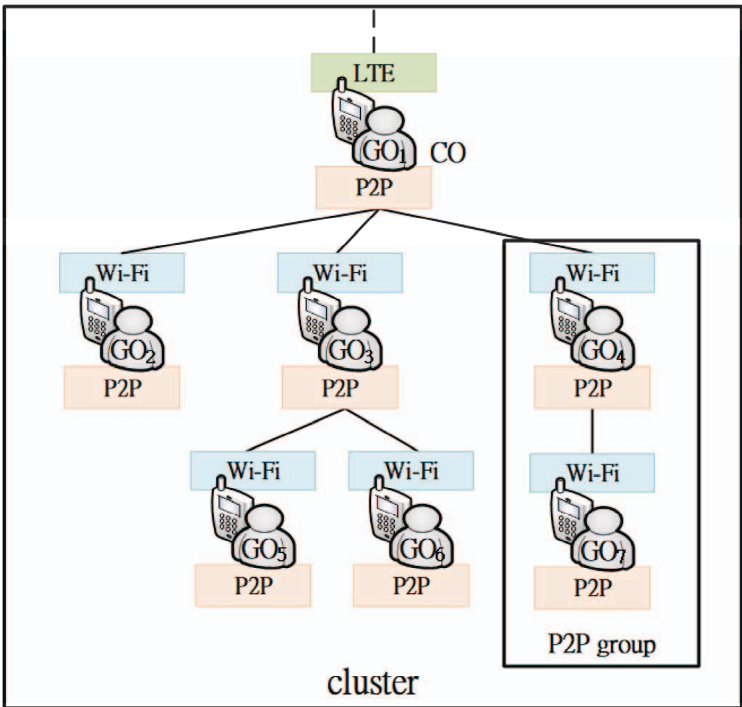
The system builds a tree-like topology using Wi-Fi Direct. One device acts as the Cluster Owner (CO) (the root), which pulls data from the MEC or Content Server and propagates it down the tree.
3. MDRA: The Multi-hop D2D Rate Adaptation
Standard DASH (Dynamic Adaptive Streaming over HTTP) only cares about the link between the server and the client. The proposed MDRA (Multi-hop D2D Rate Adaptation) heuristic changes the game by using a bottom-up quality selection process.
- The Logic: Every node in the D2D tree reports its "perceived quality" (based on local data rates) to its parent.
- The Decision: The Cluster Owner selects the minimum quality level among all its descendants' capabilities. This "consensus" ensures that no user in the chain falls behind and experiences a freeze.
Experimental Insights: QoE Gains
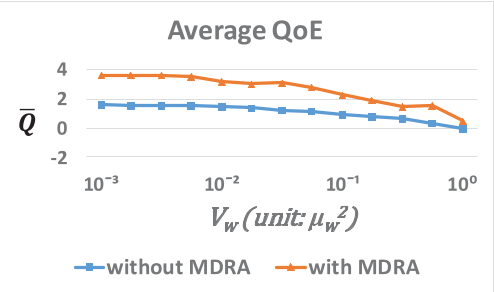
The researchers simulated a cluster of 30 users to evaluate the Average QoE () and Freeze Count ().
- Solving the Freeze Problem: In scenarios where the D2D link was the bottleneck ( is low), the system without MDRA saw a massive spike in freezes because the CO requested high-bitrate video that the local D2D network couldn't handle. With MDRA, the freeze count dropped to nearly zero.
- QoE Stability: While the average requested quality level () might be lower with MDRA (since it caters to the weakest link), the overall QoE is higher because users value a smooth, low-quality stream over a high-quality stream that stops every few seconds.
Critical Perspective: The Path Forward
The hierarchical approach of using MEC for control and D2D for data plane offloading is highly practical for 5G architectures. However, several challenges remain:
- Incentive Mechanisms: Why should a user (the Cluster Owner) use their battery to serve others? Future work should incorporate "energy-aware" routing or token-based rewards.
- Mobility: The tree topology is sensitive to nodes leaving. A more mesh-like, self-healing structure would be the logical next step for highly mobile social environments.
Conclusion
This work shifts the focus of D2D from simple "direct sharing" to a "managed local ecosystem." By leveraging MEC as a local orchestrator and implementing MDRA to respect the constraints of multi-hop links, the authors provide a viable blueprint for offloading 4K/8K live streams in dense social scenarios without compromising user experience.