
MAST: Bridging the Gap Between Environmental Data and Public Health via Multi-Agent Systems
Multi-agent-based System Technologies in Environmental Issues
This paper introduces a generalized Multi-Agent System Technology (MAST) designed for Environmental Impact Assessment (EIA). The system integrates distributed data sources, applies diverse data mining techniques (Regression, ANN, GMDH), and provides decision support for managing the relationship between environmental pollutants and human health.
TL;DR
Determining how environmental pollutants directly impact human health is a "wicked problem" characterized by fragmented data and complex causality. This paper presents MAST (Multi-Agent System Technology), an autonomous framework that utilizes specialized agent teams to fetch, clean, model, and simulate environmental scenarios. By leveraging "Committee Machines" and domain ontologies, the system transforms raw meteorological and clinical data into actionable strategies for government authorities.
Academic Positioning: This work serves as an architectural blueprint for Intelligent Decision Support Systems (IDSS), moving beyond simple monitoring to a full-cycle "Information-to-Recommendation" pipeline.
Problem & Motivation: The Heterogeneity Crisis
Environmental Impact Assessment (EIA) is notoriously difficult because:
- Data Fragmentation: Information is scattered across various agencies (meteorological, industrial, clinical).
- Quality Issues: Raw datasets are often riddled with "gaps," "artifacts," and inconsistent scales.
- Model Uncertainty: No single algorithm (Neural Networks vs. Regression) is perfect for every pollutant; relying on one leads to biased forecasts.
The authors' intuition is that Multi-Agent Systems (MAS) are uniquely suited for this because they can mimic a human expert team: one agent gathers data, another cleans it, and a "committee" of experts (models) debates the final forecast.
Methodology: The Three-Layered Intelligence
The proposed MAST architecture is functionally divided into three logical layers, which the authors implement using the Prometheus Development Tool (PDT) and JACK Intelligent Agents.
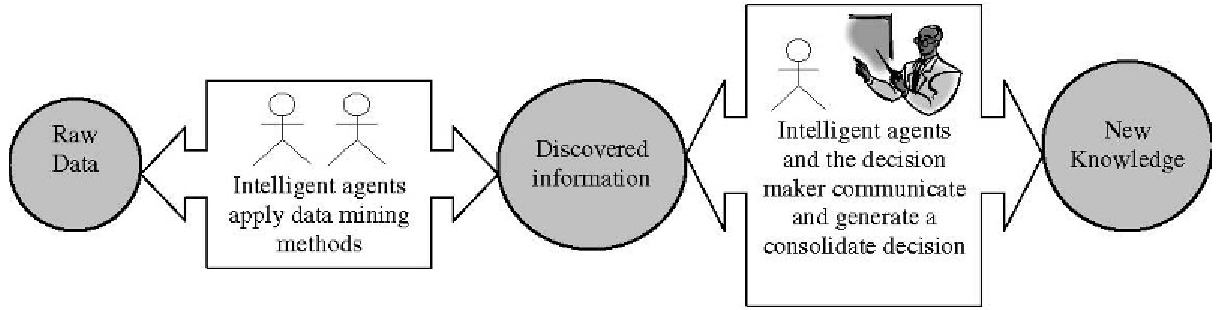
1. The Information Change Lifecycle
Information undergoes a state-change from "Raw Data" "Information" (Models/Dependencies) "New Information" (Forecasts/Recommendations).
2. Core Agent Roles
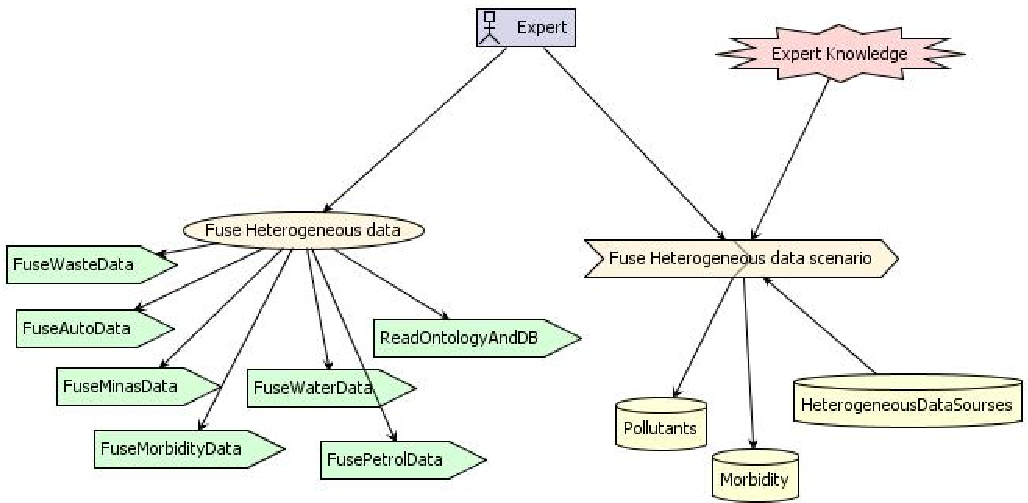
- Data Aggregation Agent (DAA): Connects to the Domain Ontology (OWL files) to understand the meaning of data before "fusing" pollutants (water, air, traffic) with morbidity statistics (ICD-10 codes).
- Data Preprocessing Agent (DPA): A specialized team that handles normalization, correlation, and gap-filling.
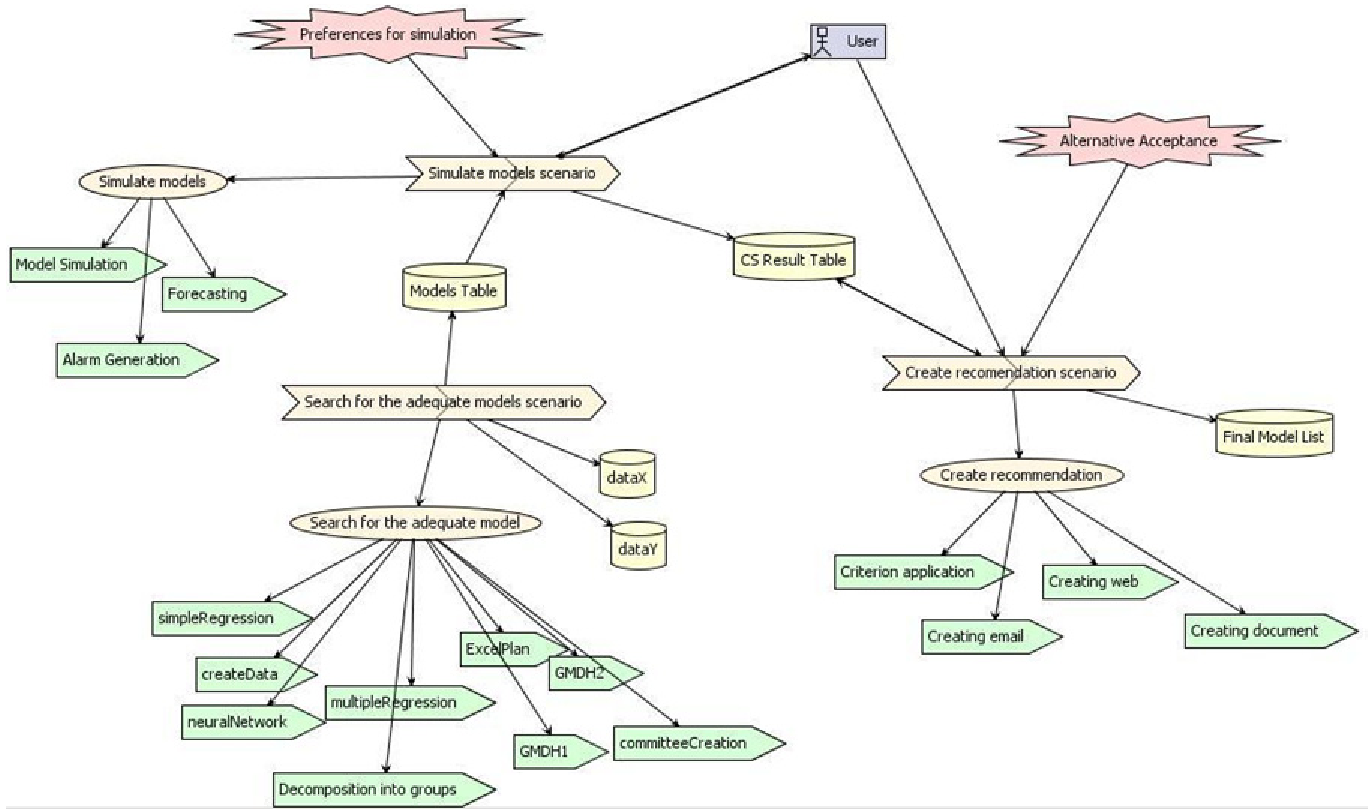
- Function Approximation Agent (FAA): This is the "brain" of the system. It runs specialized agents for Regression, Artificial Neural Networks (ANN), and Group Method of Data Handling (GMDH) in parallel.
- Committee Machine Agent (CMA): Acts as the final evaluator, selecting the most robust models to form a "hybrid" prediction.
Experiments & Results: Real-World Deployment
The authors tested the system on data from Castilla-La Mancha, Spain.
- Data Refinement: The system automatically identified that out of 65 pollutants, only 52 had sufficient data quality for long-term modeling.
- Model Explosion: The FAA evaluated an massive array of models:
- Regression: 4,405 variants.
- Neural Networks: 1,329 variants.
- GMDH: 2,435 variants.
- Key Findings: The system pinpointed specific correlations between water quality and cases of neoplasm and congenital malformations in the Albacete region. It provided 4-year forecasts (6-month steps), warning when pollutants would breach "alarm levels."
Critical Analysis & Conclusion
Takeaway
The strength of this research is its modularity. By separating the "Domain Ontology" from the "Agent Logic," the authors created a system that can be re-oriented to an entirely different field (like finance or logistics) simply by swapping the ontology file.
Limitations
- Computational Cost: Evaluating thousands of models (ANN, GMDH) in real-time is resource-intensive.
- Data Dependency: As noted in the results, the "heterogeneity" of data remains a bottleneck; the system dropped 13 pollutants because the raw time-series were too sparse.
Future Outlook
The next step for such systems is the integration of Large Language Models (LLMs) to act as the "Decision Maker" interface, allowing government officials to query the MAS using natural language (e.g., "What happens to the local asthma rate if we reduce traffic by 20%?").
Final Verdict: A robust, industrial-strength application of MAS that demonstrates how decentralized intelligence can solve centralized environmental crises.