
Decentralized Community Mining: A Multi-Agent Self-Organization Approach
A Multi-Agent Based Decentralized Algorithm for Social Network Community Mining
This paper introduces a multi-agent based decentralized algorithm for social network community mining. By transforming the partitioning problem into an optimization task on a "supplementary graph," the authors utilize autonomous mobile agents to achieve community detection through self-aggregation and asynchronous local search.
TL;DR
The paper proposes a novel decentralized algorithm for mining communities in social networks. By treating network nodes as a "supplementary graph" and deploying autonomous mobile agents to "color" these nodes, the system achieves complex community partitioning through local interactions and self-aggregation. Unlike centralized SOTA methods, this approach requires no global network knowledge, making it a robust candidate for P2P and large-scale distributed systems.
1. The Bottleneck of Centralized Mining
Traditional community detection algorithms, such as the Girvan-Newman or spectral methods, operate under a "God's eye view" assumption. They require the complete adjacency matrix to be loaded into memory. However, in modern contexts—such as the WWW, global sensor networks, or private P2P structures—obtaining a global snapshot is either computationally prohibitive or violates the decentralized nature of the system.
The authors identify that for these Distributed Network Community Mining Problems (D-NCMP), we need a method that is:
- Asynchronous: No global clock required.
- Decentralized: Decisions made based on local neighborhood data.
- Scalable: Computational cost distributed across autonomous entities.
2. Methodology: From Partitioning to Supplementary Coloring
The core mathematical insight of the paper lies in the Supplementary Graph ().
A community is defined by dense intra-links and sparse inter-links. The authors define an evaluation function that counts the number of "missing links" needed to make each community a clique. In the supplementary graph (where a link exists if it doesn't exist in the original graph), this problem becomes equivalent to Graph Coloring:
"To cluster a network is to color its supplementary counterpart so that adjacent nodes have distinct colors."
The Multi-Agent Mechanism
The algorithm dispatches agents into the network. Each agent follows a simple local logic:
- Update: Change the current node's color to minimize local conflict .
- Move: Select the next neighbor to visit, prioritizing those with the highest local conflict (highest ) to "fix" the clustering.
- Terminate: Die after a predefined number of
hops.
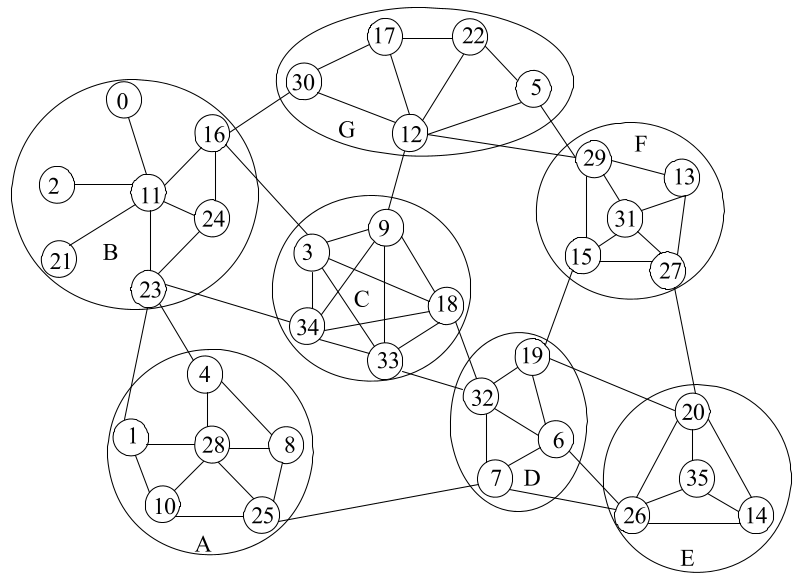 Figure 1: Demonstration of how local and global evaluation functions converge rapidly (within ~50 hops) in a test network.
3. Experimental Validation
The authors tested the Decentralized-P* algorithm on several classic benchmarks:
Zachary’s Karate Club
The algorithm correctly identified the two primary communities split by the club's president and instructor. The only error was Node 10, an overlapping node with balanced ties to both groups, highlighting the challenge of "fuzzy" boundaries in hard partitioning.
US College Football
Testing against 115 teams organized into 12 conferences, the algorithm achieved a highly regular near-diagonal adjacency matrix.
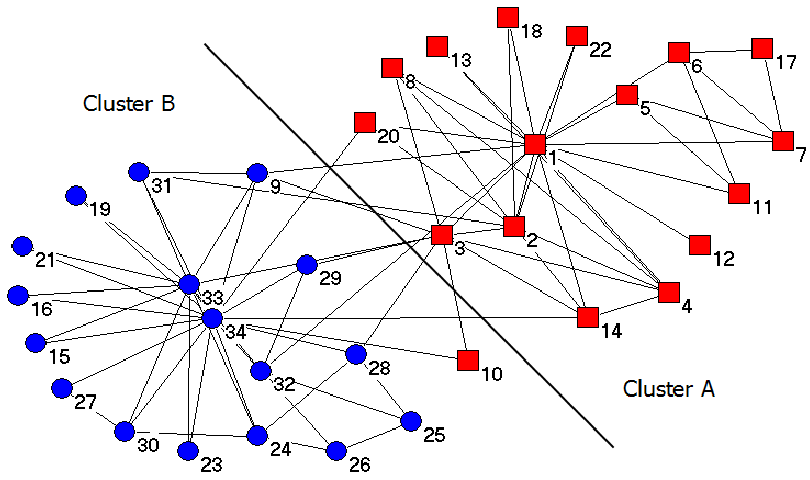 Figure 2: The reconstructed adjacency matrix (right) clearly shows the 12 communities (conferences) as dense diagonal blocks.
4. Academic Insight & Critical Analysis
The brilliance of this work is not just in the decentralization, but in the probabilistic movement (parameters ). By allowing agents to occasionally make sub-optimal or random moves, the system avoids getting stuck in local minima—a classic strategy in heuristic local searches like Simulated Annealing, but implemented here as an emergent behavior of a multi-agent swarm.
Limitations:
- The 'k' Problem: The algorithm requires the number of communities to be predefined. In real-world discovery, is often unknown.
- Supplementary Density: In very sparse networks, the supplementary graph becomes extremely dense (), which could increase the local search complexity per agent move.
5. Conclusion
This paper shifts the paradigm of community mining from "global computation" to "agent-based emergence." It provides a viable path for community discovery in ad-hoc networks, such as building recommendation systems for mobile devices (iPDAs) where global topology is hidden. Future work involving "k-free" hierarchical partitioning could make this approach the gold standard for truly massive, decentralized graph analysis.