
[Nature Biomedical Engineering 2026] BioMedAgent: The Rise of the Autonomous AI Data Scientist for Complex Biomedicine
Empowering AI data scientists using a multi-agent LLM framework with self-evolving capabilities for autonomous, tool-aware biomedical data analyses
BioMedAgent is a self-evolving multi-agent LLM framework designed for autonomous biomedical data analysis. It leverages a collaborative architecture (Planning, Coding, Execution) and a memory retrieval mechanism to chain specialized bioinformatics tools into executable workflows, achieving a 77% success rate on the BioMed-AQA benchmark and significantly outperforming general-purpose LLM agents.
Executive Summary
The era of big data in biomedicine has arrived, but the "bottleneck" remains the scarcity of experts who can bridge the gap between biological hypotheses and complex computational code. BioMedAgent, a seminal work published in Nature Biomedical Engineering, introduces a self-evolving multi-agent framework that transforms Large Language Models (LLMs) from simple chatbots into autonomous data scientists.
Key Achievement: BioMedAgent achieves a 77% success rate on the complex BioMed-AQA benchmark, nearly doubling the performance of ChatGPT-4o (46%). It doesn't just write code; it plans, executes, debugs, and remembers how to solve problems.
The Pain Point: Why GPT-4 Fails at Bioinformatics
Standard LLMs suffer from three critical flaws in scientific research:
- Tool Illiteracy: They cannot natively handle specialized binaries like BWA or GATK.
- Reasoning Fragility: Complex multi-step workflows (e.g., cross-omics) often collapse during execution due to logic errors.
- Goldfish Memory: They treat every task as a "first time" encounter, failing to leverage past successes to solve similar future problems.
Methodology: The Self-Evolving "Brain"
BioMedAgent solves these via a tiered multi-agent architecture:
1. Interactive Exploration (IE) - The Collaborative Refiner
Instead of a single prompt, BioMedAgent uses a trio of agents: Planner, Programmer, and Executor. If a unit test fails, the Executor feeds terminal errors back to the Programmer for automated bug-fixing. This "group intelligence" mimics a human lab team.
2. Tool-Aware Flexibility
The system includes a Tool Manager that learns from documentation. It can use Local Tool Usage (LTU) for heavy lifting (like alignment) and Custom Tool Code (CTC) for lightweight data munging.
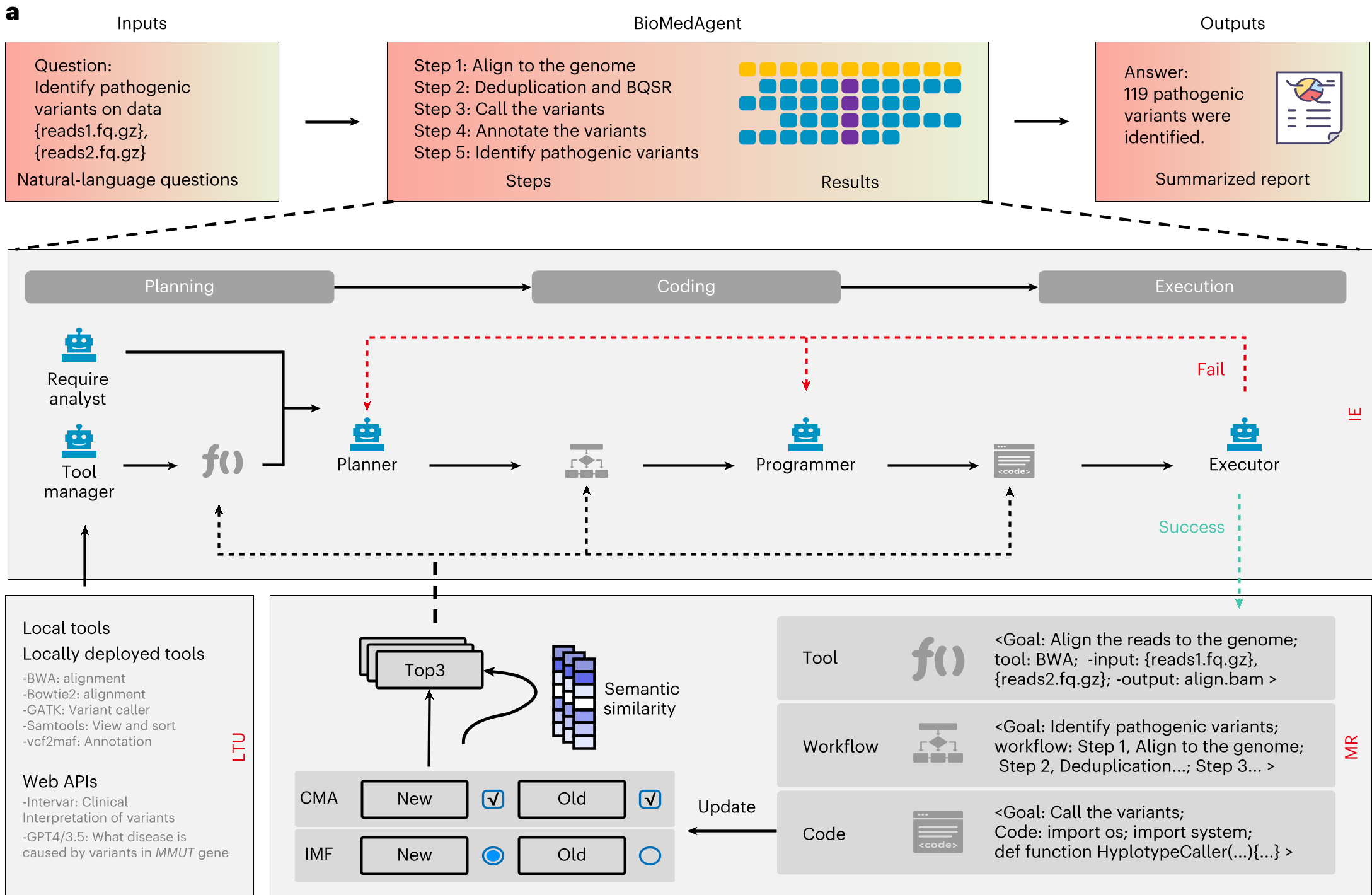 Figure 1: The BioMedAgent workflow from natural language input to final scientific summary.
3. Memory Retrieval (MR) & The IMF Strategy
This is the "Self-Evolution" core. The framework stores successful workflows in a memory base. Crucially, the authors found that Iterative Memory Forgetting (IMF)—pruning redundant or inefficient paths—actually leads to faster convergence and higher accuracy than simply keeping everything.
Experimental Results: SOTA Performance
Evaluated on BioMed-AQA (327 tasks) and BixBench, BioMedAgent consistently crushed baselines.
- Omics Analysis (O): 94% Success Rate.
- Precision Medicine (P): 78% Success Rate.
- External Generalization: Outperformed BixBench baseline agents by significant margins (e.g., 49% vs 37% on open questions).
 Table 1: BioMedAgent significantly outperforms both GPT-4o and specialized OpenAI Assistants.
Real-World Impact: Reproducing Nature Medicine Studies
To prove it's not just "benchmarking," the authors tasked BioMedAgent with reproducing a study on liquid biopsy (ctDNA) for predicting venous thromboembolism. Using only natural language instructions, the agent:
- Performed data preprocessing.
- Trained Random Survival Forest (RSF) models.
- Calculated C-indices (matching the original study's result of ~0.74).
Deep Insight: Why It Works
The secret sauce is the Inductive Bias provided by the multi-agent structure. By separating "Planning" from "Coding," the model avoids the cognitive overload that occurs when a single LLM tries to do everything at once. Furthermore, the IMF strategy mimics biological neural pruning, ensuring the agent retrieves only the most "elegant" solutions from its past.
Conclusion & Future Outlook
BioMedAgent is a major step toward a true "AI Scientist." While limitations like hallucinations in long-chain reasoning persist, the framework’s ability to "learn" its own tools suggests a future where researchers focus on asking the right questions, rather than debugging the scripts to answer them.
Takeaway for the Industry: The future of AI in science isn't just bigger models—it's smarter, self-evolving architectures that can manage their own library of specialized tools.