
The Newsvendor’s Social Edge: Optimizing Inventory through Word-of-Mouth Multi-Agent Simulation
A Multi-agent Approach for the Newsvendor Problem with Word-of-Mouth Marketing Strategies
This paper proposes a multi-agent model to solve the Newsvendor Problem by integrating Word-of-Mouth (WOM) marketing dynamics. By simulating the viral spread of information using an SIR (Susceptible-Infectious-Resistant) model on small-world networks, the authors determine optimal inventory levels and identify high-influence nodes through social network analysis.
TL;DR
Classic operations research treats demand like a roll of the dice, but in the era of social media, demand is a viral contagion. This paper replaces static probability distributions with a Multi-Agent SIR (Susceptible-Infectious-Resistant) model, proving that choosing the right "Patient Zero" for a marketing campaign can be the difference between a 500% profit loss and a SOTA optimization.
Problem & Motivation: The Failure of "Aggregate" Thinking
The Newsvendor Problem—deciding how much to order for a single period of uncertain demand—is a cornerstone of supply chain management. Typically, we assume demand follows a Normal or Poisson distribution. However, Word-of-Mouth (WOM) marketing creates non-linear dynamics.
The authors argue that previous "Mean-Field" approaches (which assume everyone interacts witheveryone else) are fundamentally flawed. They ignore the topological structure of social networks. If you ignore the "small-world" nature of human connection, you end up with "optimal" order quantities that are wildly inaccurate, leading to massive overstocking or stockouts.
Methodology: Simulating the Viral Contagion
The core of this work is the marriage of Social Network Analysis (SNA) and SIR Modeling.
1. The Infection Logic
The market is viewed as a population in three states:
- Ignorant (I): Potential customers.
- Spreader (S): Customers who bought the product and are actively "infecting" friends.
- Resistant (R): Customers who bought the product but stopped talking about it because the "news value" has faded.
2. Network Topology
Instead of a random graph, the authors use a Watts-Strogatz Small-World model, which mimics real social circles where most people are connected to neighbors, but "shortcuts" (weak ties) connect distant clusters.
 Table 1: Characteristics of the generated WS small-world network used for agent simulation.
Experiments & Results: Who is the Real Influencer?
One of the most striking findings is the rejection of "Influencer" stereotypes. In marketing, we often target the person with the most followers (Degree Centrality).
The simulation reveals a counter-intuitive truth: Closeness Centrality is the superior metric. Nodes with high closeness can reach all other nodes in the network faster through "shortcuts," maximizing the spread before the "news value" (the resistant probability) kills the momentum.
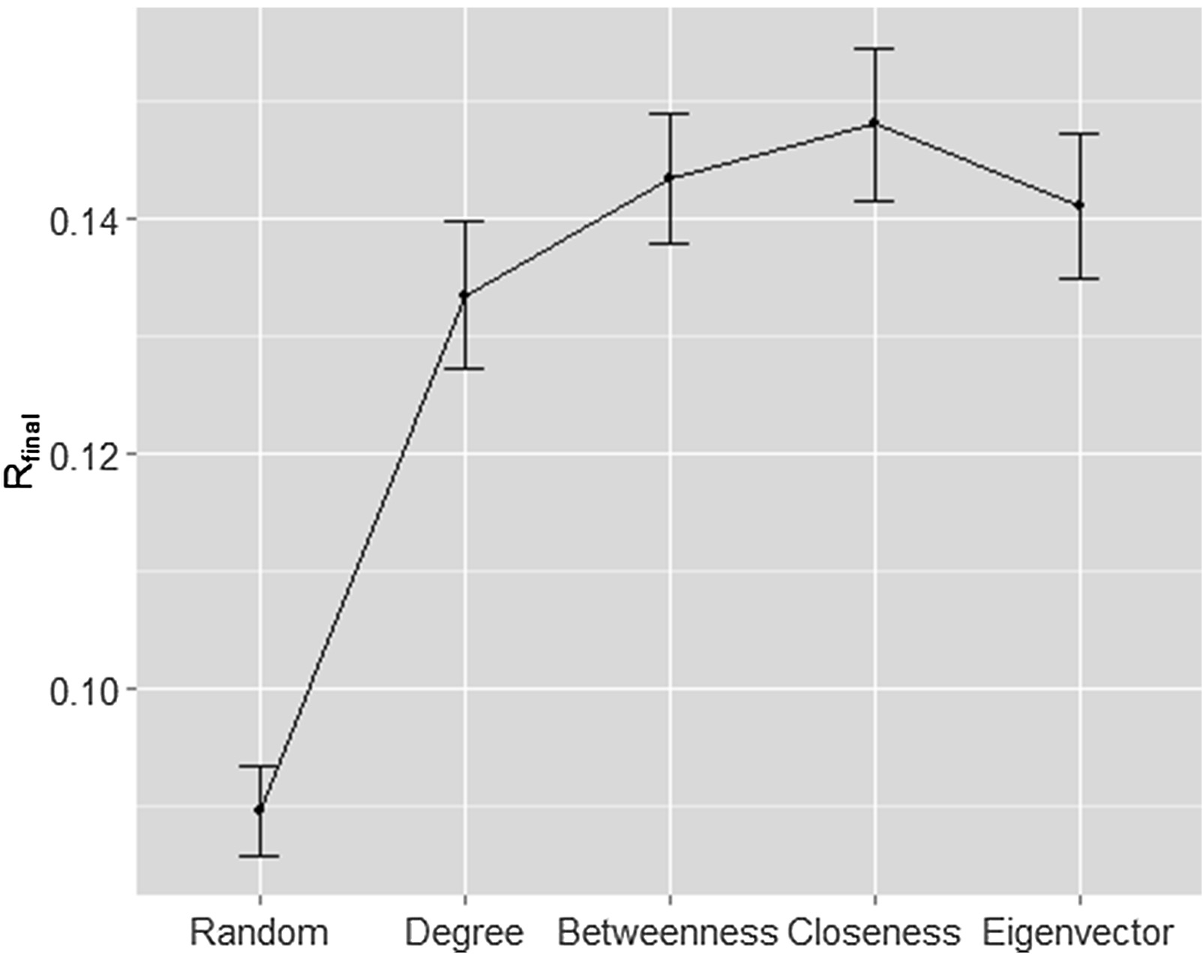 Figure 1: Comparison of market reach (R final) based on different source node selection tactics. Closeness outperforms Degree and Random selection.
The Cost of Being Wrong
The authors compared their model against the traditional "Mean-Field" approach. The Mean-Field approach predicted an optimal order quantity () of 3,984 units, whereas the Multi-Agent simulation suggested only ~1,039 units.
- Mean-Field Profit: -10,505.09 (Extreme loss)
- MAS Optimized Profit: 2,557.38
- The Gap: A 510.78% difference in expected returns.
Critical Analysis & Takeaways
Why it Works
The model recognizes that WOM is a stochastic process with a bimodal distribution. Sometimes a campaign "fizzles out" early; other times it goes "niche viral." By using quadratic interpolation on simulated demand data, the Newsvendor can hedge against these social risks.
Limitations
The study assumes a monopoly market and a single-period setting. In reality, competitors would launch counter-campaigns, and the "Resistant" state might be influenced by negative reviews, which this SIR model doesn't fully capture (it focuses on "lost news value" rather than "active dissatisfaction").
Future Outlook
This work lays the groundwork for AI-driven inventory management. Future systems could ingest real-time social graph data from platforms like X (Twitter) or WeChat, calculate the Closeness Centrality of early adopters, and automatically adjust warehouse replenishment orders.
Final Summary: Don't just find the person with the most friends; find the person who is "closest" to everyone. Your inventory levels depend on it.