
Modeling the Ripple Effect: Multi-Agent Systems in Petrol Pricing Dynamics
Application of Multi-agent Systems and Social Network Theory to Petrol Pricing on UK Motorways
This paper presents a Multi-Agent System (MAS) integrated with Social Network Theory to simulate petrol pricing dynamics on UK motorways. By modeling individual petrol stations as heterogeneous, communicative agents, the study demonstrates how pricing information diffuses through a linear geographical network.
TL;DR
This paper introduces a specialized Multi-Agent System (MAS) to explore how petrol stations on UK motorways influence each other's prices. By treating stations as "social agents" within a geographic network, the researchers successfully simulated the diffusion of price changes, proving that simple local rules—like not being too much more expensive than a neighbor—can drive complex, system-wide economic behaviors.
Background: Beyond Static Regression
Traditional economic modeling for petrol prices often relies on regression analysis, which treats variables as static snapshots. However, the retail fuel market is a complex system: it is decentralized, highly interactive, and sensitive to geography. This paper repositions petrol stations not just as points on a map, but as nodes in a social network that constantly "talk" to each other through the medium of price.
Problem & Motivation: The Geometry of Competition
Why UK motorways? They offer a unique "linear laboratory." Unlike city centers where competition is a messy 2D grid, motorways are one-dimensional stretches of road. This simplification allows researchers to isolate how information travels spatially. The core challenge was capturing the "social network" of petrol stations—the fact that station managers don't set prices in a vacuum; they react specifically to their nearest neighbors' signage.
Methodology: The Architecture of an Agent
The researchers extended a Java-based "Small World" application to create their MAS. Each petrol station is an agent characterized by:
- Heterogeneity: Specific location and price.
- Reactivity: Rules for undercutting and overpricing (e.g., "If I am 1p more expensive than my neighbor, I must drop my price").
- Distance Decay: The impact of a neighbor’s price follows an exponential scale—closer competitors matter more.
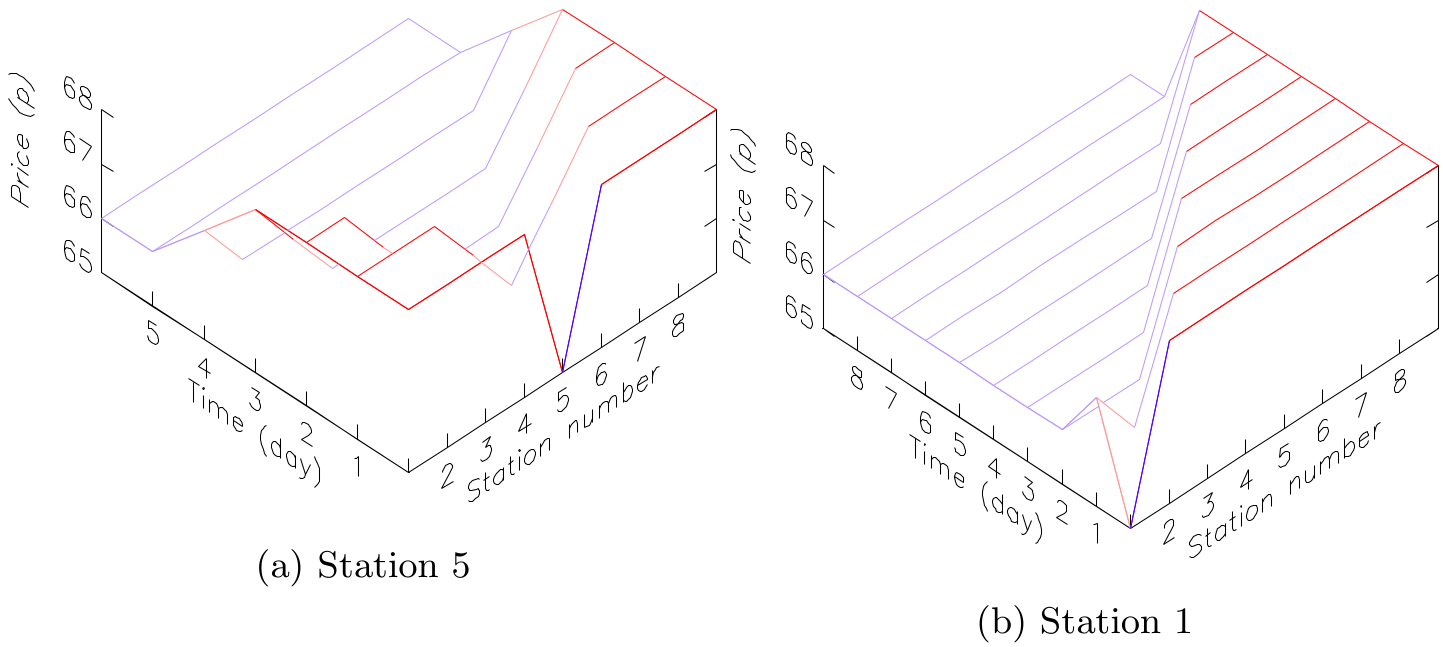 Figure 1: Visualizing the price diffusion in a linear network of 9 stations over time.
Experimental Insights: How Prices "Flow"
The team conducted "Price Drop" experiments to see how a single discount ripples through the network:
- Central Injection: A 3p drop at the middle station (Station 5) synchronized the entire 18km stretch within 5 days.
- Edge Injection: A drop at the start of the road (Station 1) took 8 days to reach the end, showing how geographical position dictates market influence.
- Self-Correction: Interestingly, if a station became too cheap compared to the new lower average, it would actually raise its price slightly to maintain the "overpricing/undercutting" equilibrium, showing the model's stability.
Deep Insight & Conclusion
The true value of this work lies in its validation of Agent-Based Modeling (ABM) for geographical economics. While the rules assigned to the agents are simple, the emergent behavior—the symmetrical diffusion of prices—closely mirrors real-world market observations.
Limitations: The current model ignores external shocks like crude oil price fluctuations or tax changes. It assumes a "closed" system where only neighbor prices matter.
Future Outlook: The next frontier for this research involves applying these agents to real-world UK motorway data, potentially allowing regulators or companies to predict how a localized "price war" might impact fuel costs across an entire region. This work serves as a cornerstone for moving from "descriptive" geography to "predictive" spatial modeling.