
Beyond Point Estimates: Capturing Reliability in Age and Gender Estimation
Multi-algorithmic Fusion for Reliable Age and Gender Estimation from Face Images
The paper introduces a multi-algorithmic fusion approach for reliable age and gender estimation using an ensemble of dropout-reduced neural networks. By leveraging stochastic forward passes, the method achieves SOTA results on the Adience benchmark, reaching 90.0% gender accuracy and 64.6% age accuracy.
TL;DR
Researchers have developed a multi-algorithmic fusion system that doesn't just guess your age and gender—it tells you how much you should trust the result. By using a specialized ensemble of neural networks and stochastic forward passes, the proposed "Multi-RAAGE" method achieves state-of-the-art (SOTA) performance on the Adience benchmark (64.6% age accuracy) while providing a reliable confidence metric that outperforms traditional softmax scores.
The Problem: Confidently Wrong
Most modern AI models are overconfident. In ideal lab conditions, they match human performance, but "in the wild"—facing shadows, blurriness, or faces that don't look like the training data—they often produce incorrect labels with 99% confidence. This lack of intuition is dangerous in high-stakes fields like forensics or law enforcement, where a misidentification has real-world consequences.
The authors argue that current methods for rejecting low-quality images (based on pixels alone) fail to account for the model’s internal biases. We need a system that knows when it is "out of its depth."
Methodology: The Power of Stochastic Fusion
The core of the paper is the transition from a single prediction to a distribution of predictions.
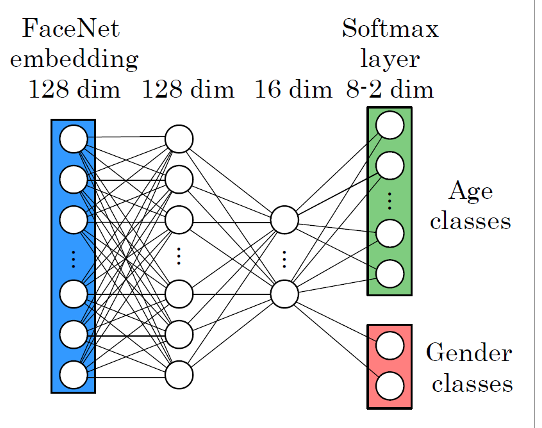
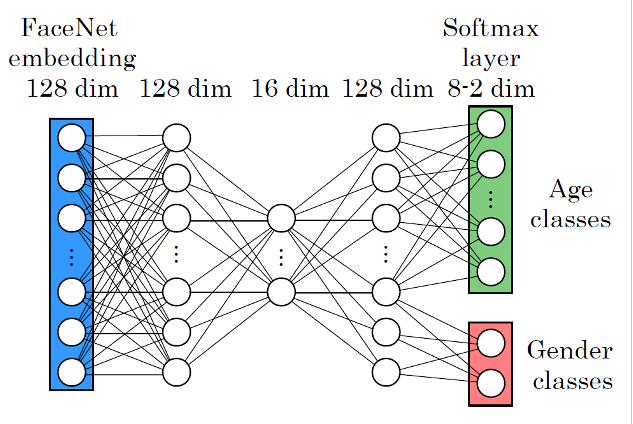
- Architecture: The system starts with FaceNet embeddings (128-D) extracted from face images.
- The Ensemble: They utilize an ensemble of three distinct neural networks, each utilizing dropout not just during training, but also during inference.
- Stochastical Forward Passes: For every single image, the system runs 100 forward passes through each network (300 in total). Because of dropout, each pass "turns off" different neurons, creating a variance in the output.
- Fusion: These 300 outputs are fused using a logistic regression model to create a unified "pseudo-softmax" layer.
Quantifying Reliability
The researchers define reliability through two lenses:
- Centrality: The average probability across all 300 passes.
- Dispersion: The disagreement between passes.
If the model’s 300 guesses are all "25-32 years old" and are tightly clustered, reliability is high. If the guesses are scattered across "8-12" and "48-53," the dispersion is high, and the reliability score drops—signaling the system is confused.
Experiments & Results
The model was tested on the Adience benchmark, a dataset notorious for "unfiltered" real-world faces.
Breaking the Record
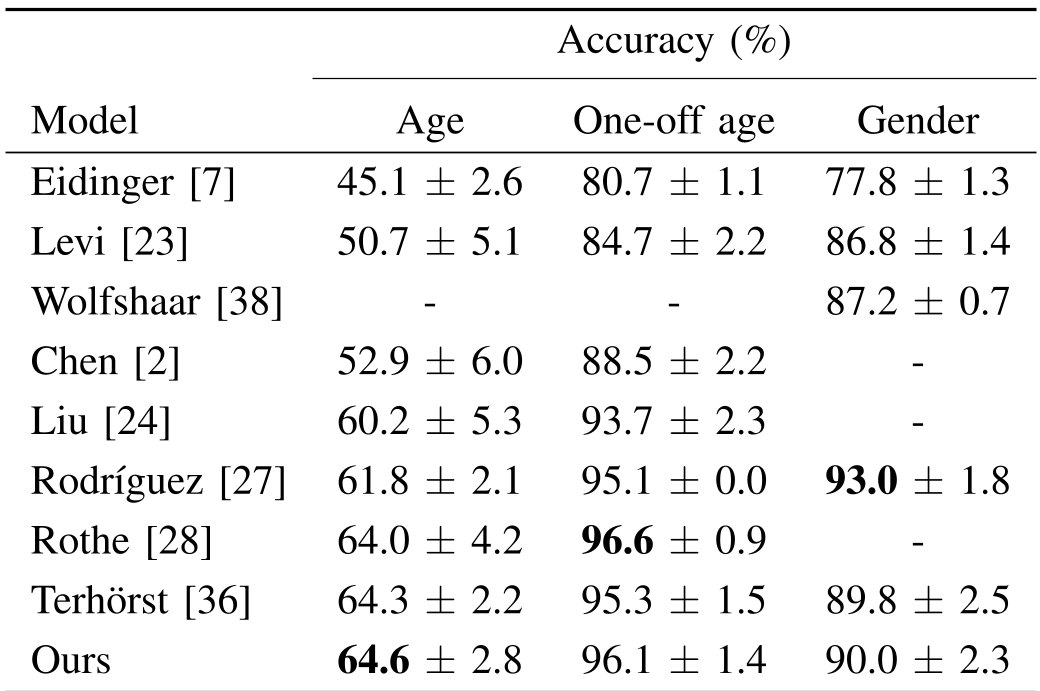
The Multi-RAAGE approach set new benchmarks, specifically in age estimation:
- Age Accuracy: 64.6% (New SOTA).
- One-off Age Accuracy: 96.1% (Predicting the correct or immediately adjacent age group).
- Gender Accuracy: 90.0%.
Proof of Reliability
The most compelling result is shown in the reliability curves. When the system is allowed to "reject" images where its reliability score is low, its accuracy on the remaining images skyrockets. The multi-algorithmic approach (Multi-RAAGE) showed much smoother and higher performance gains than previous single-model methods (RAAGE).
Visualizing Uncertainty
To prove the system captures human-like intuition, the authors visualized images at different reliability levels:
- High Reliability: Clear, front-facing babies (distinct features).
- Low Reliability: Heavy shadows, motion blur, and occlusions (hair covering eyes).
This confirms that the mathematical "dispersion" of the ensemble effectively maps to visual "noise" and complexity that naturally confuses demographic estimation.
Critical Insight & Conclusion
The significance of this work lies in its stochastic ensemble approach. While a single model with dropout can estimate its own uncertainty, it is limited by its specific architecture. By fusing multiple models, this paper captures a more holistic view of "model uncertainty."
Limitations: The system still shows bias towards the majority classes in the training data (e.g., performing better on the 25-32 age group). Future work needs to address how to maintain high reliability even for under-represented groups without simply "rejecting" them.
For the industry, this is a roadmap for building safe AI: never trust a single prediction when you can consult an ensemble of stochastic voices.