
Socially-Aware Bandits: Optimizing Vehicular Networks with Mobile Caching
Multi-Armed Bandit Learning for Cache Content Placement in Vehicular Social Networks
This paper proposes a Multi-Armed Bandit (MAB) based framework for optimal cache content placement (CCP) in Vehicular Social Networks (VSNs). By combining Combinatorial Bandits (ComBand) for static Road-Side Unit (RSU) placement and a Centrality-aware Hedge algorithm for a Mobile Cache Unit (MCU), the approach achieves significant improvements in cache hit rates across various mobility models.
TL;DR
This research addresses the inefficiency of content delivery in Vehicular Social Networks (VSNs) by introducing a Multi-Armed Bandit (MAB) framework. It optimizes content placement in static Road-Side Units (RSUs) using Combinatorial Bandits and guides a Mobile Cache Unit (MCU) through high-traffic sectors based on the social degree centrality of commuters. The result? A significant boost in cache hit rates and a reduction in file download times.
The Challenge: Mobility Meets Unpredictability
In the era of 5G and autonomous driving, commuters consume massive amounts of multimedia content. While caching at the edge (RSUs) can alleviate cellular backhaul pressure, two major hurdles remain:
- Dynamic Popularity: What is "trending" changes rapidly across different urban hotspots.
- Human Factors: Vehicle movements aren't just random; they are driven by social patterns. Existing methods often fail to adapt to these shifts, treating caching as a static problem rather than a continuous learning process.
Methodology: The Dual-Bandit Architecture
The authors break the problem into two distinct but cooperative learning tasks.
1. RSU Content Placement via ComBand
Instead of simple Thompson Sampling, which adapts slowly, the authors use Combinatorial Bandits (ComBand). Here, each RSU is a "player," and the subsets of files are "arms."
- The Intuition: By treating the selection of multiple files as a single combinatorial action, the model can navigate the massive search space of possible cache combinations more efficiently, updating its strategy based on the "pseudo-loss" of missed requests.
2. MCU Traversal via Socially-Aware Hedge
The innovation lies in the Mobile Cache Unit (MCU)—a vehicle acting as a roving RSU. Its path is determined by:
- Average Cache Miss (ACM): Identifying sectors that are currently underserved.
- Social Degree Centrality (): Prioritizing areas where commuters have the highest number of social ties/interactions, which correlates with higher request density.
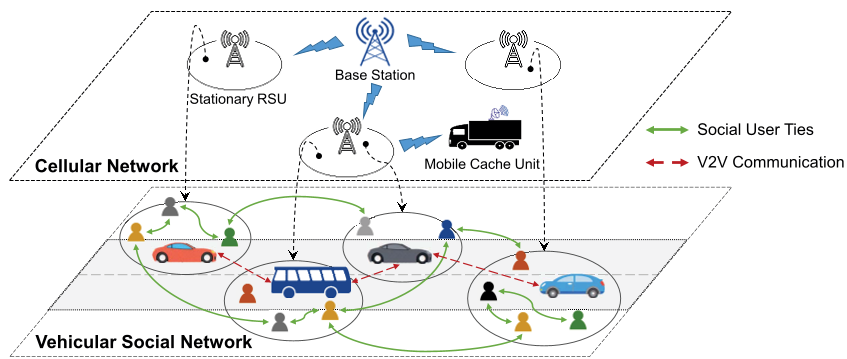 Fig 1. The hybrid VSN architecture featuring static RSUs, Mobile Cache Units, and socially-connected vehicles.
Experimental Validation
Using the SUMO (Simulation of Urban MObility) simulator on a Manhattan grid, the authors tested their algorithms (ComBand + Hedge) against baselines like MobiCacher and greedy selection.
Key Findings:
- Adaptability: When content popularity abruptly changes (at cycles 200 and 700), the ComBand algorithm recovers its hit rate much faster than standard Thompson Sampling.
- Mobility Resilience: The system was tested across four mobility models (Traffic Light, Stop Sign, etc.). In the Probabilistic Traffic Sign Model (PTSM), the cache hit ratio peaked at nearly 68%.
- Latency: As shown in Fig 4, the download time is consistently lower because the MCU effectively "follows" the demand, ensuring files are physically closer to the requestors.
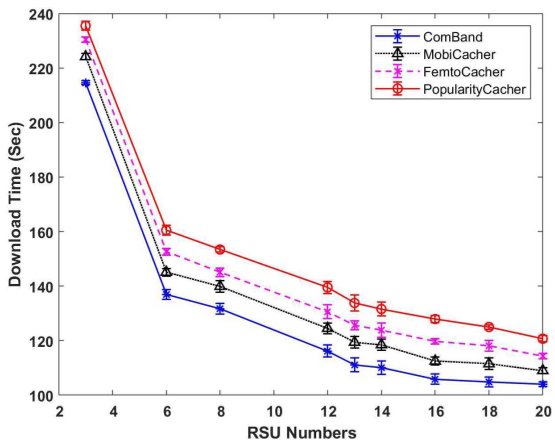 Fig 2. Download time comparison: The ComBand approach significantly outperforms legacy methods as the RSU density increases.
Critical Insight & Future Outlook
The core "win" of this paper is the integration of social physics (centrality) into hard resource allocation (caching). By acknowledging that human behavior is the root cause of network demand, the authors provide a more proactive caching strategy.
Limitations: The current model assumes a single MCU. In a real-world megacity, coordinating a fleet of MCUs would introduce "multi-agent" complexities and potential interference between mobile units.
Future Work: Transitioning from traditional MAB to Deep Reinforcement Learning (DRL) could allow the network to handle even more complex state spaces, such as real-time traffic congestion or varying file sizes.
Takeaway for Engineers: If you are designing edge networks for V2X, don't just look at signal strength; look at the social graph of your users. Proactive, mobile caching is the key to sub-millisecond latent content delivery.