
Building Minds with Machines: A New Methodology for Multi-aspect Ontologies
Methodology for Multi-aspect Ontology Development - Use Case of DSS Based on Human-Machine Collective Intelligence
The paper introduces a four-stage methodology for developing Multi-aspect Ontologies to enhance interoperability in Decision Support Systems (DSS) based on Human-Machine Collective Intelligence (HMCI). It successfully integrates heterogeneous domain knowledge into a unified structure, enabling seamless collaboration between humans and software agents.
TL;DR
To solve the chronic lack of interoperability in complex Decision Support Systems (DSS), this paper introduces a structured methodology for Multi-aspect Ontologies. By organizing knowledge into Local, Aspect, and Global levels, the framework allows humans and AI to "speak the same language" across different domains without requiring a rigid, pre-negotiated global standard.
Background Positioning
In the landscape of Knowledge Engineering, this work functions as a methodological bridge. While traditional methodologies like METHONTOLOGY or NeOn focus on general development, this research specifically targets the complexity of Human-Machine Collective Intelligence (HMCI), where ad hoc teams must self-organize and share knowledge across fluid boundaries.
The Interoperability Gap: Why Conventional Ontologies Fail
Current DSSs are often "knowledge silos." When a system tries to merge data from tourism, logistics, and human expertise, it usually hits a wall because:
- Prior Agreement Paradox: Most systems require everyone to agree on a global "Top-level" ontology before they start, which is impossible in fast-changing environments.
- Formalism Friction: Different domains use different logic styles (formalisms), making direct integration messy.
- Contextual Rigidity: Reusing an existing ontology often forces the developer to change its original structure, breaking its internal logic.
Methodology: The Multi-level Architecture
The authors propose a four-stage lifecycle that transforms domain-specific knowledge into a globally integrated system.
1. The Four-Stage Lifecycle
The process follows a logical flow from broad requirements to localized development, and finally, global integration.
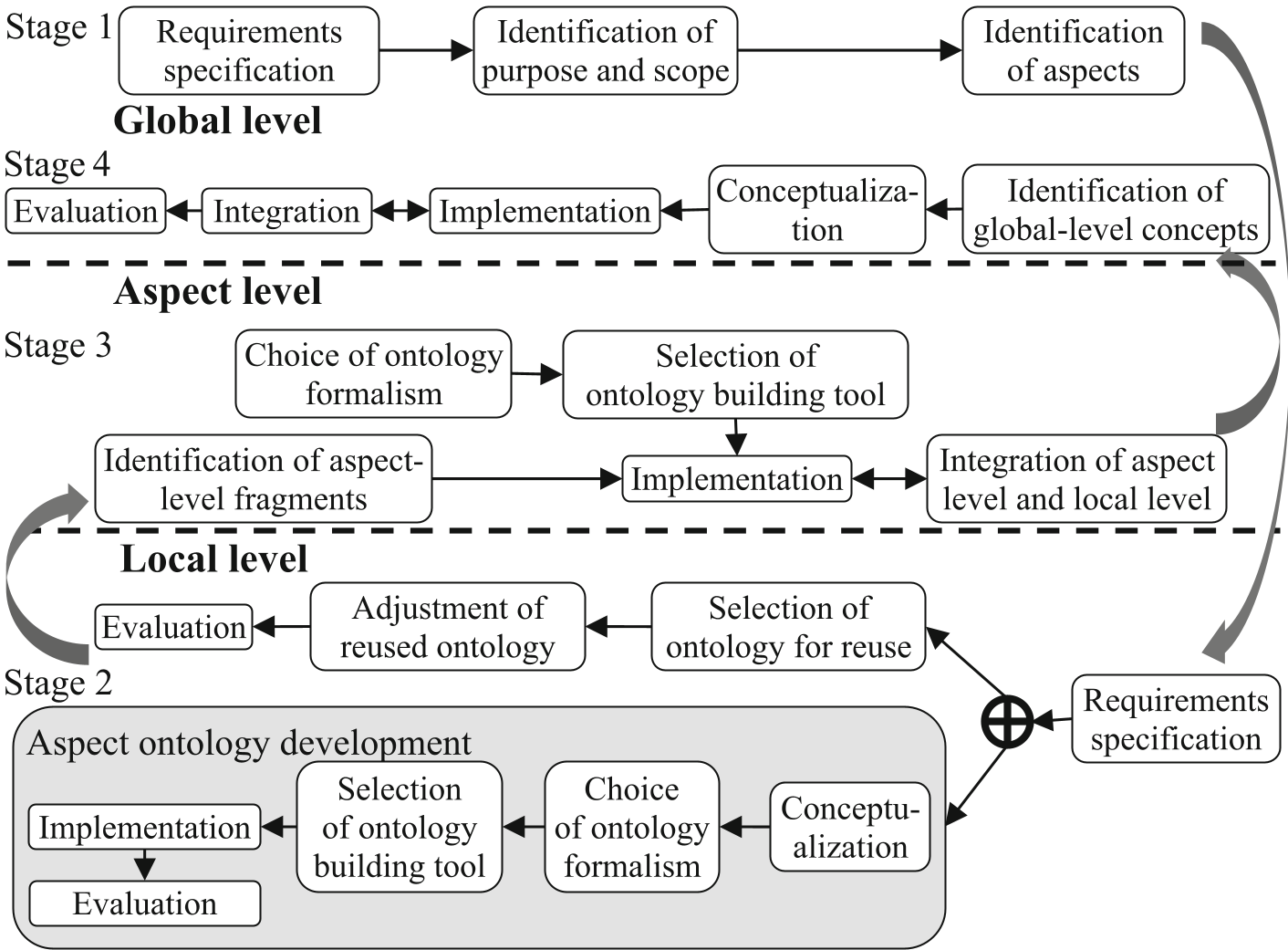
2. The Multi-Aspect Structural Insight
The core of the methodology lies in its three-tier representation:
- Local Level: Specific views or domain "dialects" (e.g., how a traveler sees a "trip").
- Aspect Level: The shared interface where concepts from local views are mapped to a common formalism (usually OWL).
- Global Level: The emergent core that defines the overarching logic of the HMCI system (e.g., the concept of "Participant" or "Problem").
Unlike traditional methods, the Global Level is a result, not a prerequisite.
Implementation: Human-Machine Collective Intelligence
The paper illustrates the methodology through a DSS use case. In this environment, "Experts" (humans) and "Software Services" (agents) form ad hoc teams.
Architecture in Action
The system uses "Bridging Rules" to ensure that an Artifact generated by a software agent at the local level is correctly interpreted as a Decision Alternative at the global decision-making level.
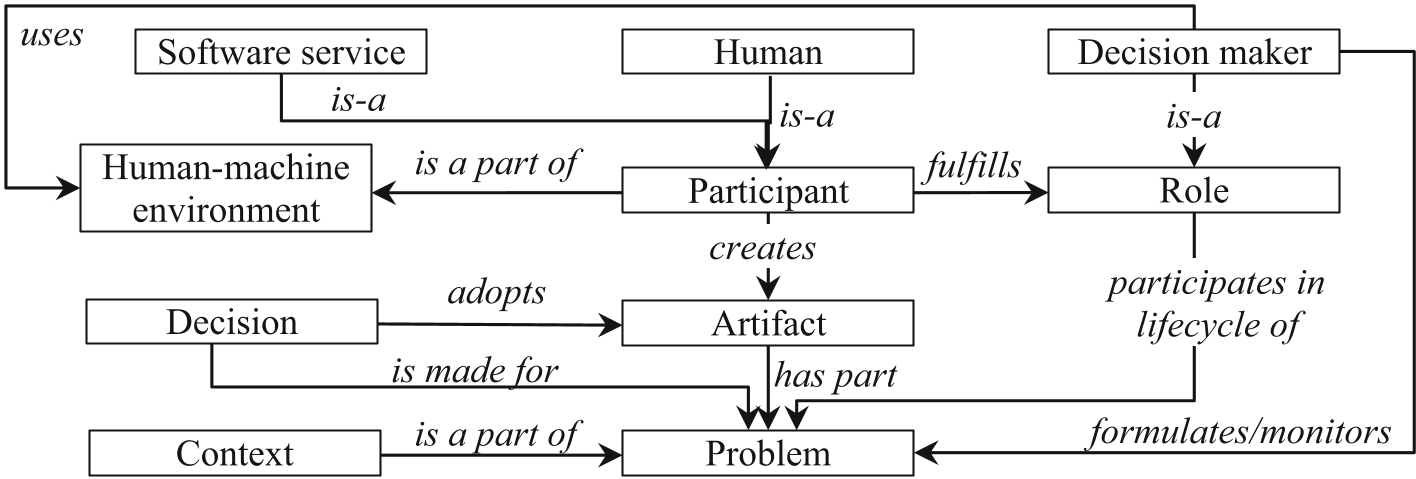
Key Mapping Results
The integration is summarized by the mapping of specific entities across different domain aspects:
| Global Level | Decision Support Aspect | HMCI Aspect |
|---|---|---|
| Participant | User | Participant |
| Artifact | Alternative | Artifact |
| Problem | Problem | Problem |
Experimental Results & Insights
The researchers demonstrated that this structure allows for a "plug-in" domain model. By replacing only the "Subject Domain" aspect, the same DSS can switch from solving E-tourism problems (where an artifact is an "attraction") to Smart City problems (where an artifact is a "transportation route") without rebuilding the core decision engine.
Quantifiable Benefit: The modularity reduces the overhead of "re-inventing the wheel" for every new application domain, maintaining 100% logical consistency through verified OWL reasoning (using the Pellet reasoner).
Critical Analysis & Conclusion
Takeaways
The "Multi-aspect" approach is a significant step toward Semantic Interoperability. Its greatest strength is the flexibility to adjust local ontologies without breaking the global system.
Limitations
The "elephant in the room" remains Manual Mapping. As the authors admit, aligning concepts between aspects still requires significant human intervention. While the methodology provides the structure for integration, it does not yet provide a fully automated engine for it.
Future Outlook
The logical next step for this research is the incorporation of automated ontology alignment (ML-driven). If the mapping process can be accelerated, this methodology could become the standard for large-scale, self-organizing autonomous systems where humans and AI must collaborate on the fly.