
Multi-Aspect Ontology Matching: Beyond Lexical Similarity with Bayesian Cluster Ensembles
A multi-aspect approach to ontology matching based on Bayesian cluster ensembles
The paper introduces a multi-aspect ontology matching solution that utilizes Community Detection and Bayesian Cluster Ensembles (BCE). By integrating terminological, topological, and extensional aspects through consensus clustering, the method achieves state-of-the-art alignment results on the OAEI benchmark.
TL;DR
Ontology matching is moving beyond just comparing word labels. This paper introduces a framework that partitions ontologies into communities and uses a Bayesian Cluster Ensemble (BCE) to find consensus between terminological, topological, and extensional data. The result? A significant boost in alignment precision (F-measure) compared to traditional single-aspect methods.
The Problem: The "Terminological Trap"
Standard ontology matching techniques often suffer from the "terminological trap." They rely heavily on the labels of classes and properties. But what happens when different domains use the same word for different concepts, or different words for the same concept?
Existing divide-and-conquer methods partition large ontologies to make matching efficient, but they typically overlook the "shape" (topology) of the knowledge graph and the "evidence" (instances/extension) of the data. This paper argues that by ignoring these aspects, we are leaving valuable alignment signal on the table.
Methodology: The Power of Consensus
The proposed workflow follows a sophisticated pipeline designed to maximize the synergy between different data views.
1. Partitioning with Community Detection
Rather than arbitrary splits, the authors use Community Detection (specifically the Brandes algorithm) to find natural clusters within the ontology graph. This ensures that closely related entities are kept together for the matching phase.
2. Multi-Aspect Feature Extraction
The core innovation lies in treating the ontology from three distinct perspectives:
- Terminological: Using Independent Component Analysis (ICA) to find relevant terms in labels.
- Topological: Measuring graph metrics like edge density, diameter, and path length.
- Extensional: Calculating probability distributions of class instances using Kullback-Leibler divergence.
3. Bayesian Cluster Ensembles (BCE)
Instead of simply averaging the results, the authors use BCE—a probabilistic generative model—to find a consensus. BCE assumes that a "hidden" consensual clustering generates the individual aspect-based clusterings.
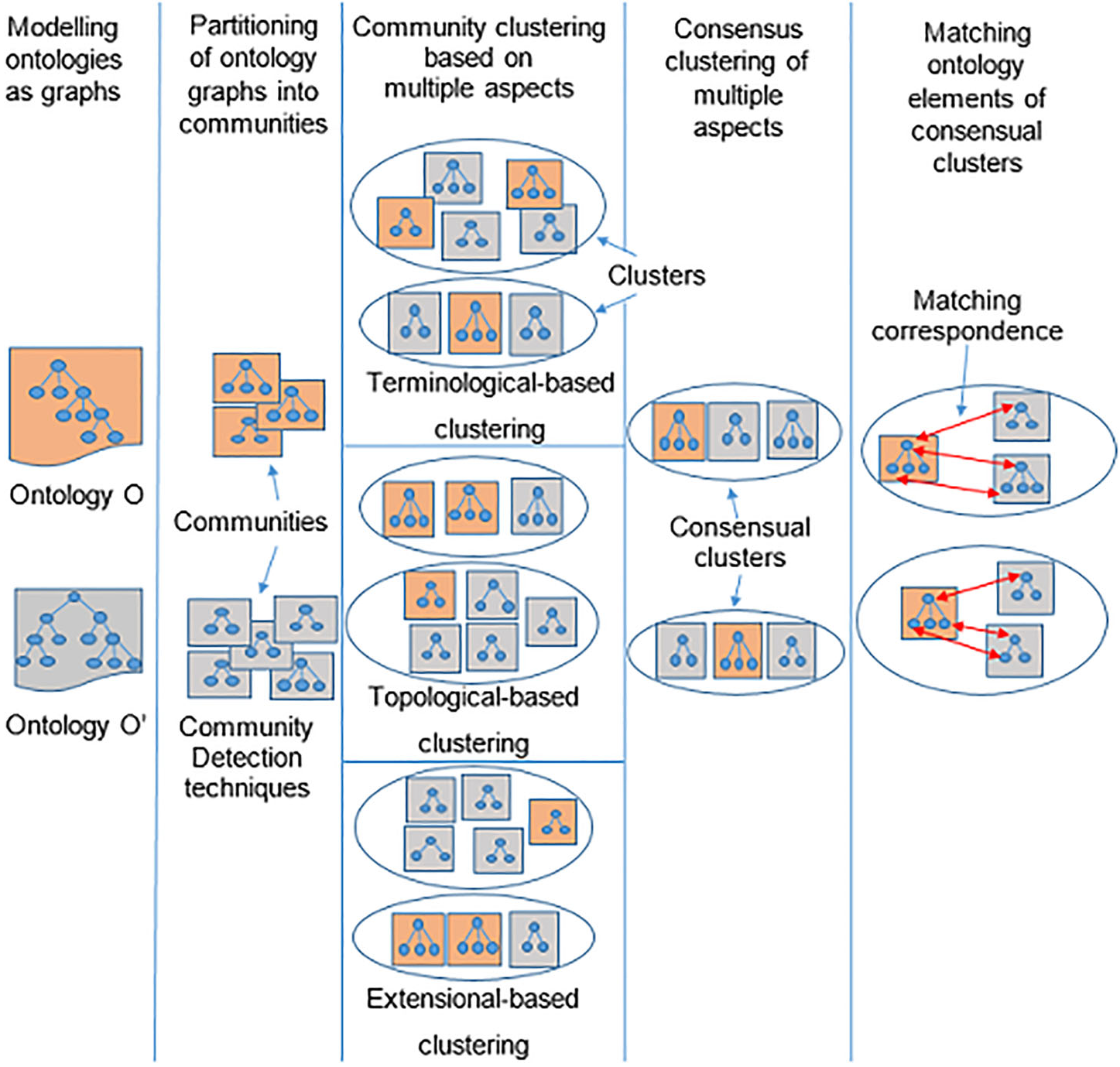 Figure: The multi-step methodology from ontology graph modeling to consensual matching.
Experimental Insights
The study utilized OAEI (Ontology Alignment Evaluation Initiative) benchmarks. One of the most striking findings was the performance of Independent Component Analysis (ICA). In the terminological phase, ICA-based clustering (Silhouette Width: 0.89) consistently outperformed the more common Latent Semantic Analysis (LSA) (0.84), suggesting ICA is better at extracting "clean" semantic signals from ontology labels.
SOTA Comparison
When comparing the ensemble techniques, BCE proved superior to traditional algorithms like CSPA or MCLA.
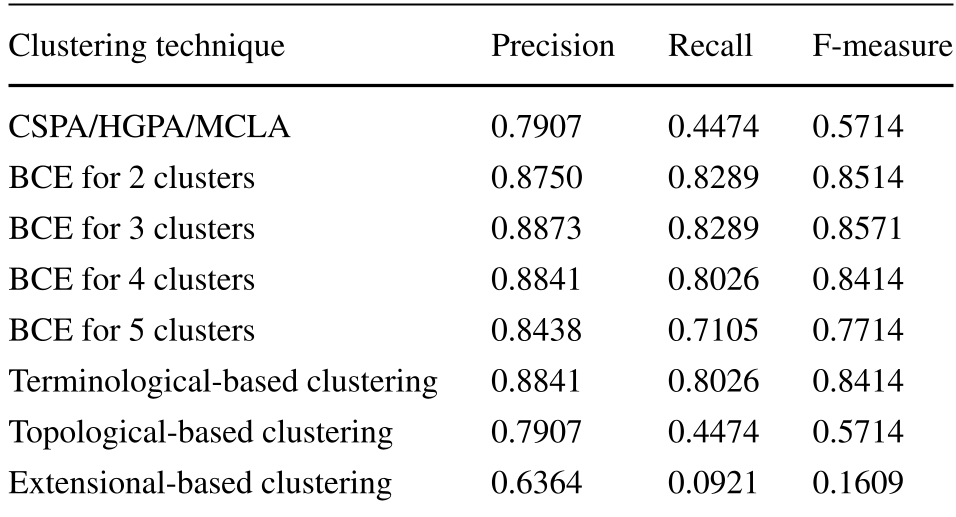 Table: Comparison of Precision, Recall, and F-Measure across different ensemble and aspect-based methods.
As shown in the results, BCE with 3 clusters hit the "sweet spot," capturing the ideal balance of information from all three aspects. It achieved an F-measure of 0.8571, significantly higher than the topological (0.5714) or extensional (0.1609) aspects alone.
Depth Insight: Why it Works
The "magic" happens because the BCE framework treats cluster membership as a probability. A community isn't just "in" or "out" of a cluster; it participates in all consensual clusters in different proportions. This flexibility allows the system to resolve conflicts where, for example, the terminological aspect suggests one alignment but the topological structure suggests another.
Conclusion & Future Outlook
This work provides a robust, configurable framework for ontology matching. By proving that ICA and BCE are powerful tools for semantic integration, it opens the door for more complex "multi-view" learning in the Semantic Web.
Future Directions: The authors suggest incorporating Latent Dirichlet Allocation (LDA) for even deeper terminological discovery and exploring sub-property relationships to further enrich the topological aspect.
Key Takeaways:
- Terminology isn't everything: Structure and instances provide critical context.
- ICA > LSA: ICA is often more effective for dimensionality reduction in sparse semantic datasets.
- Consensus is Key: Probabilistic ensembles like BCE handle the noise and ambiguity of heterogeneous ontologies better than hard-voting schemes.