
Towards a Multi-avatar Macroeconomic System: Grounding AI Agents in Human Behavior
Towards a Multi-Avatar Macroeconomic System
This paper introduces a prototype Multi-Avatar Macroeconomic System that bridges laboratory experimental economics with Agent-based Computational Economics (ACE). The core methodology involves "molding" artificial agents (avatars) by calibrating their behavioral rules against microeconomic data gathered from human subjects via data mining and heuristic techniques.
TL;DR
This research presents a novel methodology for building macroeconomic models by creating "avatars"—artificial agents whose behaviors are directly calibrated from human laboratory experiments. By applying data mining to human decision-making data, the authors bridge the gap between micro-level psychology and macro-level instability, specifically validating Hyman Minsky's Financial Instability Hypothesis within a computational framework.
Background: The "Black Box" of Agent Behavior
In the world of Agent-based Computational Economics (ACE), researchers have long struggled with a fundamental critique: how do we know our agents are behaving realistically? Traditional models often rely on arbitrary rules or oversimplified "rational" assumptions. The authors argue that to build reliable policy tools, we must move away from purely deductive reasoning and toward an inductive, data-driven approach.
Methodology: Molding the Avatars
The researchers implemented a four-step pipeline to ensure both micro and macro-level validity:
- Experimental Data Gathering: Students specialized in accounting participated in simulated economic sessions, making production and financing decisions.
- Microeconomic Calibration: Using the Differential Evolution algorithm, the authors searched for functional forms that best matched the subjects' decision patterns.
- Avatar Construction: These calibrated rules were programmed into distinct "classes" of artificial agents.
- Macro Validation: The resulting multi-agent system was tested to see if it produced realistic aggregate cycles.
The Core: Financial Decision Rules
The paper focuses on two specific types of agents (Subject 11 and Subject 13) who represent different financial temperaments.
- Subject 13 (The Risk-Averse): Adjusts equity based on a target level (), increasing buffers after suffering losses and withdrawing resources only when returns are consistently high.
- Subject 11 (The Aggressive): Maintains minimal equity to maximize ROI, only increasing buffers if a "persistent reduction in profit" or a dangerous fall in the equity ratio occurs.
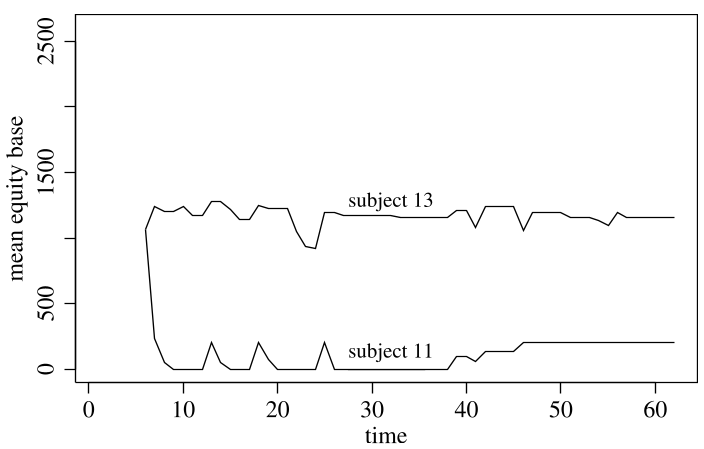 Figure 1: Divergent equity strategies observed in human subjects, later used to program artificial agents.
Experiments and Results: Minsky’s Ghost in the Machine
When these "human-molded" agents were placed in a large-scale macroeconomic simulation (200 firms), the aggregate output exhibited realistic volatility.
The most significant finding relates to Hyman Minsky’s Financial Instability Hypothesis. The simulation showed that during periods of expansion (aggregate production growth), firms tended to adopt more "dangerous" financial positions—leveraging up to maximize returns. This eventually leads to a surge in bailouts and a subsequent economic contraction.
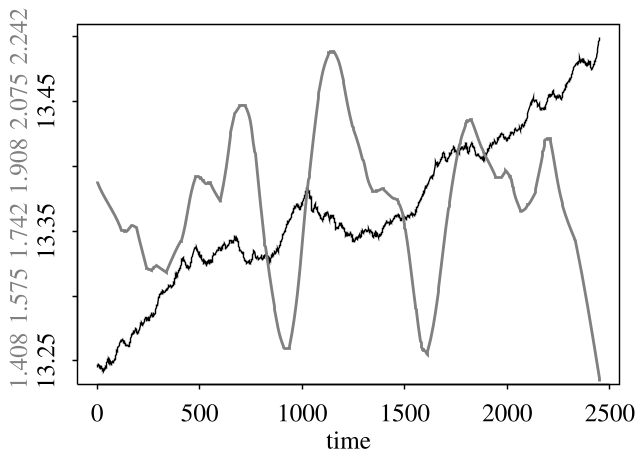 Figure 2: The correlation between aggregate production (black line) and the frequency of bailouts (gray line), reflecting Minskyan instability.
Key Metrics:
- Heterogeneity: The model tracks "market shares" between different agent types, showing how aggressive vs. cautious strategies dominate different phases of the business cycle.
- Realism: The logarithmic aggregate production series matches the stochastic nature of real-world GDP data more closely than standard equilibrium models.
Critical Insight: Why This Matters
The value of this paper lies in its Inductive Bias. Instead of assuming agents should be rational, it observes how they are boundedly rational. This "Multi-Avatar" approach provides a scientific justification for agent behavior, effectively reducing the "too many degrees of freedom" problem that has plagued ACE for decades.
Future Outlook and Limitations
While the current prototype focus on entrepreneurs, the authors acknowledge the need for consumer avatars to fully close the macroeconomic loop. Future work will involve running experiments with actual professional entrepreneurs to see if the behaviors observed in students hold true at higher levels of expertise.
Conclusion: By combining laboratory insights with heuristic optimization, this research moves us closer to a "digital twin" of the economy—one where policies can be tested on agents that truly reflect the erratic, risk-seeking, and precautionary nature of human beings.