
Multi-Campaign Spatial Crowdsourcing: Beyond Simple Task Matching
Multi-Campaign Oriented Spatial Crowdsourcing
The paper introduces a novel framework for Multi-Campaign Oriented Spatial Crowdsourcing (MCSC), addressing the collaborative assignment of workers to grouped tasks (campaigns). It proposes an objective function that balances system throughput, worker travel distance, and worker diversity, achieving high-quality assignments through heuristics like H-TIP that outperform traditional unit-task matching methods.
TL;DR
This research moves spatial crowdsourcing from simple one-to-one task matching into the realm of complex, multi-campaign management. By treating tasks as parts of larger "campaigns" and optimizing for worker diversity, system throughput, and actual travel routes, the authors provide a framework that prevents the "efficiency-distance" sacrifice common in older models like GeoCrowd.
Problem & Motivation: The Tyranny of the Bounding Circle
In traditional spatial crowdsourcing (SC), the system tries to match a worker to a task . Most existing SOTA methods solve the trade-off between throughput (how many tasks get done) and worker fatigue (travel distance) by drawing a hard bounding circle around the worker.
If a task is 1.1km away and the radius is 1km, the task is ignored—even if the worker is already heading that way. This "route-blind" approach causes two major issues:
- Missed Opportunities: Reachable tasks are ignored due to rigid spatial constraints.
- Inefficient Detours: Within the circle, the system doesn't necessarily plan an optimal path, leading to zigzagging and wasted energy.
The authors argue that we need a Soft-Form Formulation where distance is a penalty in a continuous objective function, not a binary filter.
Methodology: The Two-Step Optimization
The MCSC problem is NP-hard, reducing from the Open Vehicle Routing Problem (OVRP). To solve it, the paper breaks the process into two stages:
1. Hybrid-Benefit Based Assignment (HBA)
Before a worker moves, they must be assigned to a specific campaign (e.g., "Take photos of all Starbucks in the city"). HBA assigns workers by looking at:
- Diversity Gain: How much does this worker's profile add to the campaign's group diversity?
- Estimated Throughput-Distance Gain: A fast estimation of how many tasks the worker can complete given their capacity and location.
2. Task-Insertion Planning (TIP)
Once assigned, the system must plan the actual route. Instead of a simple greedy pick, TIP uses a LinkedList-based insertion strategy:
- It maintains an active route and evaluates every possible insertion point for a new task.
- It uses Binary Search Trees (BST) to keep track of costs (), allowing the system to update routes in time.
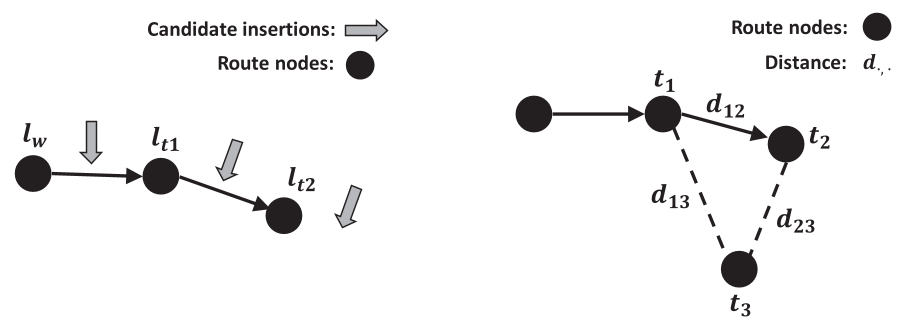 Figure: The TIP Algorithm utilizes a BST to manage insertion costs dynamically.
Experiments: Performance in the Real World
The authors tested their framework using the Meetup dataset in New York City, mapped onto the actual NYC road network (264k nodes).
Key Findings:
- Throughput Advantage: Compared to GeoCrowd, the TIP method consistently assigned more tasks because it isn't limited by the "magic circle" radius.
- Scalability: While the problem is NP-hard, the H-TIP heuristic scales linearly with the number of tasks, making it viable for platforms like Uber or Meituan where thousands of requests arrive in minutes.
- Reliability of Heuristics: H-TIP achieved >80% of the theoretical optimal score in small-scale benchmarks.
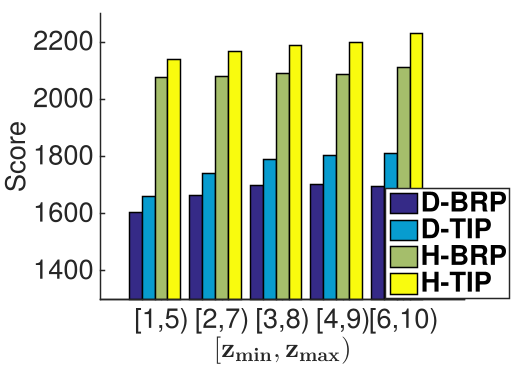 Figure: Comparison of throughput between the proposed TIP and the baseline GeoCrowd.
Critical Insight & Conclusion
The real value of this paper lies in its Linear Combination of Utilities. By merging person-to-container utility (worker-to-campaign) with pairwise utility (worker-worker diversity), the framework creates a "socially intelligent" crowdsourcing environment.
Limitations: The model assumes workers are "assigned" and will comply. In the real world, "Incentive Mechanisms" (paying more for longer distances) are crucial. While the authors mention can relate to budget, a game-theoretic extension where workers can reject tasks would be the next logical step for this research.
Final Takeaway: To maximize the efficiency of urban sensing, platforms should stop looking at tasks in isolation and start planning them as integrated, diversity-aware campaigns.