
Gaming the Spectrum: Bayesian Social Learning and the Indian Buffet Problem in Cognitive Radio
10461_Multi-Channel Sensing and Access Game Bayesian Social Learning with Negative Network Externality.
This paper proposes a multi-channel sensing and access framework for distributed cognitive radio networks modeled as an "Indian Buffet Game." It introduces a Bayesian social learning method for cooperative channel state estimation and recursive best response algorithms to achieve subgame perfect Nash equilibria under negative network externalities.
TL;DR
This research tackles a fundamental conflict in distributed wireless networks: how can rational users avoid crowding the same vacant channels? By modeling the problem as an Indian Buffet Game, the authors introduce a framework where Secondary Users (SUs) cooperatively learn channel states via Bayesian inference and make sequential access decisions using a recursive best response algorithm. The result is a subgame perfect Nash equilibrium that maximizes social welfare while accounting for negative network externalities.
Purpose-Built for crowded Airwaves: The Motivation
In Cognitive Radio (CR), SUs are guests in a spectrum owned by Primary Users (PUs). The goal is simple: find an empty seat (vacant channel) and transmit. However, if all SUs target the same "best" channel, they interfere with each other—a phenomenon known as Negative Network Externality.
Prior works often treated sensing and access as independent or simultaneous events. This paper argues that in a fully distributed network, users must act sequentially to avoid collisions, much like customers at a buffet line deciding which dishes to take based on what they see others doing and what they expect those behind them to do.
Methodology: Bayesian Learning meets Game Theory
The framework is split into two distinct phases: Cooperative Learning and Sequential Decision Making.
1. The Learning Phase (Bayesian Social Learning)
SUs don't just guess if a channel is idle. They perform two-step learning:
- Utilization Ratio Learning: Using a Bayesian rule to estimate the long-term prior probability () of a channel being idle.
- Channel State Learning: Combining real-time sensing results with the estimated to form a "belief" (posterior probability ) about the current time slot.
2. The Access Game (Recursive Best Response)
Once beliefs are formed, SUs enter the Indian Buffet Game. Each SU must decide which channels to access. To find the optimal strategy, the authors designed a recursive algorithm:
- Forward Estimation: An SU predicts how many subsequent users will choose a channel if they choose it.
- Utility Optimization: The utility function explicitly penalizes the user as the number of occupants increases.
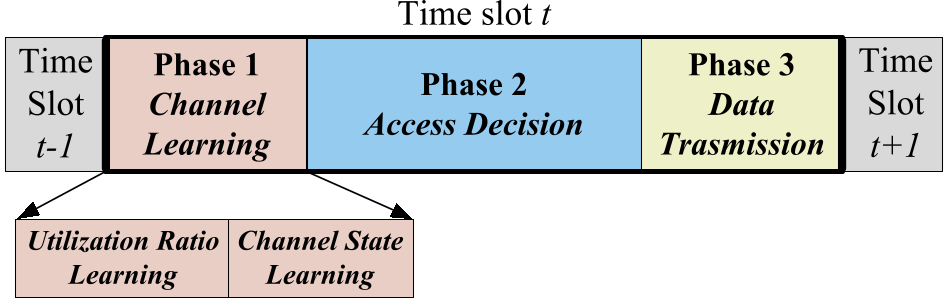 Figure 1: The time slot structure featuring Learning, Decision, and Transmission phases.
Key Insights: The Threshold Structure
One of the paper's most elegant findings occurs in the Homogeneous Case (where all SUs have the same gain). The Nash Equilibrium exhibits a Threshold Structure.
If the -th SU finds a channel too crowded to yield a positive reward and stays out, every SU following them will also stay out. Conversely, if the -th SU enters, all previous SUs in the sequence must have already entered. This simplifies the decision-making logic into a simple calculation of the maximum "capacity" the channel can support before the utility drops below zero.
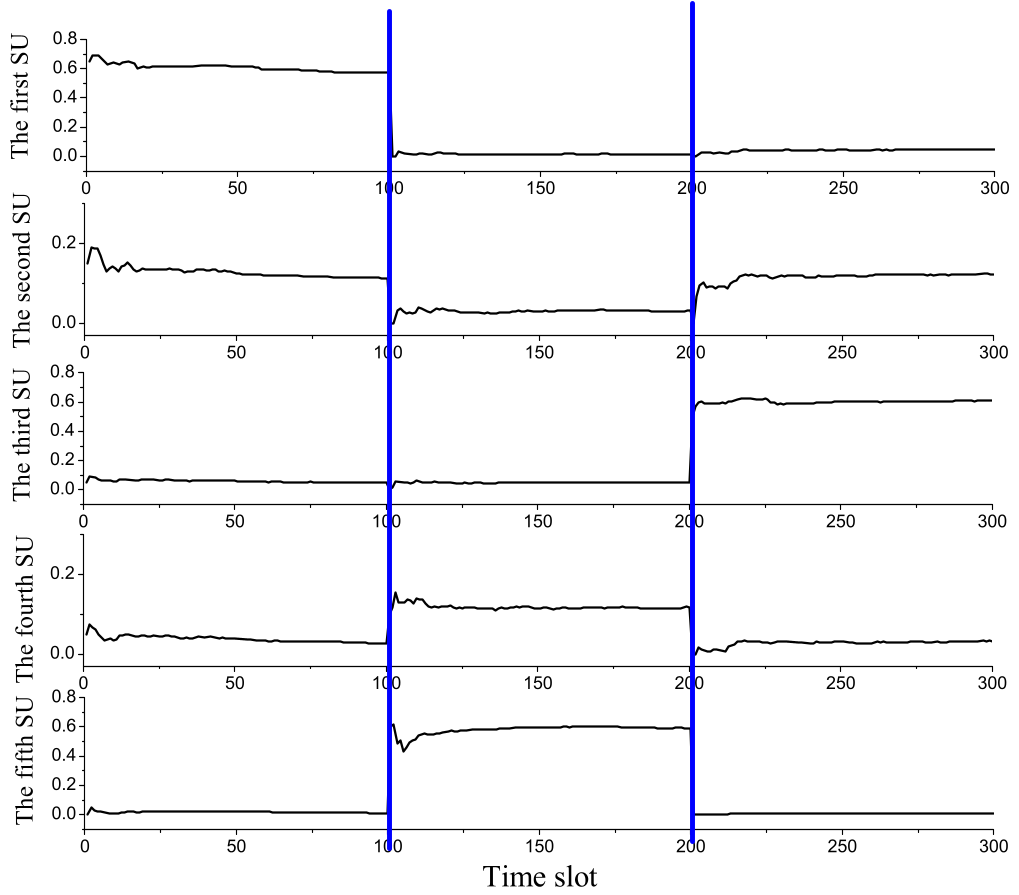 Figure 2: Social welfare comparison showcasing the superiority of the Best Response algorithm over Myopic and Random strategies.
Experimental Validation
The authors validated their model across various scenarios:
- Sensing Accuracy: Cooperative learning pushed detection probabilities near 1.0 and false alarms near 0.0 as resource constraints () were relaxed.
- Social Welfare: As the channel becomes "idling" (high ), the "Learning" strategy (which ignores others) fails miserably because it ignores congestion. The "Best Response" algorithm maintains peak performance by balancing sensing accuracy with strategic avoidance.
- Fairness: The paper notes that early-movers have a massive advantage. To solve this, the authors suggest randomizing the decision order at each time slot to ensure long-term fairness.
Critical Perspective & Conclusion
This work provides a rigorous mathematical bridge between Bayesian learning and sequential game theory. The "Indian Buffet" analogy effectively captures the multi-resource search problem.
Limitations:
- Complexity: The recursive algorithm for the resource-constrained case scales with , which might be intensive for very high-density networks.
- Control Overhead: SUs must broadcast their decisions, requiring a reliable control channel which is often a luxury in highly dynamic environments.
Future Outlook: This framework is highly applicable to modern Open RAN (O-RAN) and 6G architectures where distributed intelligence is paramount. Integrating this game-theoretic approach with Deep Reinforcement Learning could potentially reduce the computational burden while maintaining the strategic benefits of social learning.
Takeaway
In the buffet of wireless spectrum, don't just look at the food—look at the line behind you. Success requires not just accurate sensing, but strategic anticipation of your peers.