
Integrating Adversarial Autoencoders for Multi-Class Mobile Money Fraud Detection
Multi-Class Mobile Money Service Financial Fraud Detection by Integrating Supervised Learning with Adversarial Autoencoders
The paper introduces a multi-class financial fraud detection framework for Mobile Money Services (MMS) by integrating Adversarial Autoencoders (AAE) with supervised learning. By mapping high-dimensional transaction data into a constrained latent space using Gaussian Mixture priors, the authors achieve robust classification of regular transactions, local anomalies, and global anomalies, maintaining SOTA performance with significantly reduced feature dimensionality.
TL;DR
This research tackles the "needle in a haystack" problem of mobile money fraud by utilizing Adversarial Autoencoders (AAE) to compress 618 raw features into as few as 2-10 latent dimensions. By forcing these latent dimensions to follow a Gaussian Mixture prior, the researchers successfully distinguished between regular transactions and two specific types of anomalies (local and global), maintaining near-perfect accuracy while drastically reducing computational overhead for supervised classifiers.
Background: The Mobile Money Frontier
As Mobile Money Services (MMS) explode in popularity, particularly in developing economies, they become prime targets for sophisticated fraud. Unlike credit card fraud, MMS fraud often involves "local anomalies"—subtle combinations of attributes that mimic legitimate behavior. The challenge is two-fold: extreme class imbalance and high dimensionality.
The Problem & Motivation
Traditional fraud detection systems often treat fraud as a binary problem (Fraud vs. Non-Fraud). However, in financial auditing, understanding the nature of the anomaly is crucial.
- Global Anomalies: Unusual individual values (e.g., a massive transfer).
- Local Anomalies: Unusual combinations (e.g., a small transfer to an unusual recipient at an odd time).
Previous work using standard Autoencoders often struggled to separate these clusters cleanly. The authors hypothesized that the Adversarial component—a discriminator network that matches the latent code to a specific distribution—would create more linearly separable features for downstream classifiers.
Methodology: Structuring the Latent Space
The core innovation lies in how the authors "shape" the latent space. Instead of letting the Autoencoder organize data arbitrarily, they use an Adversarial Training loop.
- Encoder: Maps transaction data to a latent vector .
- Decoder: Attempts to reconstruct the original transaction.
- Discriminator: A "critic" that tries to distinguish between (produced by the encoder) and a sample from a Gaussian Mixture Model (GMM).
To ensure that the clusters in high-dimensional latent space don't overlap (which would confuse the classifier), the authors developed a Prior Distribution Generator using alternating trigonometric functions (Sine/Cosine) to position the Gaussian centroids.
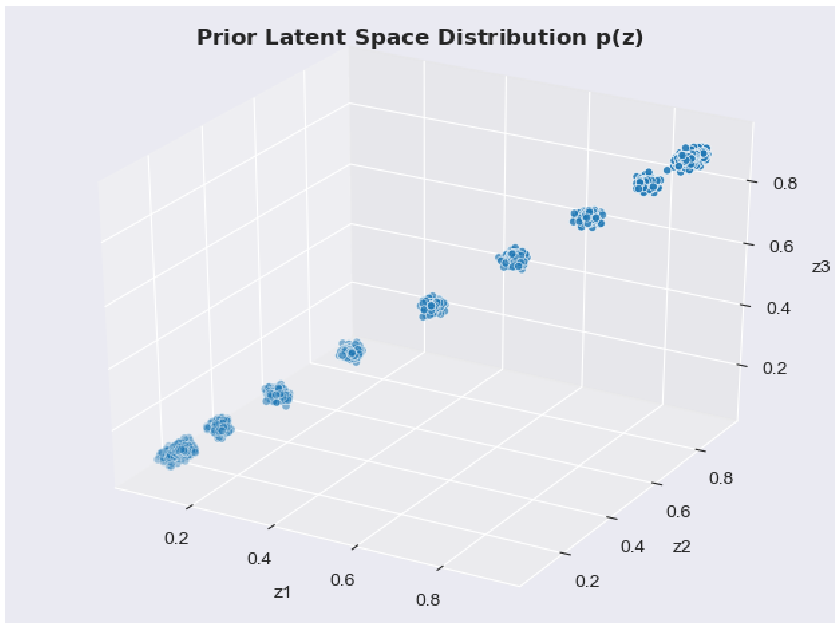 Figure 1: Comparison of Latent Space clusters with and without the proposed coordinate extension.
Experiments & Results: Efficiency without Sacrifice
The researchers tested three main classifiers: Random Forest (RF), Naive Bayes (NB), and Support Vector Machines (SVM).
Key Findings:
- Dimensionality Reduction works: Random Forest achieved a MAUC of 0.9972 on the original 618 features. When using only 2 latent features, the performance drop was negligible (-0.25%).
- Naive Bayes Boost: Interestingly, Naive Bayes performed much better in the latent space (up to +85.8% relative improvement) because the AAE effectively handled the feature dependencies that usually violate the "independence" assumption of Naive Bayes.
- Cluster Density: The number of Gaussian clusters () in the prior distribution significantly impacted performance, especially as the dimensionality () decreased.
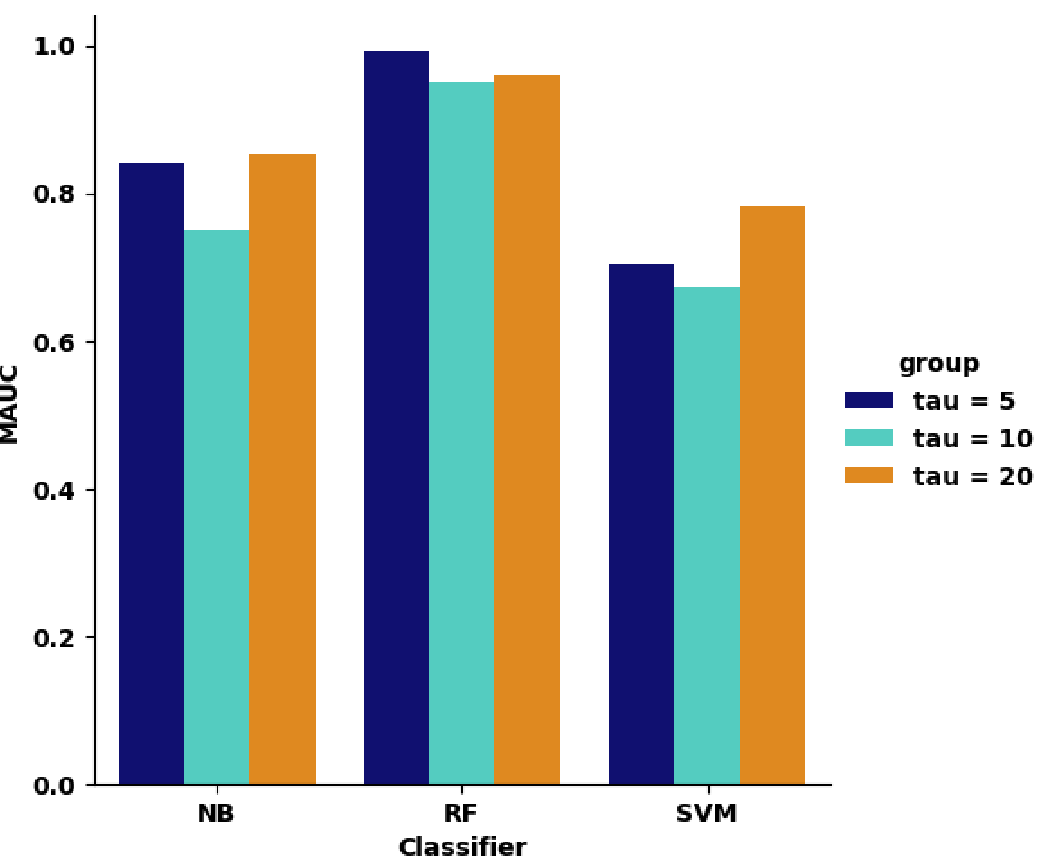 Figure 2: MAUC results for 2D, 3D, and 5D latent spaces across different cluster configurations.
Critical Analysis & Takeaways
The study proves that Latent Space Engineering is a viable path for scalable financial monitoring. By training the AAE once, auditors can feed a much smaller, "refined" stream of features into real-time classifiers, saving milliseconds that are vital in high-frequency payment environments.
Limitations:
- The study used synthetic data (PaySim). While PaySim is a standard benchmark, real-world data often contains "concept drift" (fraudsters changing their tactics).
- The AAE was trained on the entire dataset, including anomalies. Future work should investigate if training only on "regular" data (Self-Supervised Anomaly Detection) further clarifies the boundaries of the anomalous clusters.
Final Verdict: This is a robust framework for any financial institution looking to move beyond simple rule-based systems into high-efficiency, multi-class anomaly detection.