
Multi-Diffusion Degree: Optimizing Influence Spread in Multilayer Social Networks
Multi-diffusion Degree Centrality Measure to Maximize the Influence Spread in the Multilayer Social Networks
The paper introduces a novel centrality measure, Multi-Diffusion Degree (), designed for influence maximization in Multilayer Social Networks (MLSN). By leveraging a mapping matrix and the Independent Cascade (IC) model, the method identifies top-K "seed" nodes to optimize information spread across interconnected network layers.
TL;DR
Information no longer spreads through a single channel; we are interconnected via Twitter, Facebook, LinkedIn, and more. This paper introduces Multi-Diffusion Degree (), a sophisticated centrality measure that identifies the most influential "seeds" in a multilayer social network. By accounting for a user’s presence across multiple platforms and the diffusion probability of their neighbors, this method significantly outperforms standard heuristics in information propagation.
Background & Motivation: Beyond Single-Layer Analysis
In the modern digital landscape, a person is not just a single node in one network; they are a presence across an "Aggregation of Social Networks." A politician or a marketing firm needs to know who can trigger the largest "word-of-mouth" effect not just on Twitter, but across the entire spectrum of a user’s social footprint.
The authors identify a critical gap: Traditional centrality measures (like Degree or Closeness) lose their effectiveness in interconnected networks. They fail to recognize that the same individual exists in different layers (e.g., a "Retweet" layer vs. a "Mention" layer) and that their influence is the sum of their presence in all those contexts.
Methodology: The Core Architecture
The proposed heuristic is grounded in the Independent Cascade (IC) Model. The technical ingenuity lies in two components:
1. The Mapping Matrix ()
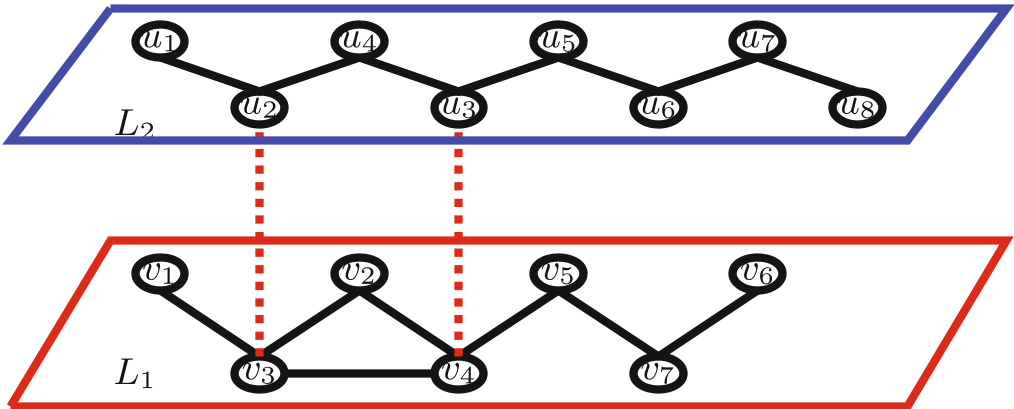
To solve the identity problem, the authors use an equivalence relation (). If user in Layer 1 is the same person as user in Layer 2, they belong to the same "class."
- Physical Intuition: Before calculating influence, the model "unifies" the various identities of a single person across the ecosystem.
2. Formula
The measure calculates centrality by considering:
- Self-Contribution: The sum of a node's weighted degrees across all layers it belongs to.
- Neighborhood Pressure: Instead of just counting neighbors, it evaluates the "Diffusion Probability" () multiplied by the degree of those neighbors, ensuring that neighbors with high outreach potential carry more weight.
- Redundancy Elimination: It uses sets to ensure that a neighbor present in multiple layers is only counted once, preventing artificial inflation of influence scores.
Experiments & Results
The authors tested their method on real-world Twitter data related to major events (Cannes 2013 and NYC Climate March 2014), tracking three types of interactions: Retweets (RT), Replies (RP), and Mentions (MT).
Performance Comparison
They compared against the Multi-Degree Centrality (), which is a common benchmark for multilayer networks.
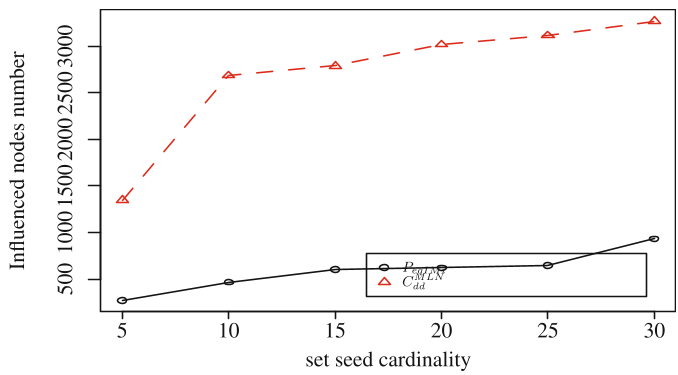 Fig 7: In the NYC 2014 dataset, consistently activates more nodes than the benchmark as the seed set size increases.
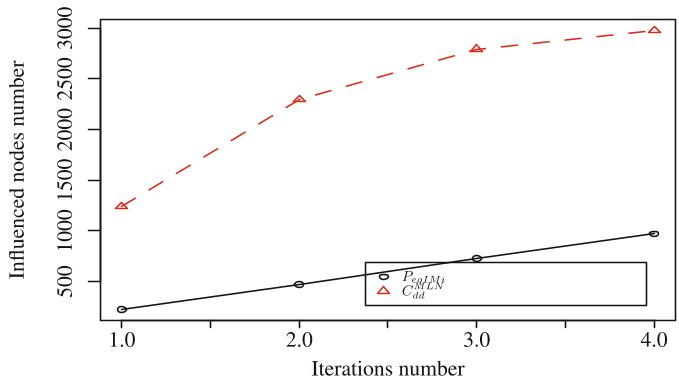 Fig 6: Tracking the diffusion over time shows that achieves faster and wider penetration from the very first iteration.
Key Finding: The research proves that selecting seeds based on "diffusion pressure" (considering level-2 neighborhood characteristics) is significantly more effective than looking at direct neighborhood counts alone.
Critical Insight & Conclusion
The power of lies in its holistic view of the user. By integrating diffusion probability and cross-layer identity, it moves beyond static topology into dynamic spread modeling.
Limitations & Future Work:
- The current model is optimized for the Independent Cascade (IC) model.
- Future Path: The authors intend to adapt this centrality measure for the Linear Threshold (LT) model, where social resistance and collective thresholds play a larger role in activation.
This work serves as a vital blueprint for marketers and social scientists looking to navigate the complexities of modern, multi-platform communication.