
Beyond the Single Bonus: Harmonizing Multi-Task Incentives in Mobile Crowdsourcing
Multi-Dimensional Incentive Mechanism in Mobile Crowdsourcing with Moral Hazard
This paper explores multi-dimensional incentive mechanisms in mobile crowdsourcing to address the "Moral Hazard" problem using Contract Theory. It proposes a linear reward package—combining fixed salary and performance-based bonuses—designed to maximize the principal's utility while ensuring continuous user participation in complex, multi-task scenarios.
TL;DR
Mobile crowdsourcing platforms like Yelp or Google Maps rely on diverse user contributions, yet rewarding these fairly is an economic minefield. This paper addresses the Moral Hazard problem—where user efforts are hidden—by moving from basic one-off rewards to a sophisticated multi-dimensional contract. By applying Contract Theory, the researchers show how to design reward packages that balance risk and effort across multiple tasks simultaneously.
The "Moral Hazard" in Your Pocket
In the world of 5G and Location-Based Services (LBS), "the Principal" (the platform) needs data from "the Agent" (the user). However, data collection isn't free. Users burn battery, spend time, and risk privacy.
The core problem is Moral Hazard: The platform can see the result (e.g., a photo or a GPS trace) but not the effort or intent. If a platform only rewards the number of photos uploaded, users might upload 100 blurry photos while ignoring traffic reports. This "effort distortion" happens because current incentive systems are too one-dimensional to handle the complexity of real-world multitasking.
Methodology: The Balancing Act of Multi-Tasking
The authors solve this by modeling the user's total contribution as a vector of hidden efforts. They use a Linear Reward Package formula: Where:
- : Fixed salary (base incentive).
- : A vector of reward weights for different tasks.
- : The observed performance (noisy signal of effort).
The Secret Sauce: Certainty Equivalent
Since users are typically risk-averse (they hate the uncertainty of measurement errors in GPS or sensors), the paper uses Certainty Equivalent (CE). This converts a complex probability of "potential reward" into a single "guaranteed value" that the user perceives, allowing the principal to maximize utility without scaring users away.
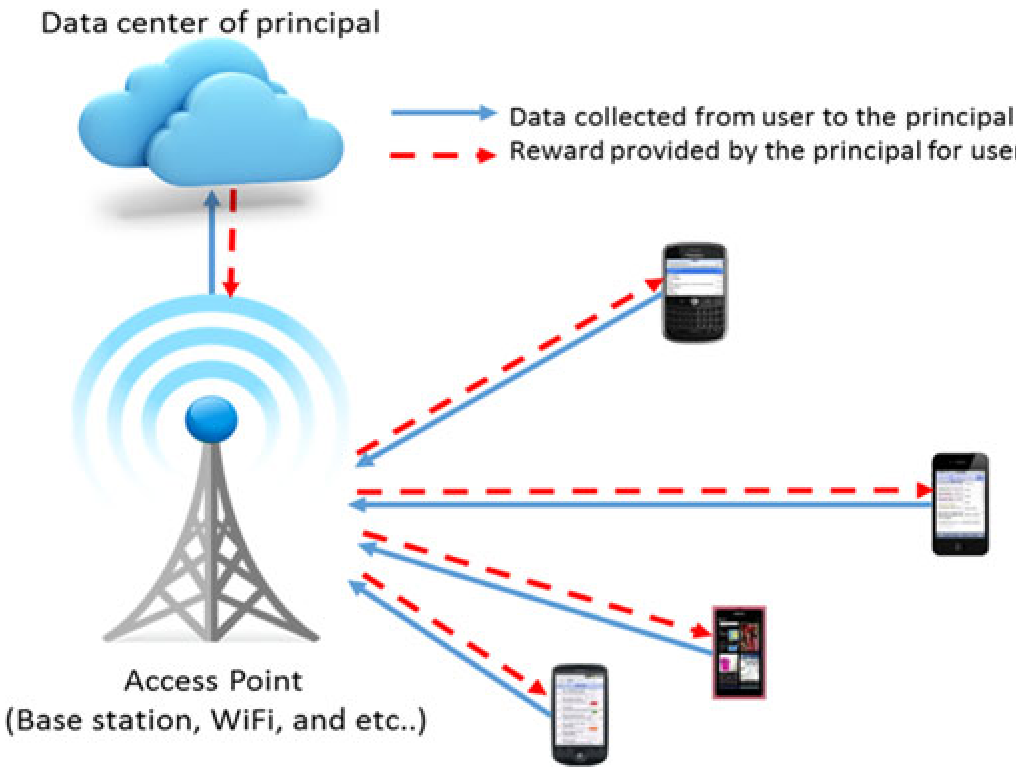 The interaction between the Principal (Cloud/Provider) and the Agents (Mobile Users) through various sensor-driven tasks.
Key Insights from the Multi-Dimensional Model
- Technological Substitutes: If two tasks share resources (like battery), increasing the reward for one might "starve" the other. The model adjusts reward weights to prevent this.
- Noise Matters: The more "noisy" a sensor (e.g., GPS in a tunnel), the lower the performance-related reward should be. Instead, the fixed salary () should increase to compensate for the risk.
- Cross-Task Rewards: Sometimes, the best way to encourage Task A is actually to slightly adjust the reward for Task B, especially when they are "perfect substitutes."
Experimental Validation
The researchers compared six different mechanisms. A standout finding: Continuous incentives win. While "Opening Rewards" (paying someone once at the start) might look profitable initially, they fail to sustain user activity over time.
 Simulation results showing how optimal efforts () decrease as measurement error covariance increases.
As seen in the results, as the Measurement Error Variance increases, the principal's utility drops because they have to "insure" the user more and motivate them less.
Academic Perspective & Takeaways
This work sits at the intersection of Network Economics and Wireless Communications. It moves the needle by proving that the "Single Bonus" approach is sub-optimal for modern platforms.
The Takeaway for Platform Designers: Don't just pay for "data points." Look at the correlation between tasks. If you want high-quality reviews and photos, your algorithm needs to account for the fact that a user writing a long review has less "effort budget" for photos. A multi-task reward vector is the only way to avoid the "Moral Hazard" of users gaming the system.
Future Outlook
While this model is robust, it assumes a central principal knows the user's cost function. The next frontier? Asymmetric Information where the principal doesn't even know the user's "type" (e.g., how much they value their time). Integrating Adverse Selection with this Moral Hazard model will be the "Holy Grail" of crowdsourcing economics.