
Crowdsourcing the Edge: Optimizing Multi-Dimensional Resource Sharing in MEC
A Multi-Dimensional Resource Crowdsourcing Framework for Mobile Edge Computing
This paper introduces a multi-dimensional resource crowdsourcing framework for Mobile Edge Computing (MEC) that utilizes peer-to-peer (D2D) resource sharing. It models complex tasks as five sequential subtasks (downloading, computing, uploading, and two D2D transfers) and formulates an optimization problem to minimize energy consumption and task failure probability.
TL;DR
As the demand for AR, 3D modeling, and mobile gaming explodes, individual mobile devices struggle to keep up. This paper presents a framework for Multi-Dimensional Resource Crowdsourcing, allowing a task to be broken down and its components (downloading, computing, uploading) shared across a neighborhood of devices. By transforming a complex, non-linear optimization problem into an Integer Linear Programming (ILP) model, the researchers achieved up to an 85% reduction in total costs.
Problem & Motivation: The Heterogeneity Gap
Most Mobile Edge Computing (MEC) research assumes the presence of a dedicated MEC server at a base station. However, deploying these servers is expensive. Peer-to-Peer (P2P) resource sharing is a logical alternative, but it faces two massive hurdles:
- Heterogeneous Demands: A task might need high bandwidth to download data but high CPU cycles to process it. A single idle neighbor might have one but not the other.
- Indivisibility Trap: Prior works often treat tasks as "all-or-nothing" blocks. If no single device can handle the whole block, the task fails, even if the "crowd" has enough aggregate resources.
The authors' insight is simple yet powerful: Divide and Conquer. By splitting a task into functional subtasks, we can map segments of work to the specific devices best equipped to handle them.
Methodology: The Five-Subtask Task Model
The core of this work is the decomposition of a task into a sequential pipeline. Instead of a single "offloading" decision, the framework evaluates five distinct subtasks:
- Downloading (d): Fetching input data from the Internet.
- D2D Input Transfer (wi): Moving input data if the downloader and processor are different.
- Computing (c): The actual CPU-intensive processing.
- D2D Output Transfer (wo): Moving generated results if the processor and uploader are different.
- Uploading (u): Sending the final result back to the cloud/Internet.

Mathematical Intuition & Linearization
The optimization goal is a trade-off: Minimize [Energy Consumption + Task Failure Penalty].
This is inherently difficult because the subtasks are coupled—you can't start computing until the download is finished (timing constraint), and a D2D transfer is only needed if tasks are split across devices (logical coupling).
The authors solve this by introducing incremental vectors and intermediate binary variables to linearize these relationships. This allows the use of standard ILP solvers (like branch-and-bound) rather than custom, potentially sub-optimal heuristics.
Experiments: Superior Crowdsourcing Performance
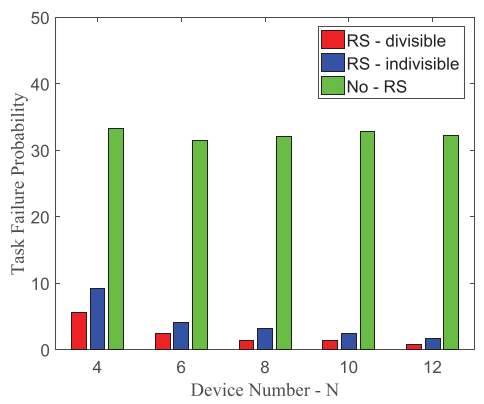
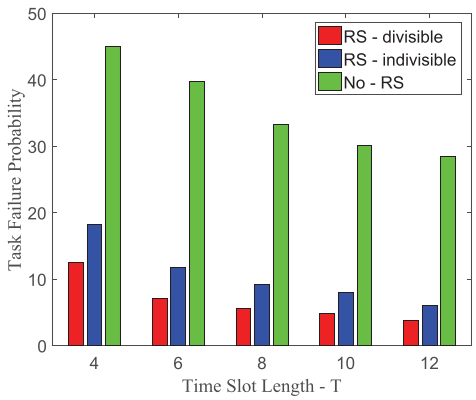
The researchers compared their RS-divisible method against two benchmarks:
- No-RS: No sharing (tasks run locally).
- RS-indivisible: Sharing is allowed, but the whole task stays on one device.
Key Findings:
- Scaling with Density: As more Mobile Devices (MDs) enter the network, the "RS-divisible" scheme's performance improves significantly because the probability of finding a "perfect match" for a subtask increases.
- Efficiency Gains: "RS-divisible" reduced costs by 25% to 85% compared to no sharing.
- Reliability: Task failure probabilities dropped by 10% to 35%, proving that flexibility in scheduling is the key to robustness in dynamic 5G/6G environments.
Critical Analysis & Future Outlook
This paper successfully demonstrates that fine-grained task division is the secret sauce for effective edge crowdsourcing. By treating the edge as a pool of diverse resources rather than a collection of potential servers, the framework maximizes utilization.
Limitations:
- Incentive Mechanisms: The paper assumes devices are willing to share. In the real world, an incentive or "credit" system (potentially via Blockchain) would be necessary to prevent "free-riding."
- Signaling Overhead: The linearization makes the problem solvable, but the control signaling required to coordinate five subtasks across multiple devices in 10-second intervals might be non-negligible in a real-world implementation.
Takeaway: This work provides a rigorous mathematical foundation for the next generation of "Serverless Edge" architectures, where the network itself becomes the computer.