
Beyond Sentiment: Decoding the Complex Palette of Multi-Emotion in Movie Reviews
Multi-emotion Detection in User-Generated Reviews
The paper introduces a multi-label emotion detection framework for user-generated movie reviews, utilizing a newly curated dataset of 44 manually annotated films. It compares a tuned One-vs-Rest (OvR) baseline against the Random k-Labelsets (RAKEL) ensemble method, achieving a State-of-the-Art F1-score of 0.456 on a challenging, small-sample supervised task.
TL;DR
Standard sentiment analysis (Positive vs. Negative) is no longer enough to capture the richness of human experience. This paper tackles the "Multi-label Emotion Detection" problem, where a single sentence in a movie review can express multiple emotions simultaneously (e.g., Joy, Surprise, and Interest). By introducing a specialized dataset and leveraging the RAKEL ensemble algorithm, the authors demonstrate that capturing label dependencies leads to superior performance over traditional binary classification, even with very limited training data.
The "Binary" Fallacy in Affective Computing
Most prior research treats emotions as a zero-sum game: a sentence is either happy or sad. However, film reviews are notoriously complex. A viewer might express "Fear" at a horror movie's plot while simultaneously expressing "Joy" or "Interest" in the director's craft.
The authors identify two major gaps in the field:
- Exclusivity Assumption: The false belief that one text snippet equals exactly one emotion.
- Data Greed: The reliance on thousands of samples, which is impractical for niche domains.
Methodology: Capturing the "Vibe" through Dependencies
The researchers compared two distinct philosophies for multi-label learning using Linear SVMs as the backbone:
1. One-vs-Rest (OvR) - The Independent Specialized
This method treats each emotion (Anger, Fear, Joy, etc.) as a separate binary "yes/no" problem. While it allows for fine-tuning the regularization () and feature weighting (TF-IDF) for each specific emotion, it is blind to correlations. It doesn't "know" that Love and Joy often appear together.
2. RAKEL - The Collaborative Ensemble
RAKEL (Random k-Labelsets) breaks the labels into smaller, random subsets. It trains "Label Powerset" classifiers on these subsets. If a subset is {Fear, Surprise}, the classifier predicts the combined state. This allows the model to learn that certain emotions act as "clusters."
Experimental Insights: RAKEL Wins on Efficiency
The results show a clear advantage for the dependency-aware approach. RAKEL achieved an overall F1-score of 0.456, outstripping the meticulously tuned OvR baseline.
| Metric | OvR (Tuned) | RAKEL |
|---|---|---|
| Overall F1 | 0.432 | 0.456 |
| Training Time | Minutes (due to tuning) | Seconds |
The "Anger" Problem
A fascinating failure mode identified by the authors was the "Anger" label. Both models failed to detect it effectively. The reason? Sarcasm and Indirectness. Reviewers often express anger at a bad movie by ironically praising a different movie, or by using subtle words like "contrived." Simple Bag-of-Words features cannot capture this linguistic subtext.

Critical Analysis & Future Outlook
While the paper proves that multi-label detection is viable with small datasets, it also exposes the limits of statistical NLP. The authors' future plan to distinguish between the trigger of the emotion (the story vs. the technical filmmaking) is a vital next step.
Takeaway: If you are building a recommendation engine or a search tool for artistic products, don't just look for "Positive" reviews. Look for "Thrilling" (Fear + Interest) or "Heart-wrenching" (Sadness + Love). The future of AI-driven curation lies in understanding these emotional overlaps.
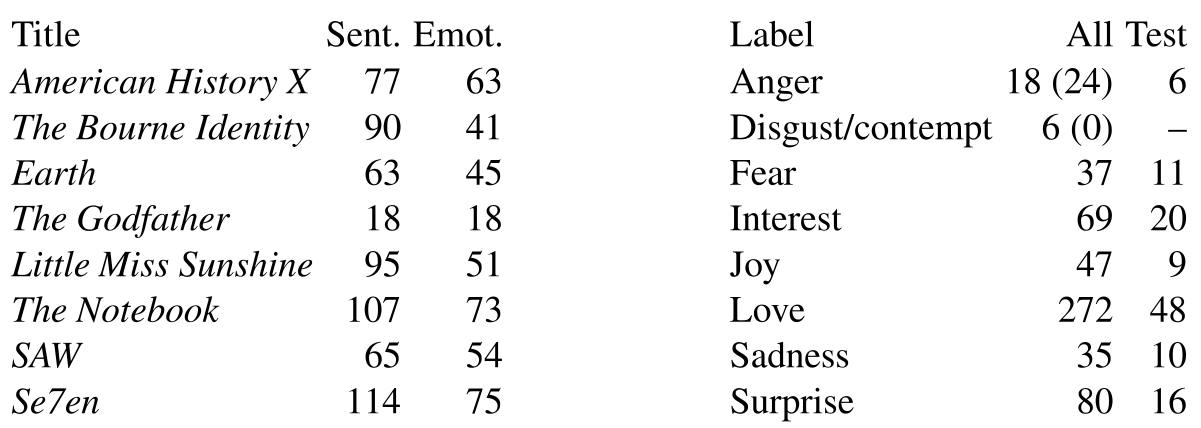
Limitations: The dataset is small (629 sentences), and the reliance on Bag-of-Words ignores word order and deep semantics—problems that modern LLMs are better equipped to handle today.