
Decoding the Chinese Face: A Data-Driven Approach to Multi-Ethnic Characterization
Multi-ethnical Chinese facial characterization and analysis
This paper presents a novel multi-ethnic Chinese face database comprising 1,600 images from eight ethnic groups (including Northern/Southern Han, Tibetan, and Uyghur). It introduces a data-driven feature selection method using mRMR to identify discriminative geometric representations (distance, angular, and ratio) for ethnic classification.
TL;DR
Researchers have constructed a comprehensive facial database of eight Chinese ethnic groups and demonstrated that angular geometric features are significantly more effective than traditional distance-based measurements for ethnic classification. By combining automated landmarking with the mRMR feature selection framework, this study achieves high-accuracy ethnic identification and reveals the subtle facial manifolds that link geography to genetics.
The "Experience" Gap in Anthropometry
For decades, anthropologists have used manual measurements to study facial variations. However, these methods often rely on a researcher’s experience and focus on simple vertical or horizontal distances (e.g., nose width or eye spacing). In the context of the highly diverse Chinese population—ranging from the Northern Mongolian groups to the Southern Zhuang—these linear metrics often fail to capture the "non-linear" nuances of facial structure. The authors argue that while existing databases like CAS-PEAL or SizeChina exist, they are not optimized for the specific task of ethnic representation and automated classification.
Methodology: Beyond Simple Distances
The study pivots from manual measurement to an automated, three-tier geometric feature hierarchy:
- Distance Features: Euclidean distances between 77 detected landmarks.
- Ratio Features: Proportions between distance pairs, providing scale-invariant data.
- Angular Features: Interior angles formed by any three non-collinear landmarks, capturing the intrinsic "tilt" and "convergence" of facial components.
To handle the resulting high-dimensional data (e.g., over 4 million possible ratio features), the team utilized the minimal-redundancy-maximal-relevance (mRMR) algorithm. This ensures that the selected subset isn't just a collection of "individually good" features, but a team of features that work together without redundancy.
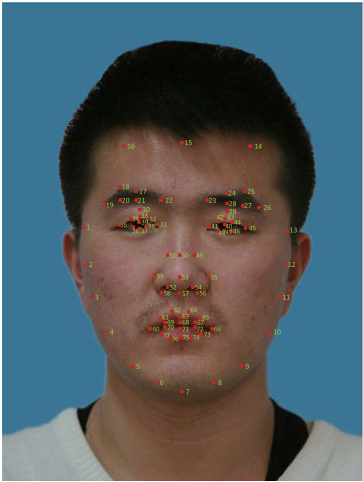 Figure: The 77 landmarks detected via STASM and the corresponding error curves.
Manifold Learning: Geography in Geometry
One of the paper's most fascinating insights comes from Manifold Learning (ISOMAP and Laplacian Eigenmaps). When the eight ethnicities are projected into a lower-dimensional space using angular features, the resulting clusters reveal striking cultural and geographical patterns:
- Southern Han vs. Zhuang: The samples for these two groups cluster compactly together, reflecting their shared geographic environment and historical fusion.
- Northern Han vs. Southern Han: While distinct, they show closer proximity to each other than to groups like the Uyghur or Tibetan, validating the intra-group differences caused by geographic isolation.
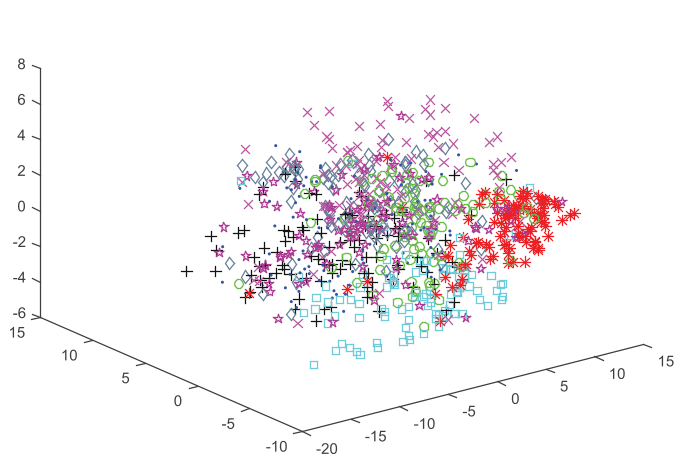 Figure: Manifold structures showing that angular features (b and e) provide much clearer ethnic separation than distance features (a and d).
Experimental Results
The evaluation phase compared "Automatic Features" against traditional "Anthropometric Features." The result was clear: Angular features attained the best classification performance across multiple classifiers.
| Classifier | Angular-M (Male) | Angular-F (Female) |
|---|---|---|
| Bayesian Net | 90.3% | 94.9% |
| LibSVM | 86.4% | 92.0% |
| Naive Bayesian | 81.3% | 87.8% |
While SMO (Sequential Minimal Optimization) achieved near-perfect scores (98-100%), the authors note that across the board, the data-driven angular approach significantly outperformed the expert-selected anthropometric indices commonly used in biological studies.
Deep Insight & Conclusion
This research underscores a fundamental shift in biometric analysis: the "shape" of a face is better defined by the angles and relative orientations of its features than by their absolute sizes. The success of angular features suggests that ethnic facial identity is encoded in the subtle slopes of the cheekbones, the convergence of the eye-line, and the specific triangle formed by the nose-tip and mouth-corners.
Limitations: The study uses frontal faces under controlled lighting. Applying these findings to "in-the-wild" scenarios remains a challenge, as pose variations would likely distort the angular calculations. However, as 3D imaging becomes more prevalent, these geometric insights will likely serve as a foundational bridge between traditional anthropology and modern AI.