
Deciphering Terrorist Networks: The "Six-Element" Multi-Factor Analysis Framework
Multi-factor Analysis of Terrorist Activities Based on Social Network
This paper proposes the "six-element" analysis method for counter-terrorism, constructing sub-networks based on People, Organization, Time, Location, Method, and Event. Applied to "East Turkistan" terrorist activities, it utilizes Social Network Analysis (SNA) and GIS to identify core nodes and temporal-spatial patterns.
TL;DR
Social Network Analysis (SNA) is no longer just about "who knows whom." This paper introduces a comprehensive "Six-Element" analysis method—integrating People, Organization, Time, Location, Method, and Event. By applying this to the "East Turkistan" dataset, the research identifies not just key leaders, but the operational DNA of the organization, revealing its geographical hubs, peak activity periods, and structural vulnerabilities.
Problem & Motivation: Beyond the Personnel Map
Traditional counter-terrorism research often suffers from "siloed" vision. Scholars typically focus on Terrorist Networks (people) or Organizational Correlations (groups). However, a terrorist act is not just a person; it is an event occurring at a specific time and location using a specific method.
The authors argue that by ignoring these auxiliary factors, we miss the "logic of activity." Why do certain groups prefer bombings in South Xinjiang while others focus on assassinations in Central Asia? This paper fills that gap by treating every element as a network node.
Methodology: The Core Framework
The "Six-Element" method moves from simple 1-mode networks (People-to-People) to complex multi-relational sub-networks.
1. Structural Metric Analysis
The researchers employ three flavors of Centrality to find "high-value targets":
- Degree Centrality: The most connected individuals.
- Closeness Centrality: Those who can reach others the fastest (information efficiency).
- Betweenness Centrality: The "gatekeepers" or brokers who connect disparate cells.
2. Clique Analysis and Invulnerability
By identifying cliques (subgroups where everyone is connected to everyone else), the study measures how resilient a network is to disruption. They categorize the network somewhere between a rigid Hierarchical Network (fragile) and a decentralized Cellular Network (highly resilient).
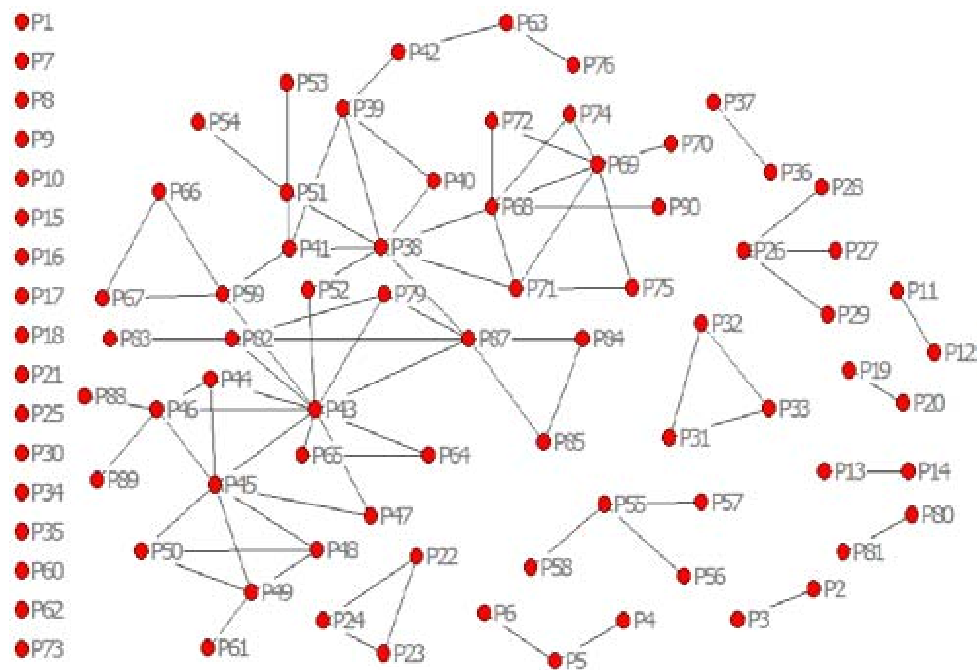 Figure 1: 1-mode network graph of "terrorists-terrorists" showing the dense clusters within the organization.
Empirical Insights: The "East Turkistan" Case Study
Utilizing data from 1949 to 2012, the study provides a masterclass in data-driven intelligence:
- Vulnerability Assessment: The analysis reveals that destroying the top 16.7% of nodes (based on degree centrality) would effectively dissolve all functional cliques, providing a clear mathematical "kill chain" for disruption strategies.
- Operational Patterns: Assassinations (23.2%) and bombings (14.3%) remain the dominant methods, though a shift toward "Internet-based instigation" and infrastructure sabotage was noted in more recent years.
- Temporal Peaks: The late 1990s (1996-1999) and the lead-up to the 2008 Beijing Olympics were identified as the most volatile periods.
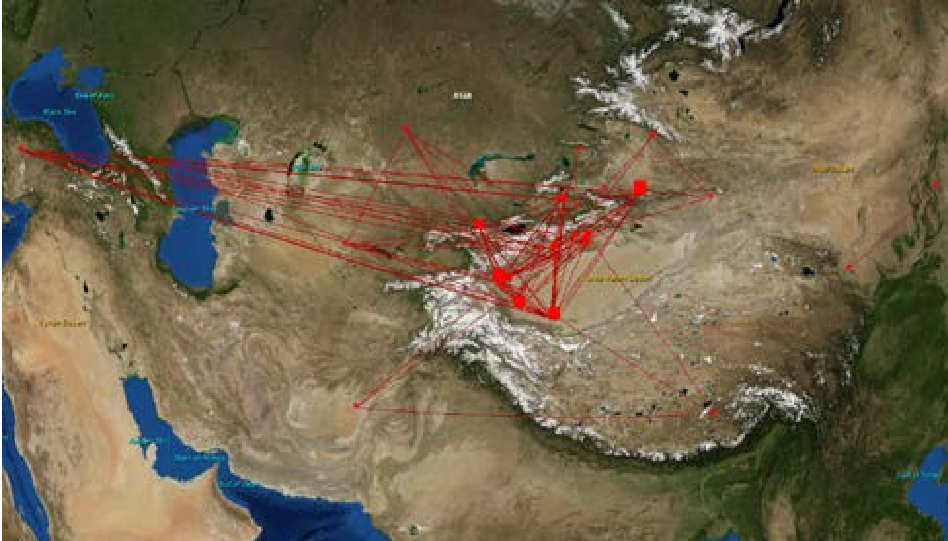 Figure 3: 3D GIS visualization showing the spatial concentration of events in South Xinjiang and cross-border activity in Central Asia.
Critical Analysis & Conclusion
The true value of this paper lies in its holistic perspective. By linking organizations (G-nodes) to locations and methods, it allows for "pattern matching." If a new event occurs in Kashi, the model can instantly suggest which organization is likely responsible and which "core people" are likely the facilitators.
Limitations
While robust, the model relies on historical web-crawled data. In the age of encrypted communications and dark-web coordination, the "Six-Element" data might be harder to capture in real-time. Furthermore, the paper focuses on "invulnerability" via node removal, but it doesn't account for the "Hydra effect"—where removing one leader causes the network to fracture into even more radical, harder-to-track sub-cells.
Future Outlook
The integration of Machine Learning to predict the next "Time-Location" node based on current network shifts is the logical next step. This "Six-Element" structure provides the perfect labeled dataset for training predictive neural networks in urban security.