
MF-Model: Tackling Multi-Dimensional Rumors via Multi-Layer Network Sampling
A Multi-Feature Diffusion Model: Rumor Blocking in Social Networks
The paper introduces a Multi-Feature Diffusion Model (MF-model) and the Multi-Feature Rumor Blocking (MFRB) problem to simulate complex rumor dynamics in multi-layered social networks. It proposes the Revised-IMM algorithm, which achieves a approximation guarantee by combining a novel "Multi-Sampling" technique with martingale-based analysis.
TL;DR
Information in the real world isn't flat. If someone claims a phone is "bad," they are usually attacking specific features like its battery life or price. This paper moves beyond traditional "one-dimensional" rumor models to propose the Multi-Feature (MF) Model. By treating social networks as multi-layered structures, the authors provide a scalable, theoretically grounded algorithm called Revised-IMM to block rumors with extreme efficiency.
Motivation: Why One Dimension Isn't Enough
Classic models like the Independent Cascade (IC) or Linear Threshold (LT) treat a rumor as a single "virus" spreading through a graph. However, the authors argue that a user's decision to believe or reject a rumor is a holistic evaluation of multiple features.
Consider a political candidate: a rumor might attack their economic policy (Feature 1) and their private life (Feature 2). A voter might ignore the private life rumors but be heavily swayed by the economic ones. To model this, we need a framework where different "features" diffuse through their own channels but converge at the user level to determine the final state.
Methodology: The MF-Model and Multi-Sampling
The authors propose a Multi-layer Graph where each layer represents the diffusion of a specific feature .
1. The Core Mechanism
A user is activated (or "blocked" from a rumor) only if the weighted sum of accepted features exceeds a threshold : Where is the weight of feature and is an indicator of whether that feature was accepted in its respective layer.
2. Multi-Sampling Technique
To solve the #P-hard problem of calculating expected influence, the authors extend Reverse Influence Sampling (RIS). Their Multi-Sampling algorithm:
- Selects a random feature node from any layer.
- Performs a reverse BFS to identify "responsible" nodes that could have influenced that specific feature.
- Combines these across layers to create an unbiased estimator of the total multi-feature influence.
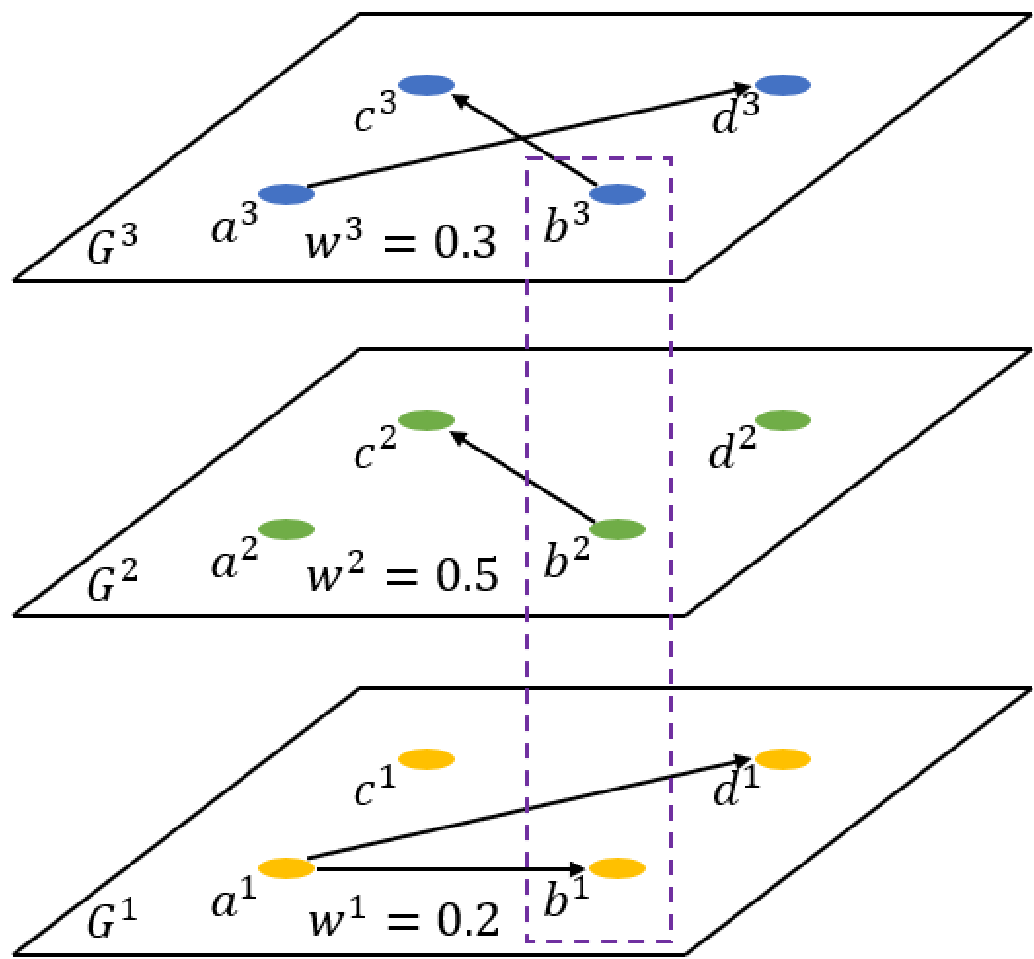 Fig 1: Example of a multi-layer realization where features diffuse independently across layers G1, G2, and G3.
3. Revised-IMM: Fixing Martingale Bias
The paper adopts the Influence Maximization via Martingales (IMM) framework but introduces a critical fix. Previous RIS-based methods faced a "bias" issue where samples used to estimate a lower bound were reused for the final selection. The authors' Revised-IMM regenerates a fresh set of Multi-Samplings after determining the required sample size , ensuring a rigorous approximation.
Experimental Validation
The authors tested their approach on several social network datasets (Dataset-1 to Dataset-3).
Efficiency and Scalability
The results prove that while the Greedy Algorithm (using Monte-Carlo) achieves similar blocking performance, its runtime is catastrophic on larger graphs.
| Dataset | Features | Revised-IMM | Greedy (Monte-Carlo) |
|---|---|---|---|
| Dataset-2 | 4 | 193.87s | 41.42 hours |
Performance Consistency
Whether using a Constant Probability (CP) or Weighted Cascade (WC) model, Revised-IMM consistently outperformed baseline strategies like "Proximity" (targeting neighbors of the rumor source) and "Random" selection.
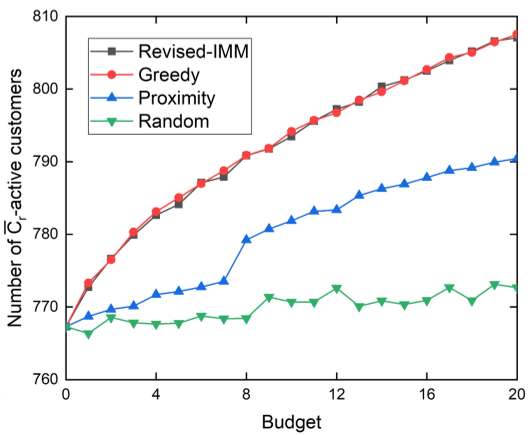 Fig 2: Performance comparison in Dataset-1. Revised-IMM (red) matches the Greedy baseline (blue) while far exceeding simple heuristics.
Critical Insight & Future Outlook
This work elegantly bridges high-dimensional feature evaluation with traditional graph influence theory. The main takeaway is that rumor blocking is more effective when you combat specific misinformation channels rather than treating the rumor as a monolithic entity.
Limitations: The current model assumes feature weights () are identical across all users (e.g., everyone values "price" the same). The authors acknowledge that a more realistic model would allow heterogeneous weights, though this might break the submodularity of the objective function, making the optimization significantly harder.
Conclusion
Revised-IMM provides a robust, scalable tool for social media platforms and brand managers to strategically deploy "positive" information to neutralize specific multi-feature rumors before they lead to public panic or economic damage.