
RMFO-GPM: Boosting Graph Pattern Matching with Reliability and Fuzzy Intelligence
Multi-fuzzy-objective graph pattern matching in big graph environments with reliability, trust and social relationship
The paper introduces RMFO-GPM (Reliability-based Multi-Fuzzy-Objective Graph Pattern Matching), a novel framework for querying subgraphs in big data environments. It integrates node reliability, social trust, and social intimacy with fuzzy logic and utilizes the NSGA-II genetic algorithm to achieve multi-objective optimization across massive social graphs.
TL;DR
In the era of Big Data, querying social or biological graphs is no longer just about finding a structural match; it's about finding the best and most reliable match. This paper introduces RMFO-GPM, a framework that marries Fuzzy Logic and Reliability Engineering with the NSGA-II genetic algorithm to solve multi-objective graph matching problems that traditional, rigid algorithms simply can't handle.
Back to Reality: Why "Strict" Matching Fails
Most existing Graph Pattern Matching (GPM) algorithms treat constraints as binary (Yes/No). If you need an "expert" with a trust score of 0.8, and a candidate has 0.79 but an infinity of social influence, a traditional algorithm deletes them. Furthermore, these algorithms assume the graph is static and immortal—they don't account for the fact that nodes (users, servers, proteins) might fail.
The authors identify three core gaps:
- The "Almost Perfect" Dilemma: Hard thresholds discard superior candidates.
- The Reliability Gap: A matched subgraph is useless if its nodes have a high failure rate.
- The Multi-Objective Explosion: In big graphs, there are thousands of matches. How do we pick the elite few that balance trust, intimacy, and reliability?
The Methodology: Reliability meets Evolution
1. Modeling Reliability
The authors treat a matched subgraph as a system. Using the history of a node's successes () and total trials (), they calculate the Confidence Lower Limit of reliability () using the Lindstrom-Madden approach. This ensures that the results aren't just good on paper, but robust in execution.
2. Multi-Fuzzy-Objective Simulation (MFOS)
By introducing a fuzzy parameter , the algorithm can "soften" the boundaries of social trust and intimacy. The goal is to optimize six objectives simultaneously:
- Social Trust ()
- Social Relationship ()
- Reliability ()
- Membership degrees for and
- Path Length (efficiency)
3. The RMFO-GPM Pipeline
 Figure 1: The conceptual approach to finding patterns in complex heterogeneous graphs.
The execution follows a sophisticated optimization path:
- Compression: Reducing the search space of the "Strong Subgraph" via accessible, pattern, and attribute compression.
- Evolutionary Selection: Using NSGA-II (Non-dominated Sorting Genetic Algorithm II) to crawl through the massive set of potential matches and return the Pareto Frontier—the set of matches where no attribute can be improved without degrading another.
Experimental Proof: Better Matches, More Insights
Testing on the Epinions trust network, the researchers compared RMFO-GPM against versions without fuzzy logic (RMO-GPM) and without reliability (MFO-GPM).
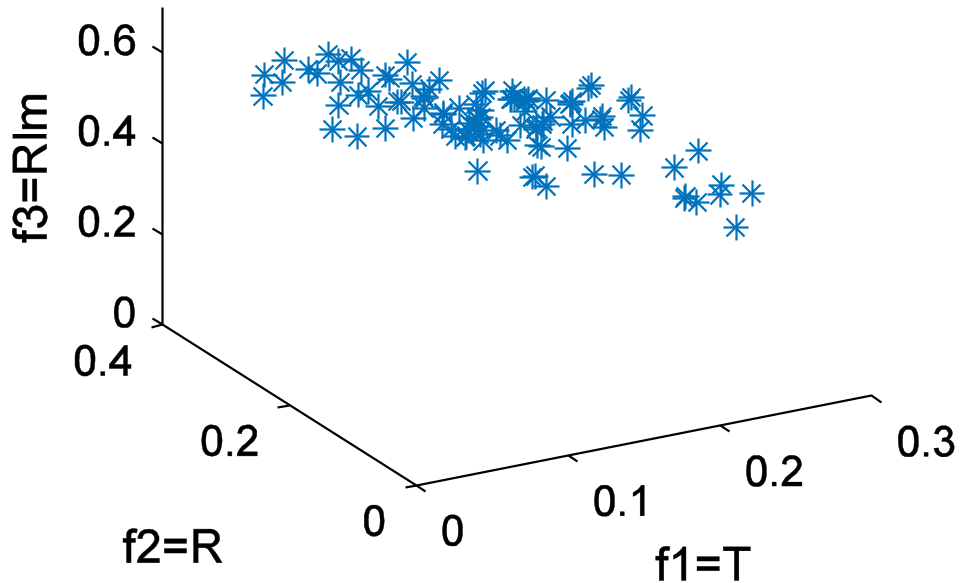 Figure 2: The Pareto frontier generated by NSGA-II, showing the trade-off between Trust, Relationship Intimacy, and Reliability.
Key Findings:
- Quantity: RMFO-GPM found nearly double the matches of RMO-GPM because the fuzzy constraints captured high-value subgraphs that strictly missed the threshold (see Figure 5 in the paper).
- Quality: The subgraphs found weren't just more numerous; they were better. The average "Social Trust" score was up to 87% higher than the reliability-ignorant baseline (MFO-GPM).
- Robustness: As the "Confidence Level" () increases, the calculated reliability decreases, providing users with a tunable "safety dial" for their queries.
Critical Insight & Future Outlook
The genius of this work lies in moving GPM from a combinatorial search problem to an optimization problem. By employing NSGA-II, the authors bypass the NP-complete bottlenecks of traditional isomorphism.
Limitations: The computational cost of running 4000 generations of a genetic algorithm on massive graphs is still significant. Future work should look into Parallel NSGA-II or Graph Neural Networks (GNNs) to approximate the Pareto frontier in real-time.
Conclusion
RMFO-GPM is a significant step toward "Human-centric" graph querying. It understands that trust is fuzzy and systems are unreliable—and by encoding that reality into the math, it delivers results that are far more applicable to social security, recommendation engines, and biological research than its predecessors.