
MAPP: Revolutionizing Edge Caching with Multi-Head Attention and Social Intelligence
3874_Multi-Head Attention Based Popularity Prediction Caching in Social Content-Centric Networking With Mobile Edge Computing.
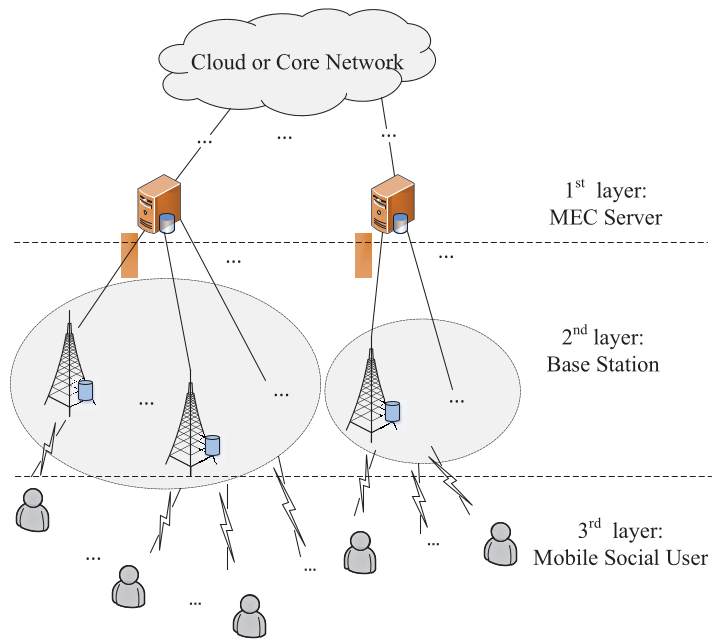
The paper introduces MeSoCCN, a novel architecture integrating Mobile Edge Computing (MEC) into Social Content-Centric Networking, alongside a Multi-head Attention Based Popularity Prediction (MAPP) model. The MAPP model achieves State-of-the-Art (SOTA) prediction accuracy to optimize edge caching decisions.
TL;DR
With social network traffic accounting for a massive share of global data, efficient caching is no longer optional—it's a necessity. This paper introduces MeSoCCN, an architecture that fuses Mobile Edge Computing (MEC) with Social Content-Centric Networking. The star of the show is the MAPP model, which uses Multi-head Attention and BiLSTM to predict content popularity by analyzing not just historical trends, but also social ties and geographic locations.
Problem & Motivation: Beyond Simple Frequency
Content-Centric Networking (CCN) promises ubiquitous caching, but "what to cache" remains a moving target. Most current systems suffer from two major flaws:
- Feature Blindness: They only look at how many times a file was requested, ignoring who is requesting it (social context) and where they are (geographic context).
- Sequential Bottlenecks: Standard RNN/LSTM models process data step-by-step, making them slow to train and incapable of effectively capturing long-range dependencies in complex social data.
The authors' insight is simple yet powerful: Content popularity in a social network is a multidimensional signal. If your friends are sharing a video in your city, that video is highly likely to trend locally soon.
Methodology: The MAPP Architecture
The proposed Multi-head Attention based Popularity Prediction (MAPP) model uses an Encoder-Decoder structure to perform multi-step forecasting.
1. Feature Fusion
The model ingests a comprehensive feature matrix:
- Temporal: Historical and future-trend popularity sequences.
- Social: Number of publishing/retrieving actions by a user's friends.
- Geographic: Local node request densities.
2. The Multi-head Advantage
While the BiLSTM layer extracts sequential features, the Multi-head Attention mechanism allows the model to "attend" to different representation subspaces. This means one "head" might focus on long-term popularity trends while another picks up on sudden social spikes.
3. Weighted Caching Strategy
The prediction isn't just a number; it drives a Cache Placement Strategy where content is weighted based on the distance to the user (len_dis). This ensures that popular content is pushed closer to the network edge, minimizing the number of hops.
Experiments & Results: Proving the Gains
The authors tested MAPP using the SONETOR generator on real-world Facebook datasets.
Superior Accuracy
MAPP significantly outperformed standard LSTMs and the classic Auto-Regressive (AR) models. By including social and geographic features, the RMSE (Root Mean Square Error) dropped from ~0.14 to 0.064, a nearly 55% improvement in precision.
| Model | RMSE (t+1) | RMSE (t+2) | RMSE (t+3) |
|---|---|---|---|
| P-LSTM | 0.143 | 0.158 | 0.170 |
| MAPP (Ours) | 0.064 | 0.072 | 0.078 |
Network Efficiency
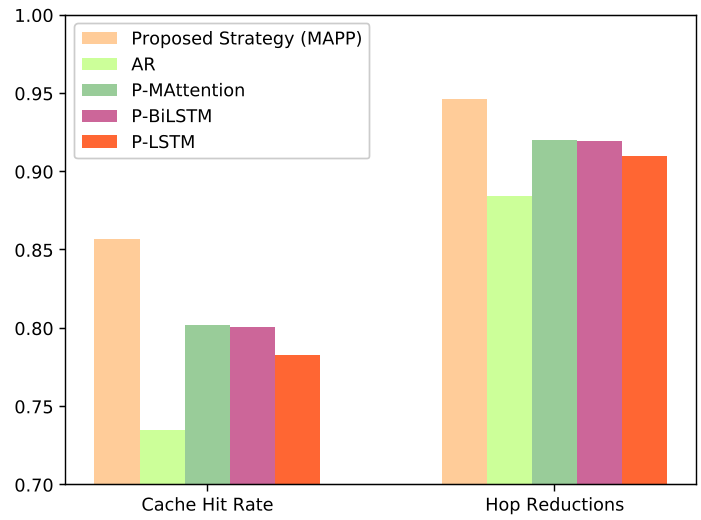
In terms of real-world impact, the Cache Hit Rate saw a 6%-13% boost, while Hop Reductions (a measure of bandwidth saving) improved by up to 7%.
Critical Analysis & Conclusion
Takeaway: The marriage of Multi-head Attention and multi-dimensional social features provides a robust framework for the next generation of "smart" edge networks. It treats network traffic not as anonymous packets, but as social signals.
Limitations & Future Work: While MAPP is powerful, the current model requires training on historical social records which might raise privacy concerns in real-world deployment. Future research could explore Federated Learning to train MAPP models on-device without exposing sensitive user social graphs. Furthermore, extending this to handle multimodal content (video vs. text) could further refine cache weights.
The path to a faster internet isn't just bigger pipes—it's smarter edges.