
3VSL: Breaking the Topology Barriers in Multi-Hop Social Trust Assessment
Assessment of multi-hop interpersonal trust in social networks by Three-Valued Subjective Logic
This paper introduces 3VSL (Three-Valued Subjective Logic), a novel framework for assessing multi-hop interpersonal trust in arbitrary Online Social Network (OSN) topologies. By extending the Beta-distribution-based Subjective Logic to a Dirichlet distribution, the model accurately handles complex structures like bridge and cyclic topologies, achieving SOTA accuracy demonstrated through real-world validation with 100 participants.
TL;DR
Assessing trust between strangers in a social network often requires traversing complex "friend-of-a-friend" paths. While Subjective Logic (SL) has been the gold standard, it collapses when faced with complex, non-series-parallel architectures (like "bridge" connections). This paper introduces 3VSL (Three-Valued Subjective Logic), which utilizes a Dirichlet distribution to incorporate a "neutral" state. This allows for accurate trust computation in any arbitrary network topology, including bridge and cyclic graphs, without losing information.
Problem & Motivation: The "Bridge" Bottleneck
In real-world Online Social Networks (OSNs), trust isn't just a simple chain. It resembles a messy web. Previous models based on standard Subjective Logic could only compute trust in Directed Two-Terminal Series-Parallel Graphs (DTTSPG).
When a "bridge" topology appears—where a middleman connects two different paths—standard SL fails. Researchers previously "solved" this by pruning edges (information loss) or picking only the strongest path. The authors of 3VSL identified that the root cause was the inability to distinguish between priori uncertainty (lack of evidence) and posteriori uncertainty (distortion during propagation).
Methodology: From Binary to Trinary Logic
The core innovation of 3VSL is treating trust as a trinary event: (Belief, Distrust, Neutral).
1. The Dirichlet Shift
By moving from a Beta distribution (binary) to a Dirichlet distribution (trinary), the model introduces a neutral state. This state acts as a container for "distorted evidence." When trust propagates from person A through B to C, the certainty A has in B's opinion is "discounted," and the lost certainty is moved into this neutral/posteriori uncertainty space rather than just being discarded.
2. Architecure and Operators
3VSL redefines two fundamental operations:
- Discounting (): Models horizontal propagation (A trusts B, B trusts C).
- Combining (): Models vertical fusion (A gets opinions about C from both B and D).
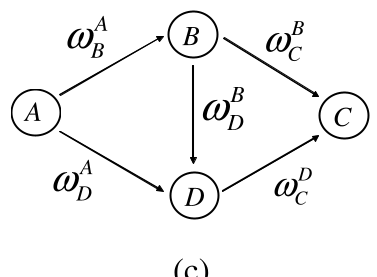 Fig 1: From simple serial/parallel to complex bridge topologies solvable by 3VSL.
3. Handling Arbitrary Graphs
The authors prove via Theorem 2 that by recursively applying these operators and distinguishing between distorting opinions (can be reused) and original opinions (used once), any two-terminal directed graph is solvable and yields a unique trust value.
Experiments & Results: Real-World Validation
Unlike many theoretical papers, the authors built an online survey system to collect 1st and 2nd-hop trust data from 100 participants to validate the model.
Key Findings:
- Accuracy: 3VSL showed a significantly lower average error compared to Subjective Logic.
- Error Distribution: 95% of combining operations in 3VSL resulted in less than 20% error, outperforming the baseline significantly.
- The Power of Bridges: Numerical analysis proved that the "bridge opinion" (which SL ignores) significantly impacts the final trust score. Ignoring it leads to over-simple and often incorrect trust assumptions.
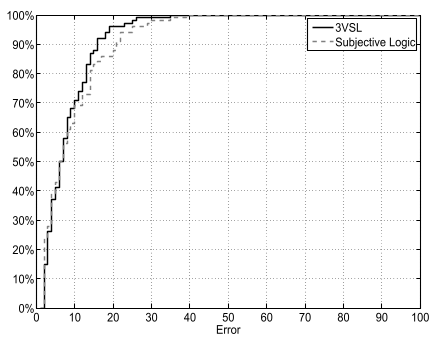 Fig 2: Error Comparison - 3VSL (Solid) vs. Subjective Logic (Dashed).
Critical Analysis & Conclusion
Takeaway
The introduction of the Neutral state is a masterstroke in modeling. It acknowledges that trust propagation is "lossy"—much like signal degradation in physics. By capturing this degradation in the Dirichlet framework, 3VSL moves trust computation from a mathematical approximation to a robust social simulation.
Limitations & Future Work
While 3VSL handles topology brilliantly, it still assumes objective evidence and ignores cognitive biases (e.g., if A is naturally suspicious, they might discount evidence differently). The authors suggest that integrating Stochastic Processes and Bayesian Analysis to handle multi-source evidence will be the next frontier for this logic.
In conclusion, 3VSL is a vital upgrade for any system relying on decentralized trust—from Sybil defense in networks to recommendation engines in social commerce.