
Multi-Hop Trust in the Shadows: A Privacy-Preserving Reputation Scheme for OSNs
A Multi-Hop Privacy-Preserving Reputation Scheme in Online Social Networks
This paper introduces a Multi-hop Privacy-Preserving Reputation Scheme for Online Social Networks (OSNs). It enables users to discover trust/reputation paths to unfamiliar entities using a novel combination of structured encryption and proxy re-encryption, achieving secure multi-hop reputation transmission without revealing detailed network topology to third parties.
TL;DR
In the era of Online Social Networks (OSNs), reputation is currency. However, revealing who you trust—and by how much—is a massive privacy risk. This paper presents a sophisticated cryptographic scheme that allows users to find a "trust path" to a stranger through mutual connections without anyone (including the central server) seeing the actual friend list or the specific trust values along the way. By leveraging Structured Encryption and Proxy Re-Encryption, the system enables secure, multi-hop reputation discovery.
Problem & Motivation: The Paradox of Public Trust
Traditional reputation systems (like those on eBay or Facebook) have a fundamental flaw: Privacy Leakage. To know if a stranger is trustworthy, you usually have to see who else trusts them. This exposes:
- Social Relationships: Your entire friend list becomes visible to the service provider.
- Subjective Attitudes: Your private "rating" of a friend or merchant is exposed to the network.
Current OSN providers are "honest-but-curious." They provide the service but eagerly mine relationship data. The authors argue that a user's attitude towards another should be a private issue. The challenge is: How do we search for a path of trust through a network we aren't allowed to see?
Methodology: Privacy via Structured Encryption
The core innovation lies in how the social graph is stored and queried.
1. The Star-Like Storage Mechanism
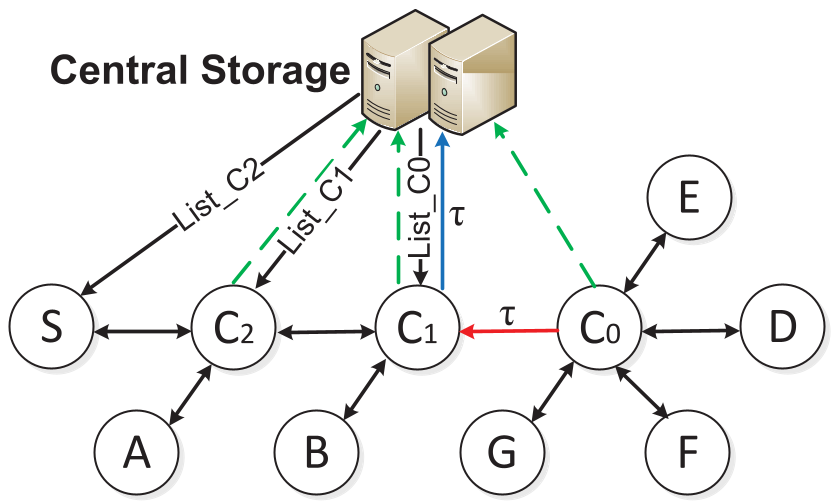
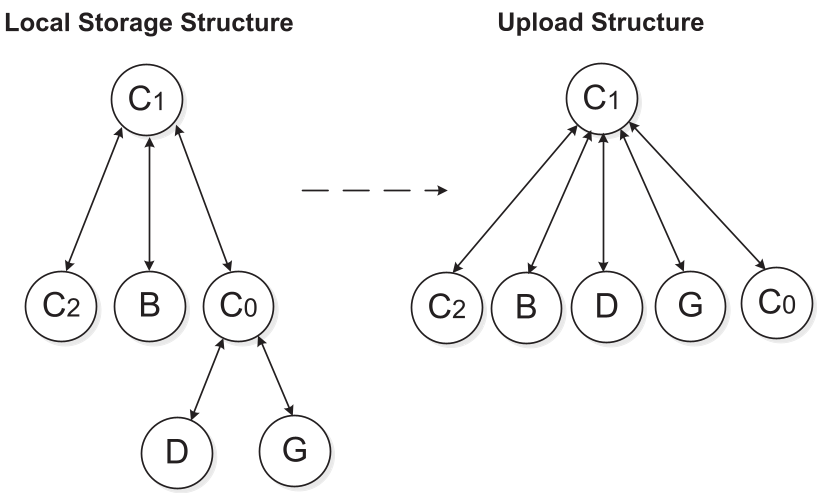
Instead of a giant, visible adjacency matrix, every user maintains a star-like structure of their immediate neighbors and their associated reputation values. These are stored on the Central Storage (CS) in an encrypted format using Structured Encryption.
2. Token-Based Searching
When User A wants to find User D, they don't ask the server for "User D." Instead:
- Tokens: User A sends a cryptographic token (generated via pseudo-random functions) to the server.
- Blind Querying: The server uses this token to find encrypted pointers in a table () without knowing what the pointers represent.
- Recursive Discovery: The process repeats hop-by-hop. Crucially, intermediate nodes act as "relays" that pass the reputation value without learning the identity of nodes more than one hop away.
3. Threshold Negotiation
What if you only want to trust someone if the path's total reputation is above 0.6? The authors designed a negotiation process where two nodes can check if their combined reputation meets a threshold using a quotient calculation () that doesn't reveal the raw trust scores to each other.
Experiments & Results: Security Analysis
While the paper focuses on the cryptographic framework rather than large-scale hardware benchmarks, its strength lies in its Security Proofs:
- Path Anonymity: No party (Source, Destination, or Server) can reconstruct the full routing table.
- CPA-Security: The ciphertexts used for reputation values and friend lists do not reveal any partial information, even under adaptive queries.
- Efficient Revocation: By using Proxy Re-Encryption, a user can revoke a "bad actor's" access easily. The Data Owner sends a re-encryption key to the server, which transforms existing ciphertexts so the revoked user's old keys no longer work—all without the Data Owner having to re-download and re-upload everything.
Critical Analysis & Conclusion
Takeaway
The paper successfully decouples "trust discovery" from "data visibility." It proves that we can have a functional reputation system where the social graph remains a "black box" to the very server that hosts it.
Limitations
- Complexity: The multi-hop recursive discovery requires multiple rounds of interaction, which might introduce latency in very large, deep networks.
- Collusion: The authors explicitly exclude collusion attacks (where multiple nodes share data to deanonymize others) from their current model, which is a significant threat in real-world OSNs.
- Reputation Logic: The paper assumes a simple product-based transitive reputation (), but real-world trust decay is often more complex.
Future Outlook
As users become more protective of their digital footprints, schemes like this will be vital for Web3 and Decentralized Finance (DeFi), where verifying a user’s "creditworthiness" or "reputation" must be done without exposing their entire private transaction history.