
G3P-MI: Navigating Educational Big Data with Multi-Instance Learning
Multi-instance genetic programming for predicting student performance in web based educational environments
This paper introduces G3P-MI, a Grammar-Guided Genetic Programming approach for predicting student performance in Virtual Learning Environments (VLEs). By utilizing a Multiple Instance Learning (MIL) framework, the method classifies students into "pass" or "fail" categories based on their behavioral logs, achieving SOTA accuracy and a superior balance between sensitivity and specificity.
TL;DR
Predicting student success is a classic "noisy data" problem. This paper presents G3P-MI, a system that uses Multiple Instance Learning (MIL) and Genetic Programming to predict whether a student will pass or fail a course based on their Moodle activity. Unlike traditional methods, it thrives on the "incomplete" nature of student logs and generates transparent, human-readable rules for educators.
Context: Why Traditional ML Fails in the Classroom
In a typical Virtual Learning Environment (VLE), no two students are alike. One student might obsess over forum posts, while another focuses solely on quizzes. In traditional supervised learning, this results in a data matrix riddled with missing values (NaNs). If there are 50 possible activities and a student only does 3, the other 47 fields are empty, confusing standard algorithms.
The authors identifies a crucial insight: student behavior is best represented as a collection of events (a "bag"), not a fixed-width vector.
The Core Innovation: Multiple Instance Learning (MIL)
By shifting to a Multiple Instance Learning framework, the researchers treated each student as a "bag" and each activity type as an "instance" within that bag.
- The Bag: Represents the student and their final label (Pass/Fail).
- The Instance: Represents specific behaviors (e.g., "Spent 3000s on Quiz P").
This allows the model to handle a "hard-working student" (a bag with 20 instances) just as easily as a "disengaged student" (a bag with 1 instance), without ever needing to fill in "missing" data.
Architectural Breakdown
The G3P-MI algorithm uses Grammar-Guided Genetic Programming. Instead of a black-box neural network, it evolves a population of logical trees based on a Context-Free Grammar (CFG).
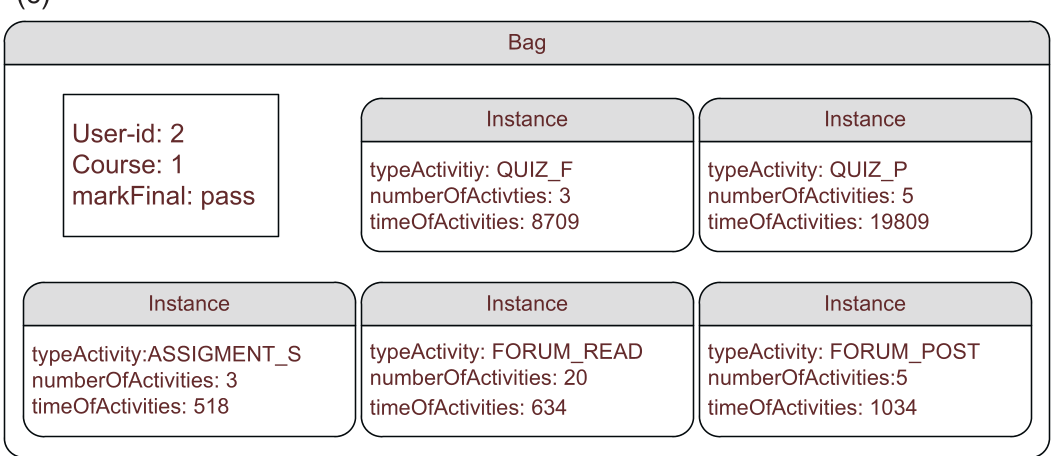 Fig 1: Comparison of traditional supervised learning (a) vs the more flexible MIL bag representation (b & c).
The fitness function is particularly clever. Instead of just looking at raw Accuracy, it maximizes the product of Sensitivity (correctly finding those who pass) and Specificity (correctly finding those who fail).
Experimental Showdown
The authors tested G3P-MI against 14 other MIL algorithms (including Diverse Density, SVMs, and Decision Trees) using real data from the University of Cordoba.
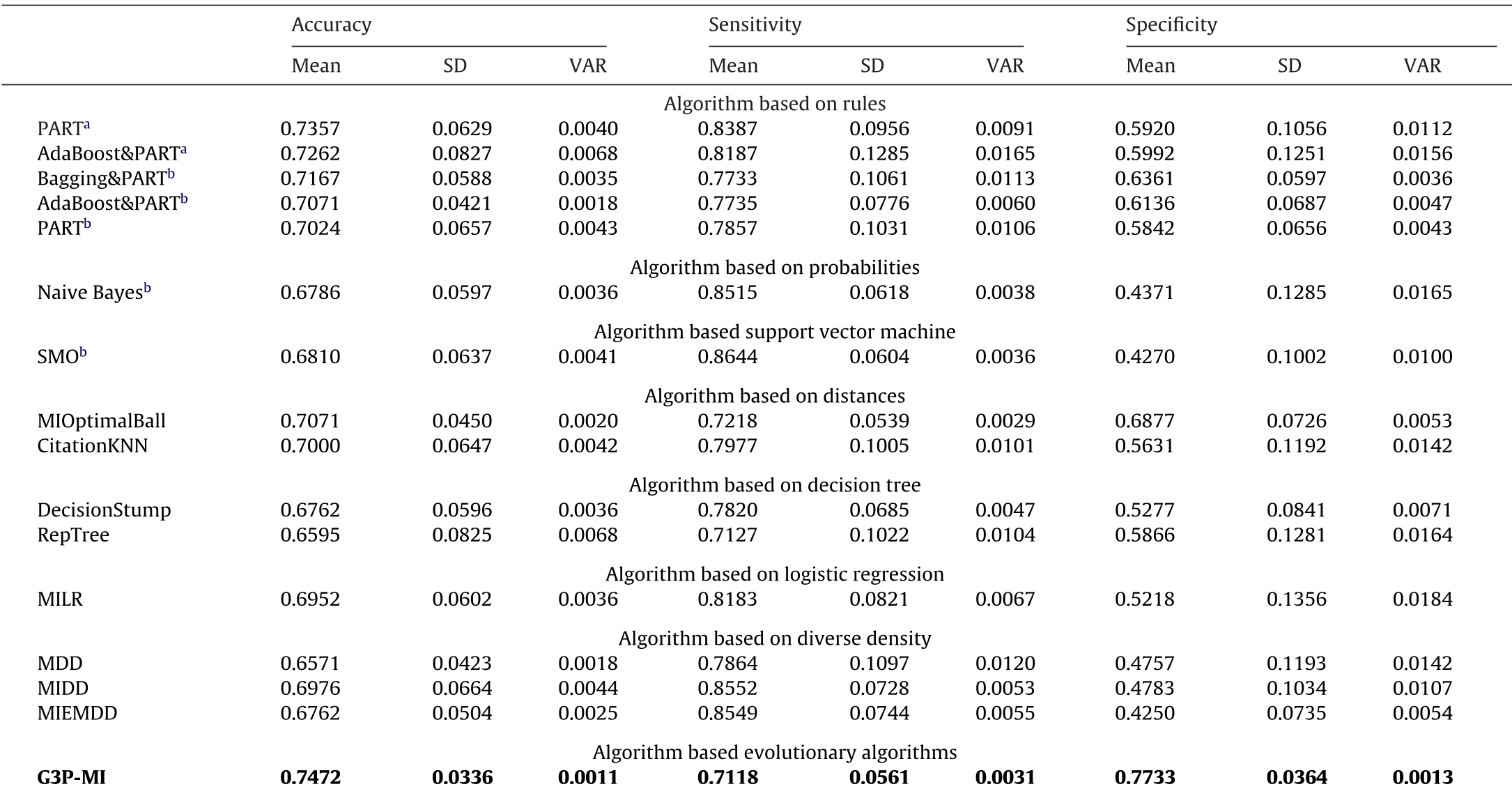 Table 1: G3P-MI outperforms competitors in Accuracy (0.7472) while maintaining the most robust balance across all metrics.
While methods like Naive Bayes or SMO achieved high Sensitivity, they failed miserably at Specificity. In educational terms, they were good at identifying students who would pass, but terrible at identifying those at risk of failing—the very students who need help the most. G3P-MI fixed this gap.
Decoding the "Black Box": Human-Readable Insights
One of the most powerful aspects of G3P-MI is Interpretability. The algorithm doesn't just output a probability; it outputs a rule. For example:
IF [(Time spent > 2984 min) OR (Passed Quizzes > 0)] AND (Total Activities > 5) THEN Student is likely to PASS.
From these evolved rules, the authors discovered:
- Quizzes are the ultimate predictor: Passing even a few quizzes is more indicative of success than many forum posts.
- The "Threshold" Effect: There is a specific "sweet spot" of time (approx. 2500–5000 mins) where the probability of passing jumps significantly.
Critical Analysis & Future Outlook
While G3P-MI is a massive leap forward for reproducible and transparent educational AI, it still primarily operates on "Post-Hoc" data (data collected after the course).
The next frontier represents a shift from prediction to prevention. If these MIL models can be applied mid-semester, they can serve as an early warning system, allowing professors to intervene when the "bag" of student activities starts looking like a "Fail" profile.
Takeaway: By embracing the inherent messiness of educational data through Multiple Instance Learning, we can build AI that doesn't just predict grades, but helps teachers understand the mechanisms of student success.