
Balancing the Edge: Optimized Multi-Job Allocation in Dense IoT Environments
Multi-Job Multi-Edge Allocation in Edge Computing Environments
The paper introduces the Weight Balance (WB) algorithm to address the Multi-Job Multi-Edge allocation problem in edge computing, formulated as a Concurrent Job Scheduling Problem (CJSP). By strategically distributing divisible jobs across heterogeneous edge nodes, the method minimizes user finish time and achieves near-optimal performance in large-scale metropolitan scenarios.
TL;DR
As data processing shifts from centralized clouds to the network edge, managing "who computes what and where" becomes a combinatorial nightmare. This paper tackles the Concurrent Job Scheduling Problem (CJSP) by introducing the Weight Balance (WB) algorithm. It utilizes dynamic weighting and real-time VM reallocation to minimize total finish time, achieving performance levels that rival optimal solutions even in complex, real-world metropolitan deployments.
Problem & Motivation: The Fragmentation of the Edge
The promise of 5G and IoT is local processing, but the reality is a fragmented landscape of "micro-clouds"—routers, gateways, and small-scale servers. The technical challenge isn't just finding a server, but optimizing the allocation of divisible jobs across multiple reachable edges.
Existing scheduling often fails because:
- Fixed Allocation: They don't account for the fact that a VM becomes free mid-process.
- Locality Blindness: They ignore the varying "pressure" different users put on the local edge cluster.
The authors identify that for edge computing to be effective, we need an algorithm that balances the "weight" of user demands against the available "supply" of virtualized compute power.
Methodology: The Weight Balance (WB) Insight
The core of the proposed solution is the Weight Balance Algorithm. Instead of a static assignment, it treats the edge environment as a fluid pool of resources.
1. Initial Pressure Mitigation
The algorithm first identifies "bottleneck-free" edges—nodes where the total demand is so low it can't possibly exceed the theoretical optimal time (). These nodes are saturated early to relieve pressure from more congested areas.
2. Dynamic Weighting ()
For the remaining jobs, the algorithm assigns a weight: This weight captures the relative importance of user to edge . The algorithm greedily assigns VMs to the highest-weight pairs, then discounts the weight as the user receives more resources () to ensure fairness.
3. Iterative Reallocation
The "secret sauce" is the reallocation loop. Rather than waiting for all jobs to finish, the moment any user completes their task, the algorithm triggers a re-evaluation of the available VMs, shifting them instantly to the next most "weighted" task.
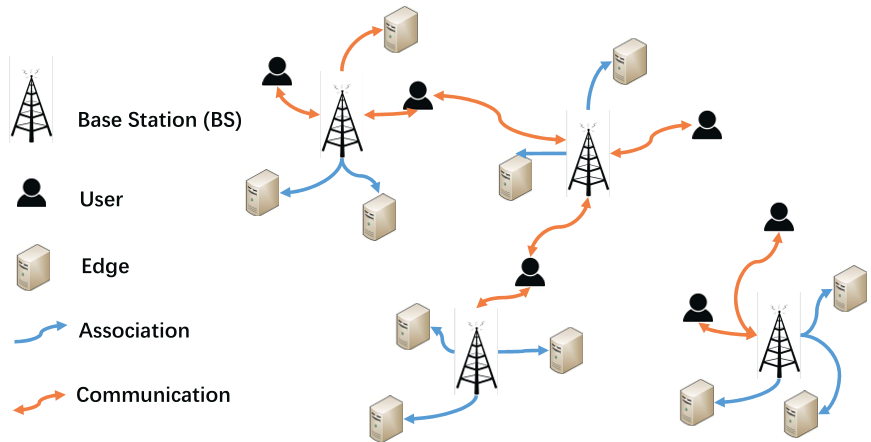 Fig 1: The Multi-Job Multi-Edge environment where users connect via Base Stations (BS) to varied edge nodes.
Experiments: Real-World Validation
To test the algorithm in a realistic setting, the authors mapped edge nodes to Starbucks locations in Beijing's 4th Ring road, noting that coffee shop distributions closely mirror urban population density.
Key Findings:
- Finish Time Optimization: As the number of available edges and VMs increases, the WB algorithm consistently hits lower finish times than SJF and MBF.
- Efficiency: Despite its iterative nature, the running time remains significantly lower than the Marginal Benefit First (MBF) approach, making it suitable for real-time deployment.
| Metric | WB Advantage |
|---|---|
| Complexity | - Quadratic with users, linear with edges |
| Consistency | Near-optimal results at small and medium scales |
| Scalability | Finish time drops sharply as VM density increases |
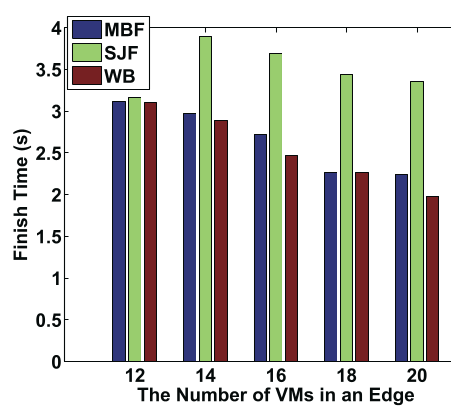 Fig 2: Comparative analysis showing Finish Time decreasing as Edge availability grows.
Critical Analysis & Conclusion
The Weight Balance algorithm succeeds because it translates the abstract "fairness" of load balancing into a concrete weighting mechanism that reacts to the completion of sub-tasks.
Takeaway: The study proves that in dense metropolitan deployments (like the Starbucks model), sophisticated heuristics can approximate NP-complete optimal solutions with minimal computational overhead.
Limitations: The current model assumes all VMs have identical processing power () and ignores transmission delays between users and local edges. Future iterations will need to incorporate Heterogeneous Compute Capacities and Varying Network Latency to fully capture the chaos of real-world IoT environments.