
Beyond Isolated Labels: Capturing Dependency in Multi-Label Crowdsourcing
Multi-Label Truth Inference for Crowdsourcing Using Mixture Models
This paper introduces MCMLI and MCMLD, two novel probabilistic models for multi-class multi-label truth inference in crowdsourcing. The core innovation lies in the transition from processing labels in isolation to joint inference, with MCMLD specifically utilizing mixture models to capture complex label correlations, achieving SOTA accuracy on both synthetic and real-world sentiment datasets.
TL;DR
When we ask the crowd to label an image (e.g., identifying both "dog" and "soccer ball"), the labels aren't just random bits—they are semantically linked. This paper presents MCMLI and MCMLD, the first entirely unsupervised probabilistic models designed for multi-class multi-label truth inference. By moving from isolated label counts to joint distribution modeling, the authors achieve significant performance gains, particularly when workers exhibit bias or labels are strongly correlated.
Background: The Strategy of Joint Inference
In the "Golden Age" of crowdsourcing, simple Majority Voting (MV) dominated. Later, the Dawid-Skene (DS) model improved results by estimating worker reliability through confusion matrices. However, most DS-based approaches treat a task with ten labels as ten separate tasks. This paper argues that this is fundamentally inefficient. If a worker identifies an "ocean," they are more likely to correctly identify "sand" and less likely to say they see a "forest."
Methodology: MCMLI vs. MCMLD
The authors propose two levels of sophistication to solve this problem:
1. MCMLI (Independent Model)
Think of this as the "Joint-Global" version of the classic DS model. It assumes labels are independent but optimizes the joint likelihood of all labels and worker confusion matrices in a single EM loop. The authors liken this to the difference between gradient descent and coordinate descent—MCMLI moves toward the global optimum for the whole instance at once.
2. MCMLD (Dependent Model)
This is the "heavy lifter." It uses a Mixture Model to handle label correlation.
- Latent Clusters: Each instance belongs to a hidden cluster.
- Mixing Coefficients: Within each cluster, the labels are generated from specific distributions that capture the patterns of that cluster.
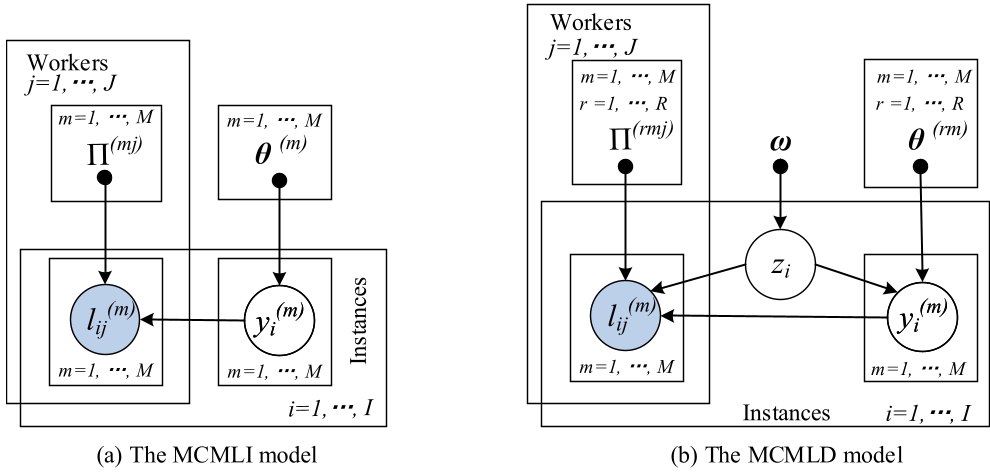 Figure: The graphical model for MCMLI (a) and MCMLD (b). Note the latent cluster variable 'z' in (b) that creates the dependency.
Handling the "R" Parameter
A classic problem in mixture models is choosing the number of clusters (). The authors provide a clever unsupervised heuristic: they apply Principal Component Analysis (PCA) to the worker labels. If a few components explain most of the variance (e.g., 70%), it indicates fewer independent "concepts" are needed, helping dynamically set .
Experiments & Results
The authors tested their models across three scenarios: Uniformly distributed errors, Strong Correlation, and Biased Annotation.
Key Findings:
- The Joint Inference Advantage: Even the "independent" MCMLI outperformed sequential DS by ~2% accuracy, proving that joint optimization is mathematically superior even without explicit correlation modeling.
- Correlation Power: On the
pentacorreldataset (specifically designed with strong dependencies), MCMLD significantly widened the gap over all other methods. - Real-World Impact: Using the
affectivenews headline dataset (6 emotions per task), MCMLD achieved an accuracy of 76.28% compared to the 72.83% of the best single-label baseline.
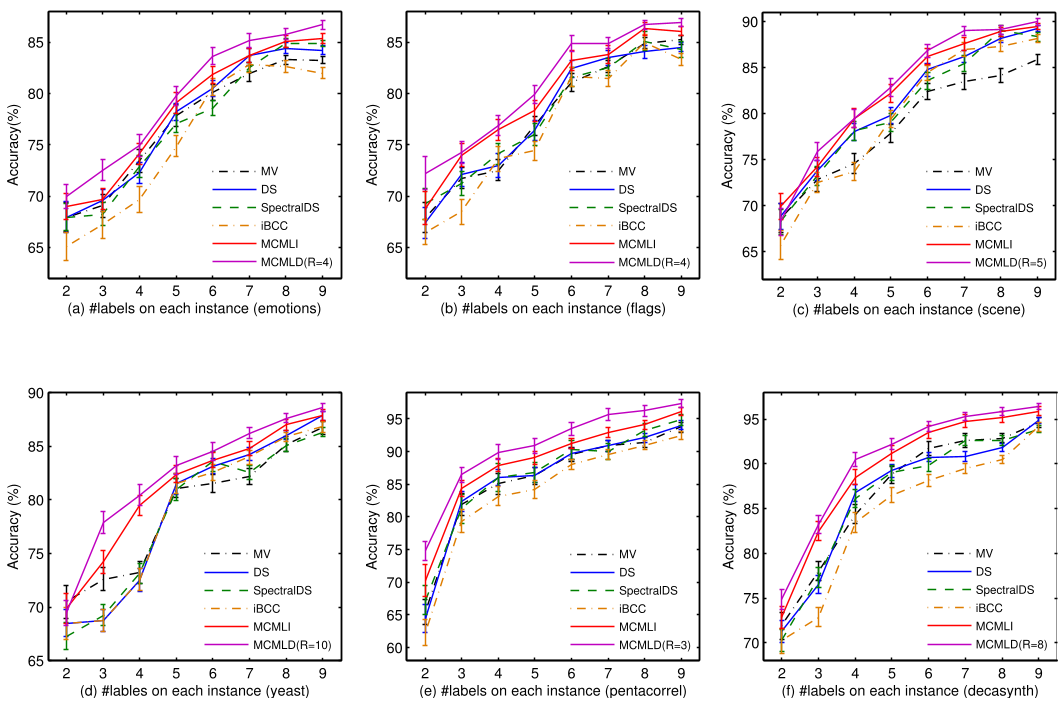 Figure: Comparison of performance across 6 datasets. MCMLD (solid red line) consistently occupies the top position.
The One-Coin Simplification
For cases where data is sparse, the authors introduced "One-Coin" versions (MCMLI-OC and MCMLD-OC). These models collapse the complex confusion matrix into a single parameter per worker. Experimental results showed that while these simplified models fail in Biased Annotation scenarios (where we need to know how a worker is wrong), they actually outperform more complex models when errors are truly random or samples are limited.
Critical Insight & Conclusion
This work highlights a shift in crowdsourcing research from "who is a better worker" to "how do the tasks themselves relate to each other." The primary limitation remains the computational overhead of EM as the number of labels () and classes () grows, though the authors' joint approach mitigates the need for massive data compared to deep learning alternatives.
Takeaway: If your crowdsourcing pipeline asks for multiple related outputs, stop running separate inference loops. Moving to a mixture-based joint inference model is a low-hanging fruit for immediate accuracy gains.