
Boosting Early Diagnosis: A Stacking Ensemble Approach to Learning Disability Detection
A Multi Layer Ensemble Learning Framework for Learning Disability Detection in School-Aged Children
This paper introduces a multi-layer stacking ensemble learning framework specifically designed for the early detection of Learning Disabilities (LD) in school-aged children. By integrating Logistic Regression, k-Nearest Neighbor (KNN), and Support Vector Machine (SVM) as base learners with a Decision Tree meta-classifier, the proposed method achieves superior classification accuracy and recall compared to standalone machine learning models.
TL;DR
Early detection of Learning Disabilities (LD) is a critical bottleneck in pediatric education and healthcare. This paper proposes a Multi-Layer Stacking Ensemble framework that fuses the strengths of SVM, KNN, and Logistic Regression with a Decision Tree meta-classifier. The result is a robust diagnostic tool that achieves 90.59% accuracy and a high 90.63% recall, significantly reducing the dangerous "false negative" gap in early student screening.
Problem & Motivation: The Complexity of the Hidden Struggle
Learning Disabilities (LD) are neurological disorders—not indicators of intelligence—that affect how children process information. With roughly 1 in 10 children in India affected, the diagnostic challenge lies in the sheer variety of symptoms, ranging from visual memory deficits to fine motor skill impairments.
Traditional machine learning approaches often hit a "performance ceiling." A single model might excel at finding linear relationships (Logistic Regression) but fail at capturing local similarities (KNN) or high-dimensional margins (SVM). In a medical context, a "false negative" (failing to identify a child with LD) is far more costly than a "false positive," necessitating a model with high sensitivity and stability.
Methodology: The Power of Stratified Stacking
The core innovation lies in the Stacking Generalization architecture. Unlike simple "voting" ensembles, stacking learns how to best combine the predictions of the base models.
1. Base Layer (Diverse Experts)
- SVM: Chosen for its high accuracy in small, high-dimensional datasets.
- KNN: Utilized for its ability to classify based on similarity measures in feature space.
- Logistic Regression: Used to model the associations between dependent variables while avoiding overfitting via the sigmoid function.
2. The Meta-Learner (The Integrator)
The outputs of these three models are fed into a Decision Tree. This meta-model doesn't look at the raw features (age, gender, reading ability), but rather at the predictions made by the base layers. It learns which "expert" to trust for specific types of data points.
3. Preventing Overfitting via Out-of-Fold Predictions
To ensure the top-level learner is not biased, the authors employed 10-fold cross-validation. The model creates a "Prediction Matrix P" where each row is a prediction made on data the base model never saw during its specific training fold.
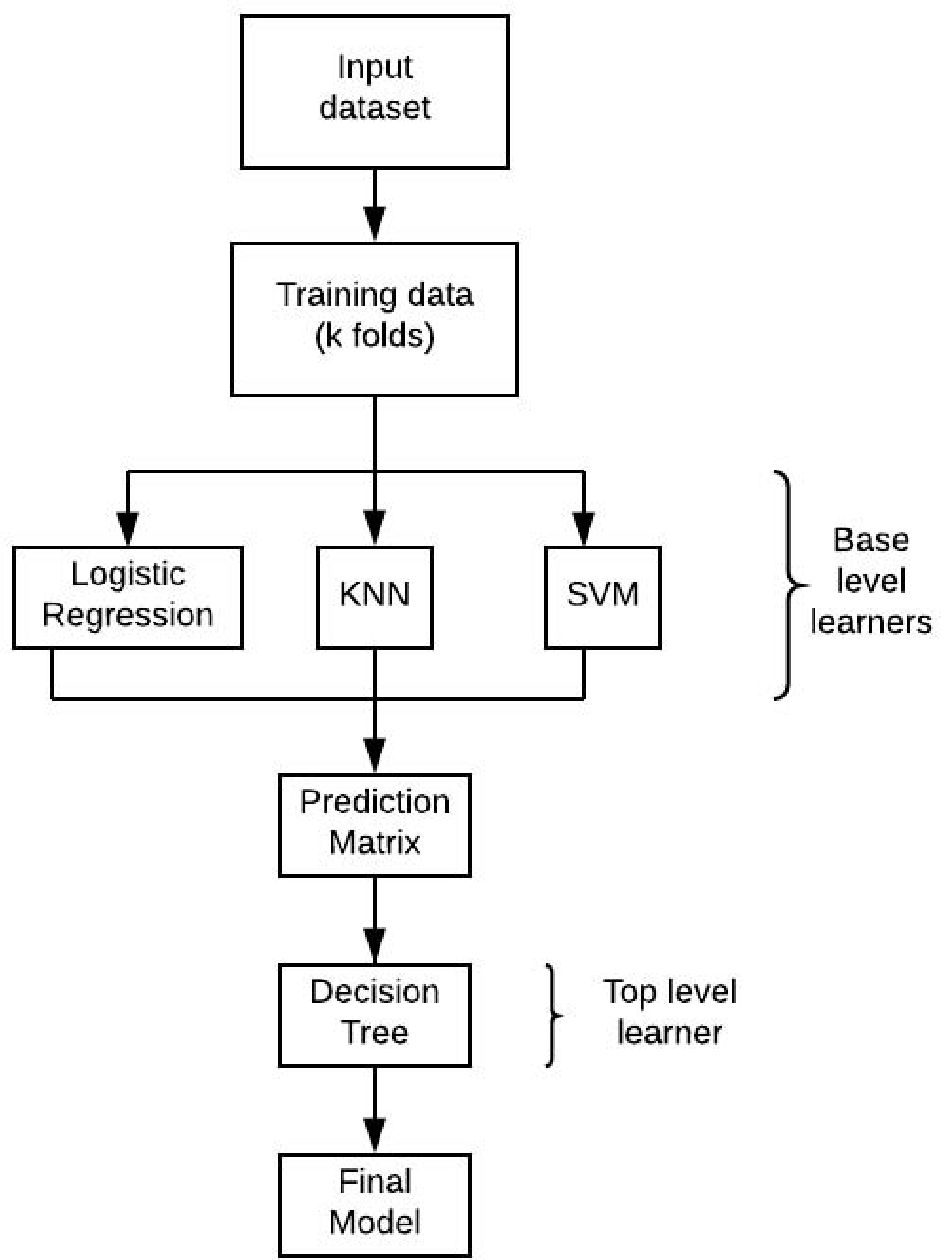 Figure 1: The architecture of the Stacking Ensemble shows the flow from input features to the final Decision Tree prediction.
Experiments & Results: Beyond Simple Accuracy
The study utilized a real-world dataset of 900 patient records across 20 attributes, including parameters like "Auditory Discrimination," "Visual Memory," and "Processing Speed."
SOTA Comparison: Accuracy & Recall
While single models performed respectably, the Ensemble model showed a clear dominance:
- Accuracy: The Ensemble hit 90.59%, a ~4-8% increase over standalone SVM or KNN.
- Recall (Sensitivity): This is the most vital metric for LD detection. The Ensemble achieved 90.62%, whereas Logistic Regression lagged at only 71.81%.
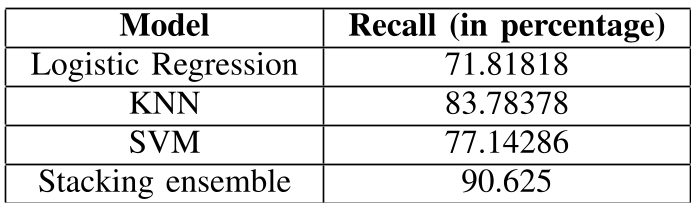 Figure 2: Performance metrics comparison highlighting the superior Recall and Accuracy of the Stacking Ensemble.
The AUC Insight
The Receiver Operating Characteristic (ROC) curves further validate the choice. While KNN and Stacking shared a high Area Under the Curve (AUC), the Stacking model provided the most stable threshold management for clinical decision-making.
Critical Analysis & Conclusion
Takeaway
The paper confirms that heterogeneous ensembles (combining models with different inductive biases) are significantly more effective for medical diagnosis than homogeneous ones. By layering models, the system compensates for individual weaknesses—e.g., SVM’s potential for overfitting vs. KNN’s sensitivity to noise.
Limitations & Future Work
- Multi-Label Complexity: A single child often suffers from more than one LD (e.g., Dyslexia and Dyscalculia). The current study treats it as a binary classification. Future research should pivot to Multi-label classification.
- Interpretability: While the top-level is a Decision Tree (which is interpretable), the underlying ensemble remains a "black box" relative to simple clinical checklists.
- Future Trajectory: Integrating these models into a real-time mobile application for teachers and parents could bridge the gap between academic research and community impact.
This work serves as a strong foundation for moving LD diagnosis away from subjective observation and toward data-driven, multi-perspective algorithmic screening.