
Multi-Layer Graph Analytics: Decoding Hidden Social Dynamics via Pareto Optimality
Multi-layer graph analytics for social networks
This paper introduces a generative hierarchical latent-variable model for multi-layer social networks, facilitating unified analysis of relational and behavioral data. By combining Bayesian Model Averaging with Multi-Objective Optimization, the authors achieve SOTA-level noise reduction and discovery of multifaceted connectivity patterns.
Executive Summary
TL;DR
This paper addresses the challenge of analyzing "multi-layer" social networks—where users are connected by different types of relationships (e.g., emails vs. shared behavioral interests). By proposing a hierarchical latent-variable model and leveraging Multi-Objective Optimization, the authors provide a robust framework for noise reduction and anomaly detection, moving beyond simple graph averaging to a more nuanced, Pareto-optimal synthesis of data layers.
Background Positioning
In the landscape of graph theory, this work sits at the intersection of Probabilistic Graphical Models and Multi-Objective Optimization. It acts as a bridge, transforming the "curse" of multiple noisy data sources into a refined signal through a principled Bayesian framework.
Problem & Motivation: The Silo Effect in Graph Analysis
Most network analysis tools treat relationships as monolithic. However, in reality, a person might be a "neighbor" in a communication graph but a "stranger" in a behavioral interest graph.
The authors identify two fatal flaws in existing approaches:
- Noise Sensitivity: Single layers are often corrupted by spurious links or missing data.
- Context Loss: Ignoring the interplay between layers discards "multifaceted" behaviors—patterns that only exist in the overlap or conflict between relational and behavioral data.
The Research Insight: There exists a common, underlying "true" connectivity structure () that informs all layers. If we can treat each layer as a different "view" of this latent variable, we can reconstruct more accurately than by looking at any single source.
Methodology: The Hierarchical Latent Model
The core of the paper is the creation of a latent selection variable . This variable acts as a switch that allows the model to "choose" which layer is more informative at any given point, effectively decoupling the complex posterior distributions.
Architecture & Mathematical Intuition
The model collapses observed adjacency matrices into a MAP (Maximum A Posteriori) estimation problem. Instead of a hard choice, it uses a mixing parameter to perform a weighted synthesis.
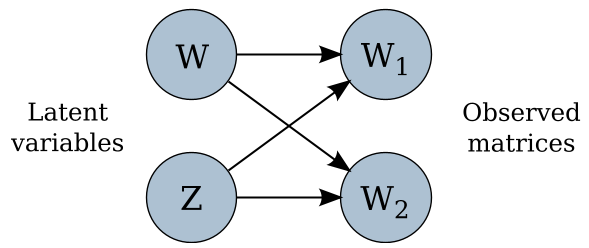 Fig. 3: The proposed model where W represents the latent similarity matrix and Z handles the layer selection.
When the objective functions are non-convex, the authors argue that simple scalarization (weighted averaging) is insufficient. They introduce Pareto Optimality, defining a "Pareto Front" of solutions. This allows analysts to explore the trade-offs between layers—for instance, deciding how much to prioritize "official" email logs over "extracted" behavioral similarity.
Experiments & Results: Uncovering the ENRON Crisis
The authors validated their model using both synthetic simulations and the infamous ENRON email corpus.
1. Robustness to Noise
In simulated environments with varying noise variances (), the multi-layer approach consistently outperformed single-layer clustering, maintaining a higher Adjusted Rand Index (ARI).
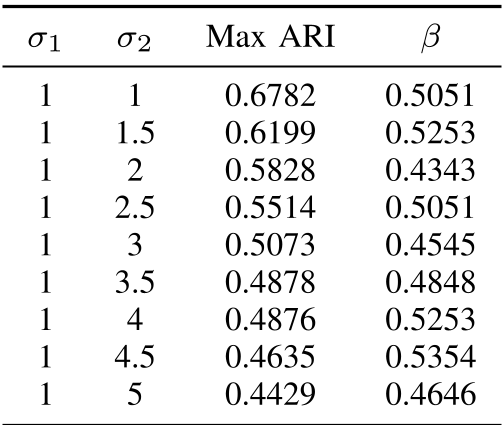 Table I: Optimal mixing parameters ((\beta)) across different noise levels.
2. The ENRON Evolution
By applying a multi-layer Dynamic Stochastic Block Model (DSBM), the study revealed a fascinating insight: during the peak of the corporate scandal (weeks 95–115), the "Betweenness Centrality" of Directors spiked significantly—but only when viewing the combined multi-layer graph.
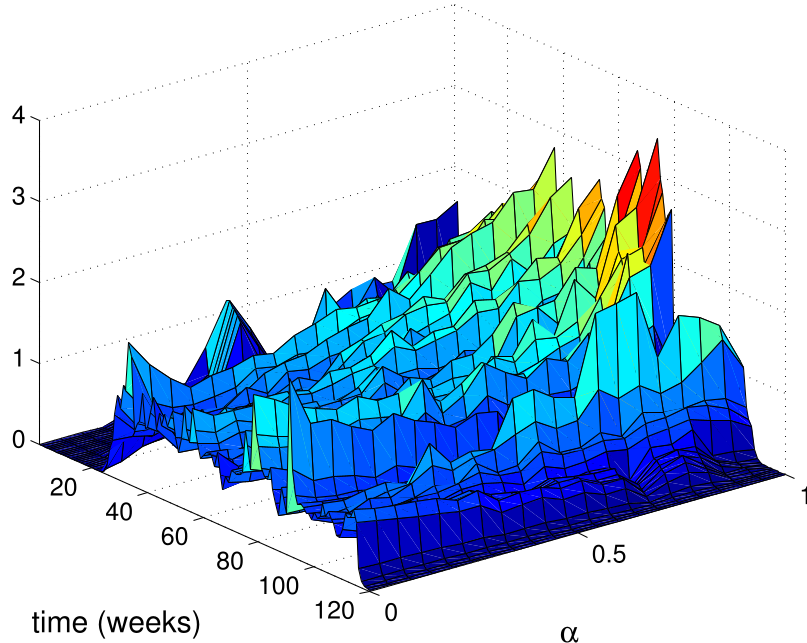 Fig. 5: Betweenness centrality peaks during the company upheaval when alpha ((\alpha)) is balanced between layers.
This proves that the "hub" status of individuals in a crisis isn't just about who they email (relational), but the alignment of what they are talking about (behavioral) relative to others.
Critical Analysis & Conclusion
Takeaway
The integration of Multi-Objective Optimization into graph analytics is a significant step forward. It provides a mathematically rigorous way to handle "conflicting" data sources, allowing the user to tune the "confidence" they place in each layer.
Limitations & Future Work
While powerful, the model assumes a common underlying structure across layers. In cases where layers are fundamentally contradictory (e.g., a person's public professional network vs. a private hobbyist network), this assumption might fail. Future work could benefit from non-convex optimization strategies and applying this framework to even higher-dimensional data like video-audio multi-layer graphs.
Final Thought: In an era of multi-modal AI, this paper provides the foundational logic for how graph-based systems can "listen" to multiple signals at once to find the truth hidden in the noise.