
Multi-Layered Graphs: Mapping the Human Factor in Cyber Vulnerability
Multi-layered graph-based model for social engineering vulnerability assessment
The paper introduces a multi-layered graph-based model designed to assess vulnerabilities to Social Engineering (SE) attacks. By integrating various contexts (Social Networks, email, web) into a unified structure, it enables security professionals to model multi-stage attacks like profile cloning and recommendation system manipulation.
TL;DR
As technical defenses harden, the "human link" becomes the path of least resistance. This paper presents a specialized graph-based model that maps social engineering attacks across multiple digital layers (Twitter, Facebook, Blogs). Unlike standard network security models, it tracks actions that "leave no trace" on corporate servers, identifying the specific cross-platform behaviors that expose an organization to automated identity theft and manipulation.
The "Invisible" Attack Surface
Standard vulnerability models are built for firewalls and servers. They operate on the assumption that if an action doesn't change a system's state variables, it doesn't exist. Social Engineering (SE) thrives in this blind spot.
A social engineer gathers info on LinkedIn, nurtures a relationship on a niche forum, and finally executes a phishing attack via a personal email. To an internal security officer, these steps are invisible. The authors argue that we need a model that accounts for inter-contextual interplay—how a footprint on Twitter can lead to a compromise on Facebook.
Methodology: The Three-Dimensional Graph
The core of the paper is a multi-layered model defined by the set of layers .
- Contexts (): Different platforms like Twitter, Email, or the "Physical" world.
- States (): The progression of the attack (Information gathering Relationship building Execution).
- Scenarios (): Groups of similar attack patterns to allow for model reuse.
Identity and Action Edges
The model uses two clever mechanisms:
- Identity Edges: These connect the same person across different layers (e.g., "User_A" on Twitter to "User_A" on a Banking Forum).
- Logical Operators: By using AND/OR logic on graph edges, the model can represent choices an attacker makes (e.g., "I can get the email from a search engine OR an email directory").
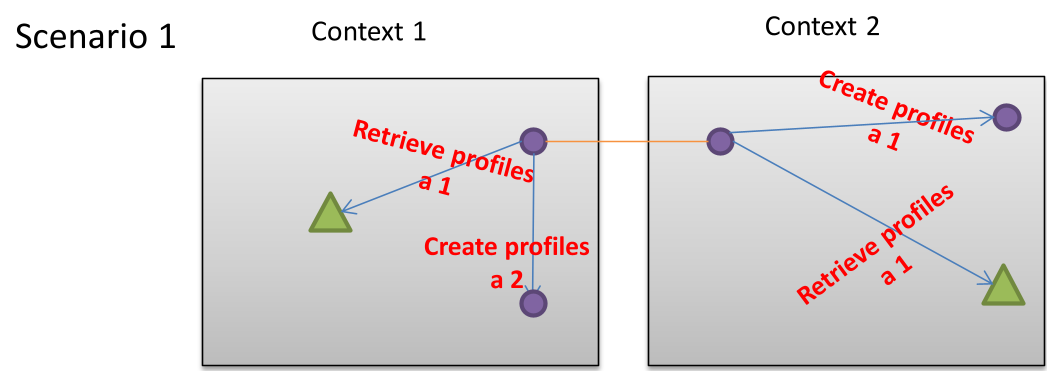 Fig 1: A conceptual view of two layers in the model, showing how an attacker transitions between resources and targets.
Case Study: Automated Profile Cloning
The authors validated the model by tracking Cross-site Profile Cloning. In this scenario:
- Attacker finds a user on Twitter who isn't on Facebook.
- Attacker clones the Twitter identity onto a new Facebook account.
- Attacker "adds" the victim's colleagues who are on both platforms, leveraging instant trust.
By mapping this, the model reveals that the Facebook Search function is a "Critical Node." Limiting the searchability of employees makes the entire multi-step attack significantly harder to execute.
Empirical Results: The 0.5% Rule
In a massive crawl of Twitter and over 1,700 forums (focusing on bank card keywords), the researchers analyzed over 200,000 nodes.
- Finding: 99.5% of users interact on only one layer.
- Insight: The remaining 0.5% are the "super-connectors" who exist across multiple forums and social networks. These individuals suffer from "inter-layer vulnerabilities" and are the prime targets/gateways for attackers to infect the wider network.
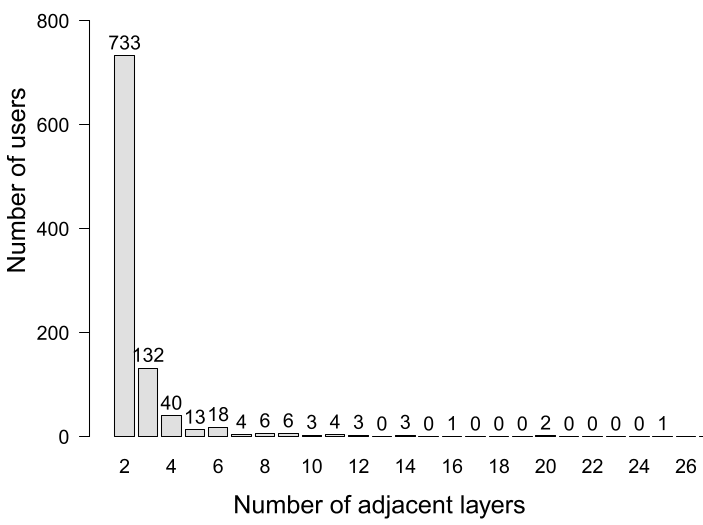 Fig 2: Distribution of nodes per layer—highlighting the tiny fraction of users who create high-risk cross-layer links.
Critical Analysis & Conclusion
Takeaway
The value of this work lies in its Proactive Defense capability. Instead of waiting for a log entry to show a failed password attempt, security officers can use this graph to identify which employees have the most "vulnerable" cross-platform footprints and tailor identity-protection training specifically for them.
Limitations
The primary challenge is Data Acquisition. While social networks like Twitter offer APIs, private forums and encrypted messaging apps are much harder to crawl. Additionally, the "Identity Mapping" (linking a forum alias to a real Twitter handle) remains a probabilistic challenge that requires high-confidence heuristics.
Future Outlook
As we move toward a world of Deepfakes and AI-driven social engineering, these multi-layered models will likely integrate Behavioral Biometrics to distinguish a cloned account from a real user, providing a real-time "trust score" for every digital interaction.