
Multi-Leader Multi-Follower Games: The New Frontier of Socially-Aware Crowdsensing
A Multi-Leader Multi-Follower Game-Based Analysis for Incentive Mechanisms in Socially-Aware Mobile Crowdsensing
This paper proposes a multi-leader multi-follower Stackelberg game to design incentive mechanisms for socially-aware Mobile Crowdsensing (MCS). It addresses the strategic interactions between multiple Crowdsensing Service Providers (CSPs) and multiple socially-connected users, incorporating social network effects and service interconnections (substitutability/complementarity) into a unified game-theoretic framework.
Executive Summary
TL;DR: This paper revolutionizes Mobile Crowdsensing (MCS) by moving beyond "one-to-many" models. It introduces a hierarchical multi-leader multi-follower Stackelberg game that accounts for two crucial real-world variables: multiple competing service providers and the social influence users exert on each other.
Positioning: This work is a significant "Systematization of Knowledge" and theoretical advancement. It provides the first rigorous mathematical proof for equilibrium uniqueness in a multi-platform MCS market where social network effects and service interconnections (substitutability/complementarity) are jointly modeled.
Problem & Motivation: Beyond the Isolated Platform
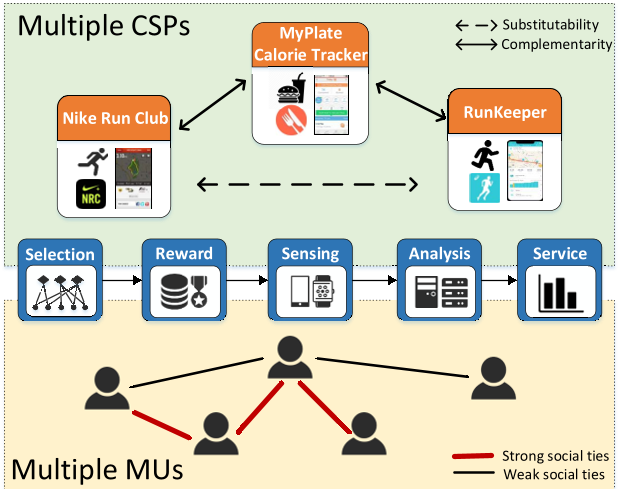
Traditional MCS research treats the platform (CSP) as a monopolist. However, in reality, a user might choose between several fitness apps (substitutable) or use a nutrition tracker alongside a running app (complementary).
Furthermore, humans are social animals. If your friends are sharing their workout achievements, you are more likely to participate—this is the "Social Network Effect". Existing models fail to explain how multiple CSPs should adjust their rewards when they are competing for the same user base that is internally driven by social ties.
Methodology: The Hierarchical Strategy
The authors propose a two-stage game-theoretic framework:
- Stage I (Leaders): Multiple CSPs determine the optimal reward vector to maximize their individual profits, considering both user feedback and the strategies of rival CSPs.
- Stage II (Followers): Users decide their participation levels (e.g., frequency of data updates) across all available CSPs to maximize their socially-aware utility.
Modeling the "Socially-Aware" Utility
The utility function of a user is not just about rewards minus costs. It includes:
- Internal benefits: Personal gains from using the service.
- External benefits: The "fun" of peer interaction, modeled using an adjacency matrix representing social ties.
- Service Interconnections: A parameter that defines if services are rivals (substitutable) or partners (complementary).
The Mathematical Core: Variational Inequalities
When multiple followers interact, finding a Nash Equilibrium (NE) is notoriously difficult. The authors utilize Variational Inequalities (VI) theory to prove that under certain convexity and diagonal dominance conditions (Assumption 1), a unique NE for users exists. They then use matrix manipulation (Kronecker and Hadamard products) to derive the closed-form solution for CSP rewards.
Experiments & Results: The Power of Cooperation
The authors validated their model using the Brightkite social network dataset and extensive simulations.
Key Finding 1: Social Ties as "Free" Incentives
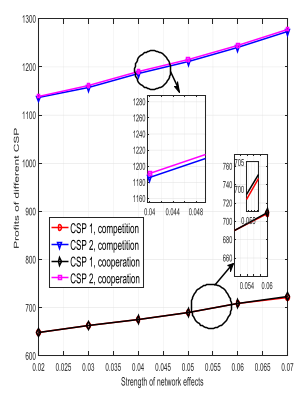
Stronger network effects act as an external motivator. When users influence each other, CSPs can actually reduce physical rewards while still maintaining high participation levels, effectively "outsourcing" the incentive cost to the social network itself.
Key Finding 2: Competition vs. Cooperation
The paper reveals a fascinating dynamic regarding service types:
- Substitutable Services: CSPs engage in a "reward war," driving up costs. Cooperation here helps CSPs lower rewards to save costs.
- Complementary Services: CSPs sometimes offer lower rewards in competition, hoping a partner CSP’s rewards will drive participation that spills over to them (the "free-rider" effect). Cooperation here actually increases rewards to maximize the synergistic participation of users.
Critical Analysis & Conclusion
Takeaway: This work provides a masterclass in applying advanced matrix theory and Variational Inequalities to complex economic behaviors in IoT. The introduction of CXEP (Crowdsensing Cross Elasticity of Participation) is a brilliant adaptation of traditional economics to the tech stack.
Limitations:
- The model assumes rationality; however, social behavior is often boundedly rational or emotional.
- The unit costs of sensing are assumed to be known or observable, which might not hold in privacy-sensitive environments.
Future Outlook: The next logical step is integrating Deep Reinforcement Learning to allow CSPs to "learn" these equilibrium strategies in real-time, especially when social ties are dynamic rather than static.
Senior Editor's Note: This paper is essential reading for anyone designing multi-agent incentive systems where the "human in the loop" is connected to a social graph.