
Game Theory Meets Social Networks: Optimizing Incentives in Multi-Provider Crowdsensing
Multi-Leader Multi-Follower Game-based Incentive Scheme for Socially-Aware Mobile Crowdsensing
This paper proposes a Multi-Leader Multi-Follower Stackelberg Game framework for socially-aware Mobile Crowdsensing (MCS). It utilizes a two-stage game to model competition and cooperation among multiple Crowdsensing Service Providers (CSPs) and the strategic participation of Mobile Users (MUs) influenced by social network effects.
TL;DR
This research tackles the complex economics of Socially-Aware Mobile Crowdsensing (MCS). By modeling the interaction between multiple service providers and socially-connected users as a Multi-Leader Multi-Follower Stackelberg Game, the authors reveal how social "network effects" and provider cooperation can be mathematically optimized to maximize both platform profits and user utility.
Motivation: Beyond the Single-Provider Silo
Most existing Mobile Crowdsensing (MCS) models assume a monolithic world: one server, many independent users. However, reality is messier. We use multiple health apps (substitutable) or a mix of fitness trackers and diet logs (complementary). Furthermore, we are social animals; if our friends use an app, we are more likely to contribute data.
The authors identify two critical gaps in prior SOTA:
- Lack of Multi-CSP Dynamics: Real markets involve competition and service interconnections (substitutability/complementarity).
- Ignored Social Coupling: User behavior is not independent; it is coupled through social ties, creating a "network effect" where participation is contagious.
Methodology: The Hierarchical Game Architecture
The paper employs a two-stage Stackelberg Game framework to model this ecosystem.
1. The MU Utility (Followers)
The users' utility function is meticulously constructed to include:
- Internal Benefits: Modeled via a linear-quadratic function to reflect diminishing marginal returns.
- Social Network Effects: Represented by a reciprocal adjacency matrix , capturing how friend participation boosts one's own utility.
- Service Interconnections: A parameter that defines whether adding another service helps (complementary) or hurts (substitutable) the current utility.
2. The CSP Profit (Leaders)
CSPs aim to maximize the difference between the revenue derived from aggregated data and the total rewards paid out to MUs.
3. Solving the Equilibrium
To handle the high-dimensional strategy space, the authors use Variational Inequalities (VI). They prove the uniqueness of the Nash Equilibrium among MUs by demonstrating that the Jacobian of the utility function is strictly diagonally dominant—ensuring that users won't infinitely increase participation levels.
 The generalized utility modeling for Mobile Users, incorporating social influence and rewards.
Experimental Insights
The simulations validate the theoretical proofs with several "Aha!" moments for MCS architects:
- Social Ties are Cost-Savers: When network effects are strong, CSPs can actually lower rewards because the social benefit of participating with friends compensates for the user's effort cost.
- The Power of Cooperation: CSPs achieve significantly higher aggregate profits under a "Cooperative/Collusive" strategy compared to a "Competitive" one, especially when services are strongly complementary.
- Crowd Growth Dynamics: As more MUs join, individual participation levels actually rise due to the feedback loop of social influence.
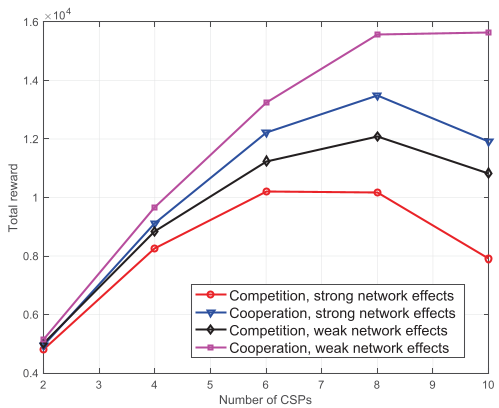 Figure 1: Performance metrics showing how participation and profits scale with the number of MUs.
Critical Insight & Future Outlook
This work provides a rigorous mathematical foundation for Socially-Aware Incentive Design. By shifting from "User-as-an-Island" to "User-in-a-Network," it provides a blueprint for platforms like RunKeeper or HealthKit to design rewards that propagate through social graphs.
Limitations: The model assumes users are perfectly rational and that social ties are static. In dynamic real-world social networks, these ties evolve, and users often exhibit bounded rationality. Future research could integrate Evolutionary Game Theory to model the temporal shifts in user influence.
Conclusion: For the MCS industry, the takeaway is clear: don't just pay for data—incentivize the connection.