
CSAW: Building the "ImageNet" of Mammography with Millions of Images
A Multi-million Mammography Image Dataset and Population-Based Screening Cohort for the Training and Evaluation of Deep Neural Networks—the Cohort of Screen-Aged Women (CSAW)
The paper introduces the Cohort of Screen-Aged Women (CSAW), a massive population-based mammography dataset comprising over 2 million images from 499,807 women. It provides a high-quality platform for training and evaluating Deep Neural Networks (DNNs) in breast cancer risk prediction, tumor detection, and screening sensitivity assessment.
TL;DR
The Cohort of Screen-Aged Women (CSAW) represents a monumental leap in medical imaging data. By consolidating over 2 million mammography images from nearly half a million Swedish women, this project provides the massive scale, clinical depth, and pixel-level precision necessary to train the next generation of AI-driven breast cancer screening tools.
The Data Bottleneck in Breast Radiology
While Deep Neural Networks (DNNs) have revolutionized computer vision, their application in mammography has been hindered by a "small data" problem. Early datasets like DDSM or mini-MIAS were vital for pioneering work, but they often contained fewer than 3,000 cases—hardly enough for a modern transformer or deep CNN to generalize across diverse clinical scenarios.
Furthermore, these datasets often lacked "negative priors" (previous normal scans), making it impossible to train models to detect the subtle, early-stage changes that radiologists look for to prevent interval cancers.
The CSAW Methodology: Population-Scale Curation
The authors utilized Sweden's integrated healthcare system to bridge this gap. The CSAW cohort is not just a collection of images; it is a longitudinal medical history.
1. Population Integrity
Unlike datasets that only collect "interesting" cases, CSAW includes every woman aged 40-74 invited for screening in the Stockholm region between 2008 and 2015. This ensures the data reflects the true prevalence and variety of the real world.
2. Deep Annotation & Linkage
- Biopsy Verification: 99% of diagnoses are confirmed via biopsy, ensuring the "ground truth" is biologically accurate.
- Pixel-Level ROI: Radiologists manually annotated tumors not only at the time of diagnosis but also went back to "negative" prior mammograms to mark retrospectively visible tumor signs.
- Metadata Richness: Includes everything from compression thickness to specific molecular subtypes (Luminal A, Basal, etc.).
 Figure 1: The scale of data collection across regional centers in Stockholm.
Key Results & Experimental Potential
The cohort's statistics are staggering compared to previous benchmarks:
- Total Women: 499,807
- Incident Cancers: 8,463
- Total Images: ~2,000,000+ currently transferred.
One of the most valuable subsets defined in the paper is the Case-Control Subset. It contains 10,000 healthy controls and all cancer cases from one major hospital, designed specifically for efficient external evaluation of third-party AI models.
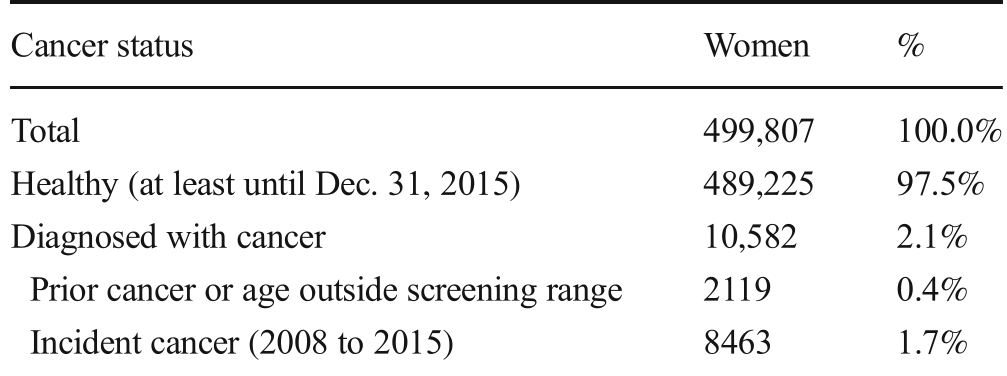 Table 1: Breakdown of the incident cancer cases within the CSAW cohort.
Deep Insights: Beyond Simple Classification
The authors outline four major "frontiers" that CSAW enables:
- Risk Prediction: Training on images of women who are currently healthy but will develop cancer in 2 years to identify high-risk phenotypes.
- Sensitivity Assessment: Understanding why some cancers are "interval cancers" (missed by screening) by analyzing the prior negative scans.
- Autonomous Triage: Using AI as a "standalone reader" to mitigate the global shortage of breast radiologists.
- Interactive Education: Using the 1,891 annotated images to train junior radiologists on difficult-to-spot cases.
Critical Analysis & Conclusion
The main limitation noted is the current reliance on images from a single hardware vendor (Hologic) in the case-control subset. However, the authors are expanding to include other vendors, which will improve the domain generalization of models trained on this data.
Takeaway: CSAW isn't just a dataset; it's an infrastructure for the future of elective health. By providing the "gold standard" of population-level data, it allows AI researchers to move from simple tumor detection to predicting the future risk of cancer—potentially saving lives through personalized screening intervals.