
Hybrid Intelligence: Enhancing Healthcare Rehab with Multi-Modal Posture Recognition
Multi-Modal Posture Recognition System for Healthcare Applications
The paper proposes a Multi-Modal Posture Recognition System designed for healthcare and rehabilitation, utilizing a hybrid sensing approach. It combines 3D depth mapping from a Microsoft Kinect with on-body Inertial Measurement Units (IMUs) to achieve high-precision full-body motion capture and posture classification.
TL;DR
This research presents a robust system for posture analysis aimed at physical therapy and yoga. By fusing 3D Depth Mapping (Kinect) with Inertial Measurement Units (IMUs), the authors developed a multi-modal recognition system that achieves a 97% accuracy rate in identifying complex body positions, providing a digital "expert trainer" for home-based rehabilitation.
Problem & Motivation: The Risk of Incorrect Practice
Physical rehabilitation is a precise science where the "how" is just as important as the "what." In exercises like Yoga or post-injury physiotherapy, performing a movement with the wrong alignment can be more detrimental than not doing it at all.
Current technological solutions usually fall into two camps:
- Vision-based systems: Prone to occlusion (e.g., an arm hiding behind the body) and lighting issues.
- Wearable-only systems: Excellent at measuring joint rotation but poor at understanding the body's global position relative to the ground.
The authors' insight was to combine these two worlds. By using a 3D depth sensor to "see" the upper body and IMUs to "feel" the precise rotation of the legs, they created a system that is both spatially aware and rotationally precise.
Methodology: The Fusion of Sight and Motion
The system architecture is divided into two distinct data pipelines that converge for final classification.
1. Spatial Geometry and Depth Calculation
Using IR sensors and cameras, the system calculates the depth () of body parts relative to the sensor using the principle of similar triangles and disparity: This allows the creation of a skeletal rig in a 3D environment (Blender), providing the user with a real-time virtual twin.
2. Rotational Precision via IMUs
For the lower limbs, the system utilizes four BNO055 sensors. These 9-DOF units output quaternions, which are converted into Euler angles (Bank, Altitude, Heading) to describe the exact orientation of the thighs and shins.
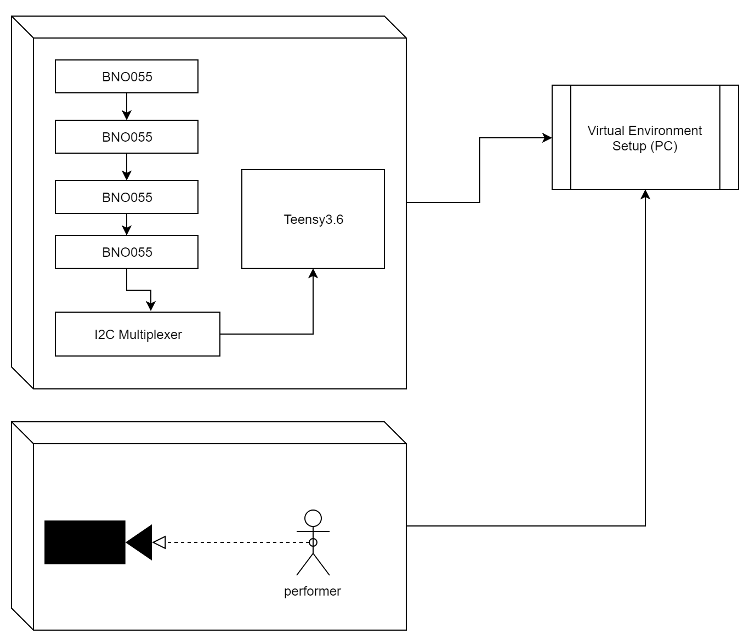 Fig 1: Multi-modal fusion architecture - Tracking upper body via Kinect and lower body via IMU sensors.
3. Classification Pipelines
The authors compared two approaches:
- Exhaustive Approach: A brute-force Manhattan distance comparison between the user's current point cloud and a dataset of known "perfect" postures.
- Machine Learning (CNN) Approach: A 4-layer Convolutional Neural Network extracts features from the 3D point cloud, which are then concatenated with the IMU rotational vectors before being passed through a Softmax layer for posture classification.
Experiments & Results: Precision in Practice
The system was tested using four distinct postures (as shown below) performed by multiple trainers and a student.
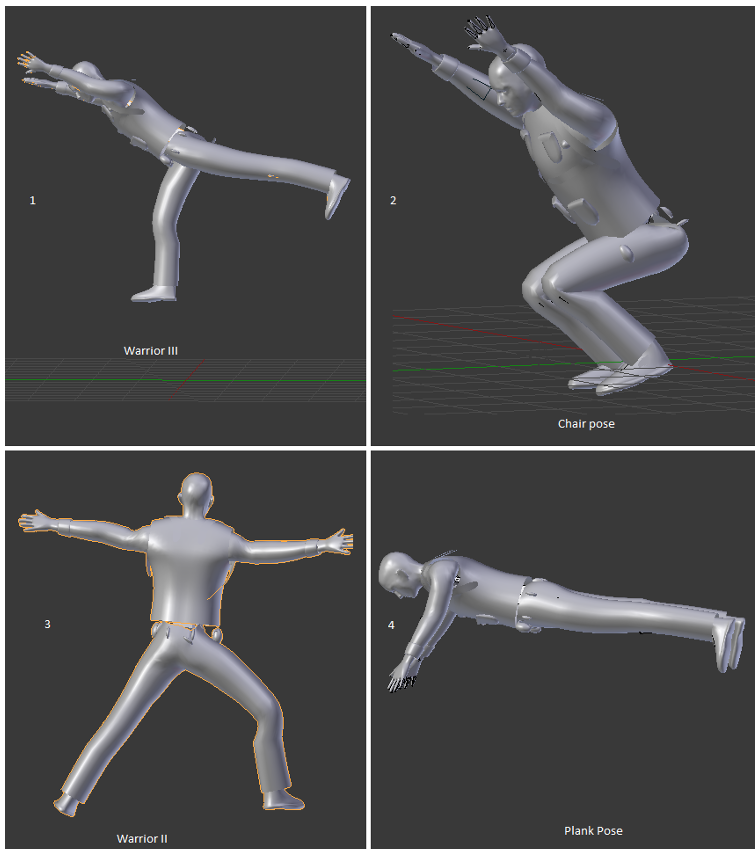 Fig 2: The four core postures used during the training and validation phases.
The results were impressive:
- Accuracy: The CNN model correctly identified 194 out of 200 cases.
- Real-time Performance: The internal oscillator and UART connections allowed for data rates up to 500Hz, ensuring that the virtual avatar moved fluidly with the human user at 30 FPS.
Deep Insight & Conclusion
The true value of this work lies in its minimal invasiveness. By only requiring wearable sensors on the legs (where vision systems often struggle with occlusion from the torso or floor), it provides a full-body picture without encumbering the user in a full motion-capture suit.
Limitations
While highly accurate, the current system relies on a central hub (Teensy 3.6). Future iterations could benefit from wireless IMU modules (e.g., BLE-enabled) to allow for greater freedom of movement. Additionally, expanding the dataset from four postures to a full library of rehabilitative exercises would be necessary for commercial healthcare applications.
Final Takeaway
This paper serves as a blueprint for hybrid motion capture, proving that multi-modal sensing is the key to moving posture recognition from the "gimmicky" level of gaming into the "clinical" level of medical rehabilitation.