
EES: Revolutionizing Multi-Modality Sentiment Learning via Explicit Emotion Signals
Multi-modality weakly labeled sentiment learning based on Explicit Emotion Signal for Chinese microblog
This paper introduces an Explicit Emotion Signal (EES) based multi-modality sentiment learning framework for Chinese microblogs. By utilizing emoticons as weakly labeled signals in a two-stage deep learning architecture, the method achieves SOTA performance (60.1% accuracy) while significantly reducing the reliance on expensive human-labeled data.
TL;DR
Researchers from Xiamen University have developed a unified framework that solves the "data hunger" of multi-modal sentiment analysis. By using emoticons as "Explicit Emotion Signals" (EES), they've created a system that outperforms traditional SOTA models while using up to 97% less human-labeled image data.
Context: The Semantic Gap in Social Media
Sentiment analysis on platforms like Sina Weibo is notoriously difficult. Unlike structured reviews, microblogs are a messy mix of low-level pixels (images) and informal sequences (text). Prior works often relied on:
- Sentiment Lexicons: Limited by the evolution of slang.
- Visual Sentiment Ontology (VSO): Relies on complex Adjective-Noun Pairs (ANPs) like "beautiful flowers," which are harder to detect than simple icons.
- Supervised Deep Learning: Requires thousands of manually labeled images/texts for every new domain.
The "Insight": Emoticons as the Perfect Bridge
The authors realized that users essentially "label" their own posts through emoticons. Statistically, emoticons show less ambiguity than emotion words and appear in a massive number of posts. By treating these as a middle-level feature layer, they bridge the gap between raw data and high-level sentiment.
Methodology: The Two-Stage Framework
The framework is split into two distinct learning stages, allowing it to digest both massive unlabelled data and precise human labels.
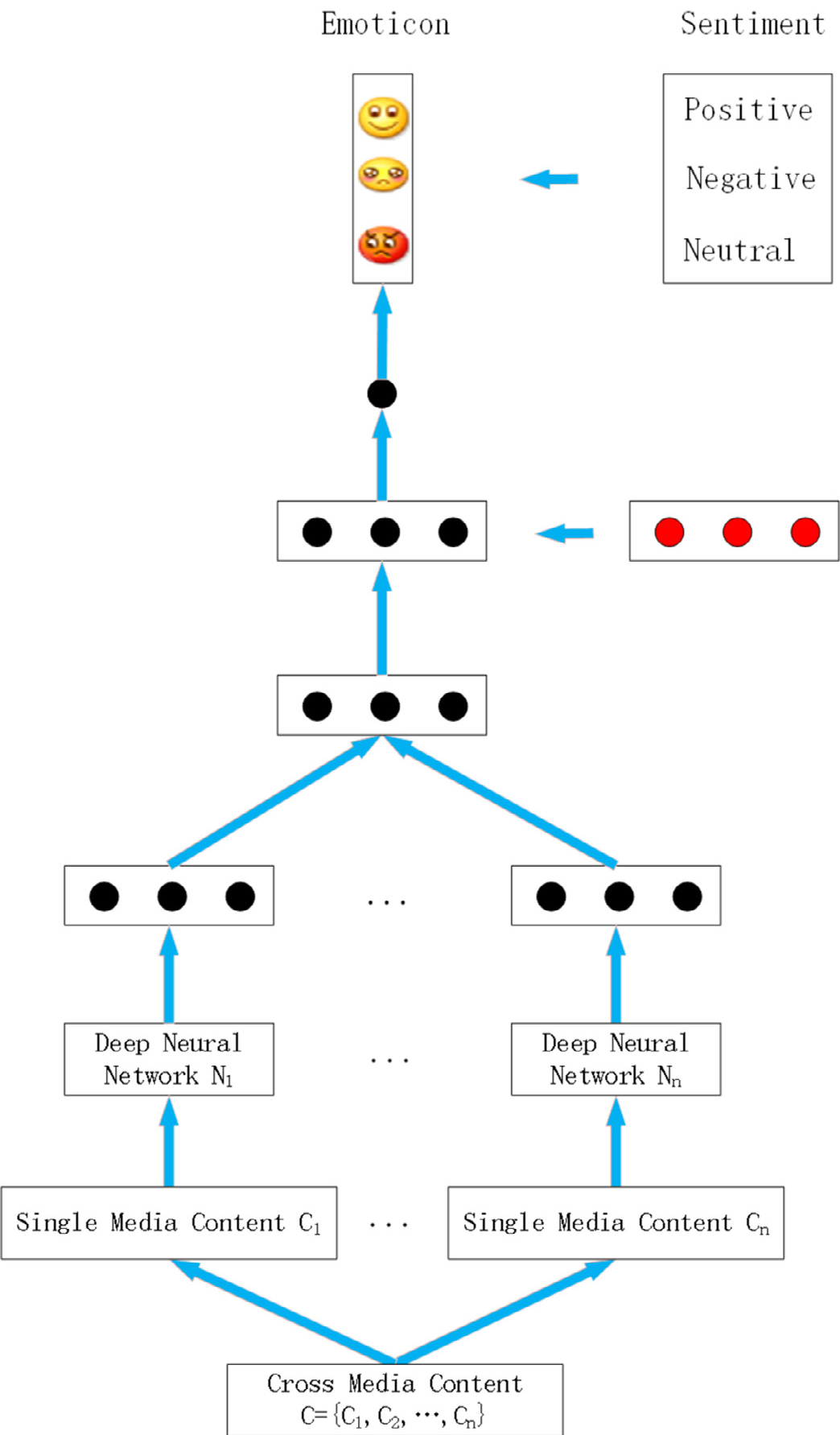
1. Unified Architecture
The model employs a CNN (VGG-style) for image processing and a 1D-CNN + LSTM hybrid for text processing. This allows the model to capture both local 3-gram patterns and global context in microblog posts.
2. The Learning Process
- Stage 1 (Weakly Labeled): The model is trained on ~1.14 million posts where the target is the emoticon itself. This forces the deep layers to learn "what a happy image looks like" or "how a sad sentence is structured" without a single human label.
- Stage 2 (Fine-Tuning): The output layer is replaced, and a small set of human-labeled samples (4,500) is used to map the learned EES features to the final sentiment classes (Positive, Negative, Neutral).
Experimental Breakthroughs
The results prove that "more data" (even if weakly labeled) is often better than "perfect data."
SOTA Comparison
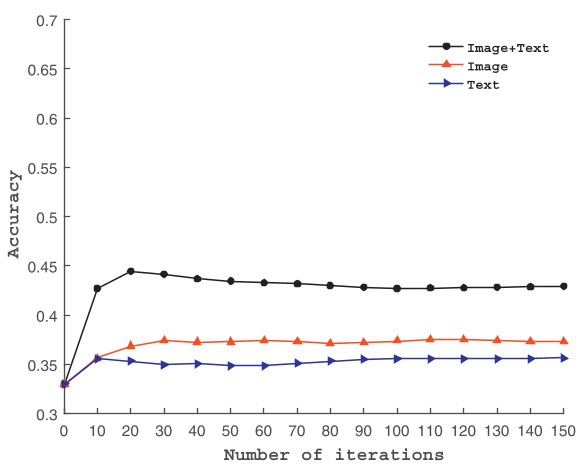
In image sentiment prediction, the EES method achieved 50.9% accuracy, significantly higher than the standard VGG fine-tuned on labeled data (43.4%). When combining both modalities (Image + Text), accuracy jumped to 60.1%.

Efficiency and Robustness
Perhaps the most striking result is the Small Training Samples Experiment. The EES model reached the performance levels of a standard VGG model using only 3% of the training data. It also solved the common "overfitting" problem in small datasets because the internal representations were already robustly formed during the weak-labeling stage.
Deep Insight: Domain Transfer
The authors tested the model across three domains: Landscape, Person, and Object. Standard models usually fail when trained on one (e.g., people) and tested on another (e.g., scenery). Because EES anchors the sentiment to a middle-level psychological signal (the emoticon) rather than specific objects, it demonstrates high generalization ability across different visual contexts.
Critical Analysis & Conclusion
While the 2017 date of this research means it uses VGG/LSTM rather than Transformers (ViT/BERT), the core philosophy remains highly relevant: utilizing user-generated behavioral signals (metadata, emojis, reactions) to pre-train emotional representations is far more scalable than manual labeling.
Takeaway: If you want to understand "mood," don't just look at the pixels; look at the signals the user explicitly left behind.
Limitations: The framework currently treats emoticons as binary labels. Future work could benefit from modeling the intensity of these signals or expanding to video-based EES.