
Multi-Objective ACO: Optimizing Dual-Task Allocation in Vehicle Crowdsourcing
Multi-objective ant colony optimization for task allocation in vehicle-based crowdsourcing
This paper introduces VC-ACO, a Multi-Objective Ant Colony Optimization algorithm designed for vehicle-based crowdsourcing task allocation. It simultaneously optimizes two conflicting objectives: task query reliability and sensing coverage, significantly outperforming the state-of-the-art NSGA-II baseline on the real-world T-drive dataset.
TL;DR
With the rise of "Smart Cities," vehicles have become powerful mobile sensor hubs. This paper presents a Multi-Objective Ant Colony Optimization (VC-ACO) approach to solve the complex puzzle of vehicle task allocation. By balancing active query reliability with passive sensing coverage under a fixed budget, the proposed method outperforms traditional genetic algorithms (NSGA-II) in real-world scenarios.
Problem & Motivation: The Dual-Task Bottleneck
Modern spatial crowdsourcing is no longer just about a person with a smartphone. Vehicles offer a unique dual-capability:
- Active Query Tasks: Drivers/passengers provide specific answers (e.g., "Is there a parking spot here?").
- Passive Sensing: On-board sensors collect environmental data (e.g., "What is the air quality on this street?").
Prior works often treated these separately or struggled with the budget-reliability-coverage trade-off. If you pay for too many workers to ensure reliability, your coverage suffers due to budget limits. Conversely, spreading workers too thin decreases the probability that any single task is actually completed.
Methodology: The Ant Colony's Intelligence
The authors leverage Ant Colony Optimization (ACO), a meta-heuristic inspired by how ants find the shortest path to food using pheromones.
The Formal Model
The paper defines a specific objective function for Query Reliability (), which uses a product-based failure probability, and Sensing Coverage (), which measures the unique grid area covered by successful tasks.
Key Heuristic Design
The core "intelligence" of the VC-ACO lies in its movement probability rule. The heuristic information () is defined as: This encourages "ants" (tasks being allocated) to favor workers () who provide high reliability () and coverage () at a lower reward cost ().

Note: The algorithm iteratively updates pheromones based on Pareto-optimal solutions found in previous generations, ensuring the search converges toward the most efficient task-worker mappings.
Experiments: Real-World Validation
The researchers tested VC-ACO against the improved NSGA-II using the T-drive dataset, which contains GPS trajectories from over 10,000 taxis in Beijing.
Performance Metrics
- Query Reliability: VC-ACO maintained a significantly higher mean success rate across varying numbers of tasks.
- Sensing Coverage: The algorithm discovered worker sets that covered more unique geographical grids without exceeding the budget.
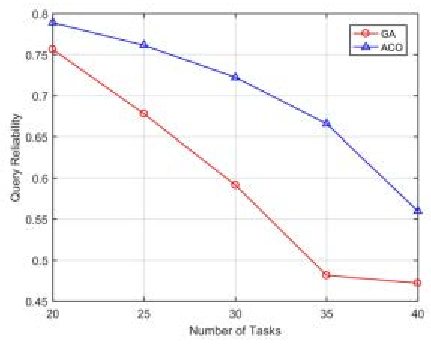 (a) Query Reliability vs. Number of Tasks; (b) Sensing Coverage vs. Number of Tasks. VC-ACO (red) consistently maintains a lead over NSGA-II (blue).
Critical Analysis & Conclusion
VC-ACO proves that traditional bio-inspired algorithms remain highly relevant when tailored to specific industrial constraints. By incorporating a penalty mechanism for incomplete tasks directly into the reliability function, the authors ensure the algorithm doesn't just chase theoretical reliability but focuses on practical task completion.
Limitations: The current model assumes static task locations and worker availability. In a real-world deployment, vehicle trajectories are dynamic and unpredictable.
Future Outlook: The next frontier for this research is dynamic task allocation, where the system must re-route or re-assign tasks in real-time as vehicles move through a city. This work provides a solid mathematical foundation for the multi-objective nature of that challenge.