
HSC-TA: Balancing Quality and Cost in the Era of Heterogeneous Spatial Crowdsourcing
Multi-Objective Optimization Based Allocation of Heterogeneous Spatial Crowdsourcing Tasks
This paper introduces a framework for Heterogeneous Spatial Crowdsourcing Task Allocation (HSC-TA) that balances task coverage and incentive costs. It proposes a mobility behavior prediction model and two optimization algorithms, MRLWO and EMOPSO, to generate a set of Pareto-optimal solutions for complex, multi-constrained location-based tasks.
TL;DR
Spatial Crowdsourcing (SC) is evolving from simple "photo-taking" tasks to complex, heterogeneous operations with strict temporal and spatial constraints. This paper tackles the HSC-TA (Heterogeneous Spatial Crowdsourcing Task Allocation) problem. By leveraging worker mobility prediction and an enhanced multi-objective evolutionary algorithm (EMOPSO), the researchers provide a buffet of Pareto-optimal solutions, allowing task requestors to choose the perfect balance between high task coverage and low incentive costs.
The Problem: The "One-Size-Fits-All" Fallacy
In traditional SC, researchers often treat task allocation as a single-objective problem: "Maximize coverage within budget " or "Minimize cost to reach coverage ."
The authors argue this is flawed for two reasons:
- Complexity: Real tasks have "Processing Time" (pt), "Valid Duration" (vt), and "Required Worker Counts" (dm). They are not trivial.
- Information Asymmetry: Requesters don't know the "market price" or worker availability beforehand. Setting a hard budget constraint might lead them to miss a solution that offers 40% more quality for only 1% more cost.
Methodology: Predicting Moves and Optimizing Sets
1. Mobility Prediction as the Foundation
To minimize "disturbance" to workers, tasks should align with their daily routines. The authors use a three-order tensor (Days × Time × Location) and a First-order Markov Model to predict not just where a worker will be, but how long they will stay (Dwell Time).
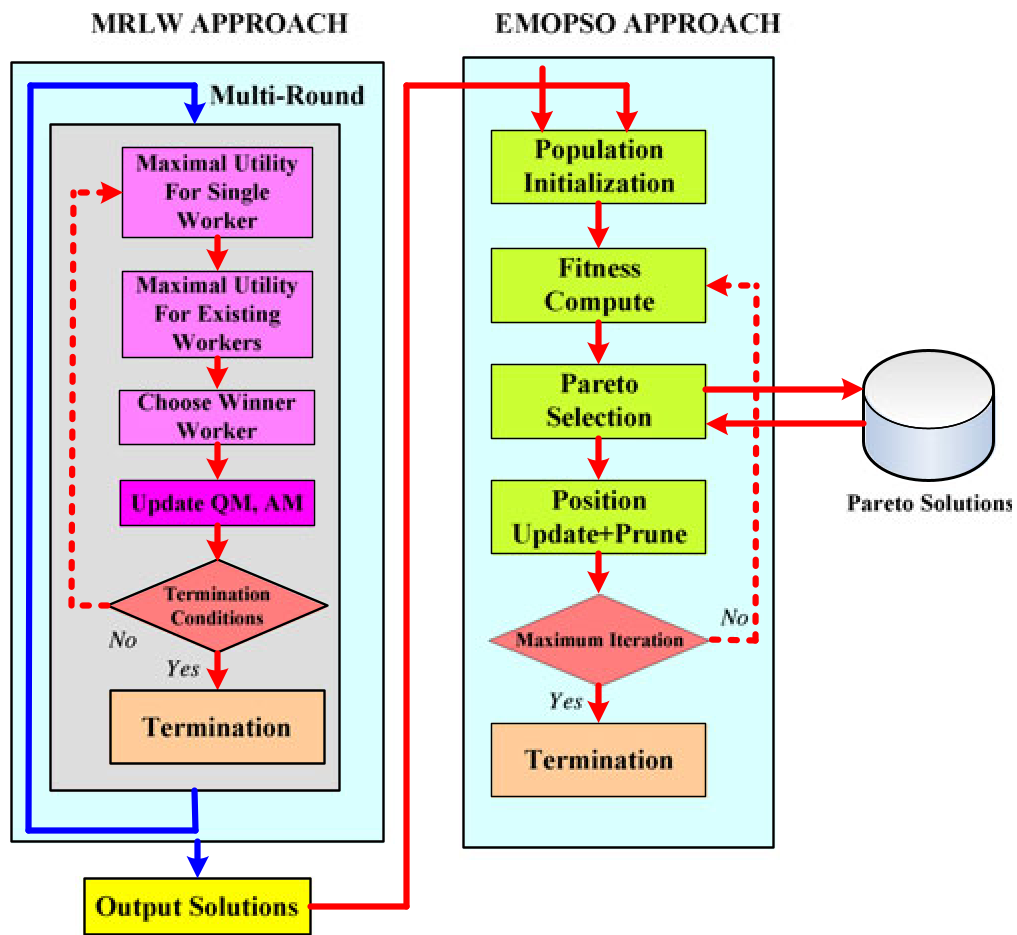 Fig 1: The dual-algorithm workflow combining MRLWO for initialization and EMOPSO for solution discovery.
2. The Incentive Model: "Bulk Buying" for Tasks
Based on a real-world survey of 57 students, the authors discovered a "scale effect": workers are willing to accept a lower per-task reward if multiple tasks are bundled along their existing route. This insight is baked into their cost function.
3. EMOPSO: Search Space Mastery
Since the problem is NP-hard, the authors propose EMOPSO. Standard Particle Swarm Optimization often fails in massive search spaces. The "Enhanced" part comes from specialized initialization: they use the results of a greedy algorithm (MRLWO) to place the "particles" near the likely Pareto frontier, significantly accelerating convergence.
Experimental Insights
Testing on the UCSD Wireless Topology Discovery dataset, the framework proved its mettle:
- Prediction Accuracy: Their WMPre model outperformed existing transition-graph baselines by roughly 2x.
- The Pareto Advantage: As shown in the benchmarking, single-objective algorithms (like CoverFirst or CostFirst) only find the "extreme" corners. EMOPSO fills the gap, providing a continuous curve of options.
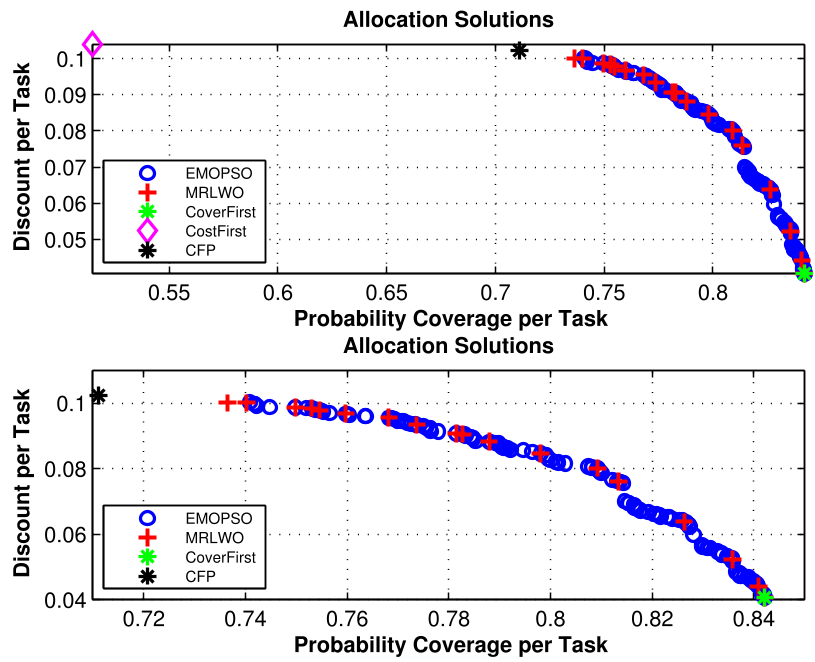 Fig 2: Comparison of achieved Pareto solutions. EMOPSO (blue circles) provides a far denser and more optimized frontier than the greedy MRLWO (red crosses).
Critical Analysis: Why This Matters
The core value of this work lies in its Decision Support philosophy. In a dynamic world, an algorithm that says "here is the only way" is fragile. By presenting a Pareto set, the system empowers the human-in-the-loop to make value judgments.
Limitations:
- The model assumes workers are "volunteers" with fixed routines. In a purely gig-economy setting (like Uber/DoorDash), workers might deviate from routines for higher pay, adding a layer of strategic behavior not modeled here.
- The off-line nature of the allocation is efficient but might struggle with real-time "pop-up" tasks.
Conclusion
This paper elevates Spatial Crowdsourcing from simple matching to a sophisticated multi-objective optimization problem. By combining mobility intuition with robust evolutionary computing, it provides a blueprint for future "Gig Economy" platforms that are both cost-effective for companies and less intrusive for workers.