
Beyond reaching everyone: Balancing Speed and Scale in Social Influence
Finding influential users for different time bounds in social networks using multi-objective optimization
The paper introduces a multi-objective approach for the Influence Maximization (IM) problem, specifically aiming to optimize both influence spread and diffusion time. By employing the NSGA-II evolutionary algorithm alongside the Latency-Aware Independent Cascade (LAIC) model, the authors identify a Pareto front of seed sets that balance these conflicting objectives across various time bounds.
TL;DR
Most viral marketing research asks: "How can we reach the most people?" This paper asks a better question: "How can we reach the most people in time?" By treating Influence Maximization as a multi-objective optimization problem using NSGA-II, the authors provide a way to find optimal seed sets for any given deadline, outperforming traditional greedy approaches.
The Need for Speed in Viral Marketing
Imagine advertising a winter coat collection. Maximizing total influence over "infinite time" is useless if the influence peaks in mid-summer. Existing approaches to Time-Constrained Influence Maximization are often "one-shot"—you pick a deadline, and the algorithm gives you one set. If your deadline changes, you start over.
The authors argue that Influence Spread and Diffusion Time are fundamentally conflicting objectives. Reaching a massive audience usually takes longer, while rapid spread often hits a smaller ceiling. Finding the "sweet spot" requires seeing the whole Pareto front.
Methodology: Evolutionary Trade-offs
The researchers leverage the NSGA-II (Non-dominated Sorting Genetic Algorithm II) to solve this. Instead of returning one set of influential users, the algorithm evolves a population of "chromosomes" (potential seed sets) to find those that are "non-dominated"—meaning you can't increase their influence without also increasing the time it takes.
The LAIC Model
The work builds on the Latency Aware Independent Cascade (LAIC) model. Unlike the standard IC model where nodes activate neighbors in discrete steps, LAIC assigns a random delay (often a Poisson distribution) to each activation, making the timing of influence continuous and realistic.
Overcoming the Computational Wall
The biggest hurdle in evolutionary IM is the fitness evaluation. Calculating exact influence for 1,000+ chromosomes over 3,000 iterations using Monte Carlo simulations is computationally impossible for large graphs. The authors solve this with two brilliant shortcuts:
- Influence Estimation: Using the Expected Diffusion Value (EDV) formula to bypass simulations.
- Time Estimation: An analytical derivation of the minimum expected delay among multiple neighbors, allowing the algorithm to "calculate" rather than "simulate" how fast a seed set spreads.
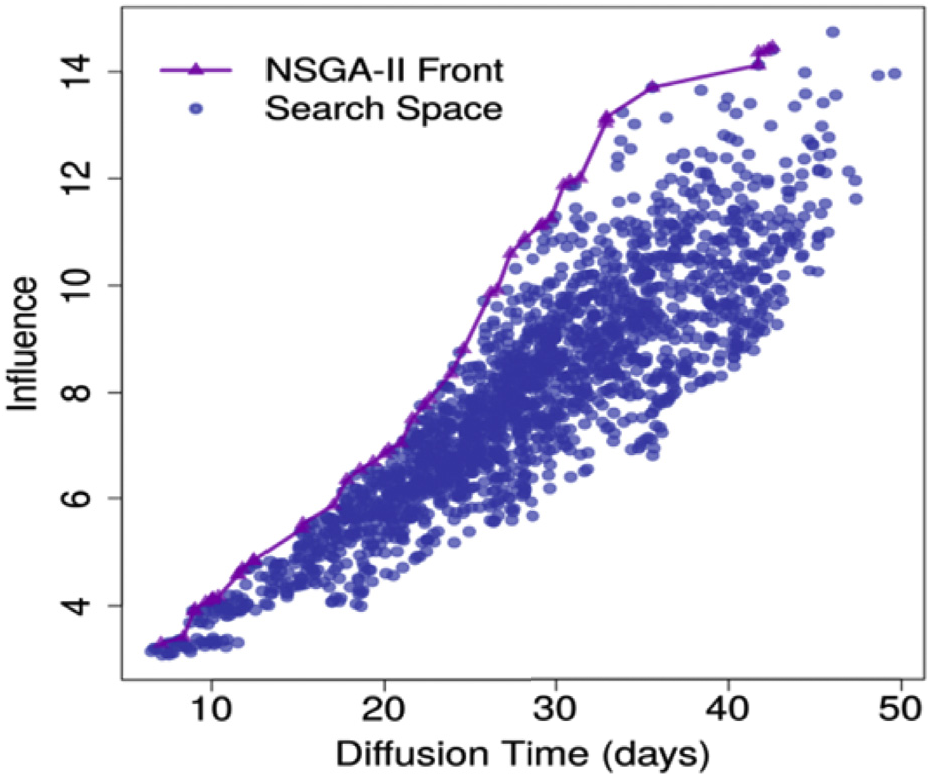 Caption: The resulting Pareto front for the Dolphin social network, showing the trade-off between influence spread (vertical) and diffusion time (horizontal).
Experimental Battleground
The algorithm was tested against the state-of-the-art Influence Spreading Path (ISP) method on massive datasets like NetHEPT (15k nodes) and Epinions (75k nodes).
The results (as seen in the figures below) show that the multi-objective approach consistently stays above the baseline. Crucially, the SOS (Selecting Optimal Set) algorithm allows the system to rethink the Pareto front: if an "older" seed set (with higher total influence) actually performs better than a "faster" set even within a short time window, the SOS algorithm corrects the selection.
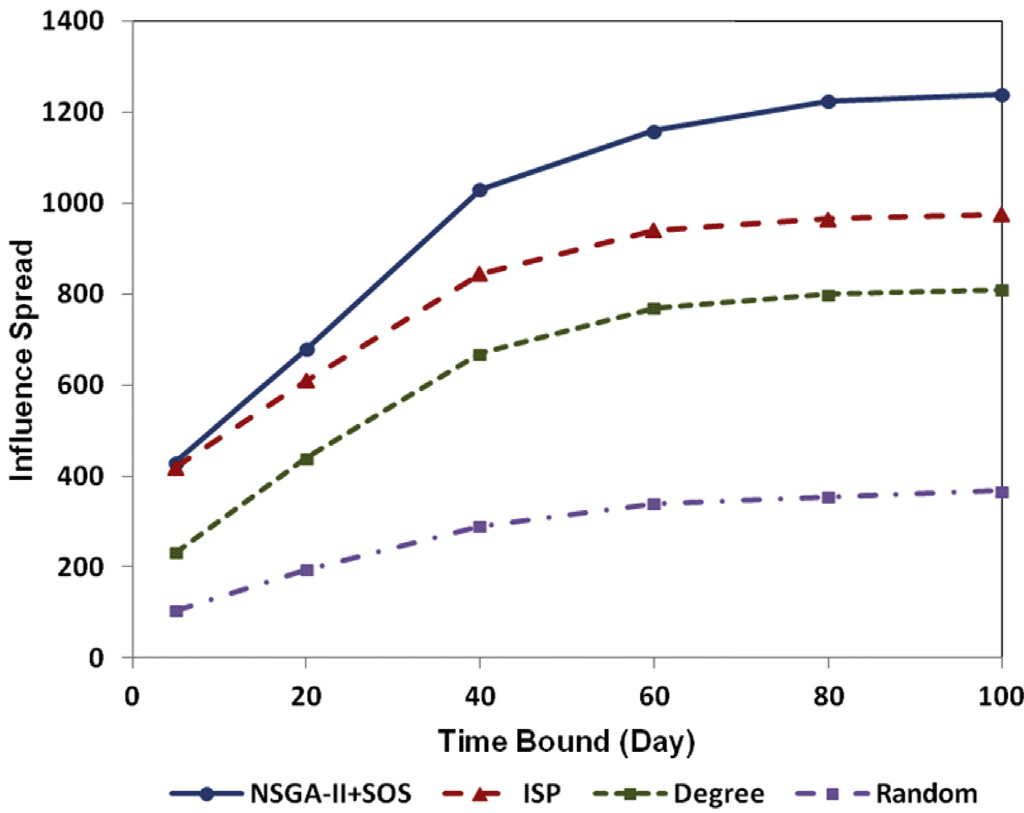 Caption: Influence spread over different time bounds. The proposed NSGA-II + SOS method (top line) consistently provides higher influence than the ISP greedy approach.
Critical Insight & Future Outlook
While the approach is a major step forward, its reliance on a binary chromosome representation (where every node in the graph is a bit) creates a memory bottleneck. As networks grow to millions of nodes, we will need more sparse representations.
The Takeaway: If you are designing viral marketing campaigns, stop looking for the "single best influencers." Instead, look for the influencers who fit your campaign's clock. This paper provides the mathematical compass to find them.