
MSGA: Decoding Customer Trust in E-Banking via Multi-Objective Optimization
Applying Multi-objective Optimization for Variable Selection to Analyze User Trust in Electronic Banking
This paper presents a multi-objective optimization approach for variable selection to analyze customer trust in electronic banking. It proposes the Multi-objective Selection Genetic Algorithm (MSGA), which identifies relevant behavioral and socio-demographic factors to optimize bank marketing strategies and customer profitability.
TL;DR
In the wake of financial crises, maintaining customer trust is the "Holy Grail" for banks. This paper introduces a Multi-objective Selection Genetic Algorithm (MSGA) designed to sift through complex datasets to find the specific variables that drive trust. By balancing model precision with administrative simplicity, the researchers provide a roadmap for banks to optimize electronic service delivery.
Background: The Trust Deficit
The shift from traditional branches to electronic banking was accelerated by a need for efficiency. However, as the 2008 crisis and subsequent fraud cases (rising from 18.82m in 2010) proved, trust is fragile. Banks need to know: What actually makes a customer trust an online platform? Is it their demographic background, their transaction history, or their specific product portfolio?
Methodology: Beyond Simple Accuracy
The researchers argue that variable selection is inherently a multi-objective problem. You want the minimum number of variables (for simplicity) and the maximum predictive power (for accuracy).
MSGA Evolution
While the classic NSGA-II is a powerhouse, it is computationally expensive for large banking databases. The paper proposes MSGA, which introduces two major innovations:
- Dual-Parent Selection: One parent is selected for quality (fitness), and the other for the size of the variable subset, maintaining high pressure on both objectives.
- Alpha Constraint (): A hard cap on the number of variables, ensuring the resulting model isn't too complex for human managers to act upon.
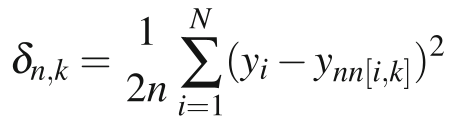 The Delta Test (shown above) acts as a noise estimator, preventing the model from over-fitting to the "noise" in human behavior data.
Experiments and Results
The study analyzed 946 valid cases using 33 different variables ranging from "Months of Experience" to "Number of Products Purchased."
Key Findings:
- The Power of k-NN: Using Mutual Information via k-Nearest Neighbors (k-NN) proved to be the most effective fitness function, capturing non-linear relationships that traditional metrics missed.
- Expert Alignment: Unlike many AI papers that ignore human intuition, this study validated results with a committee of financial experts. The MSGA with was rated the most useful for real-world business strategy.
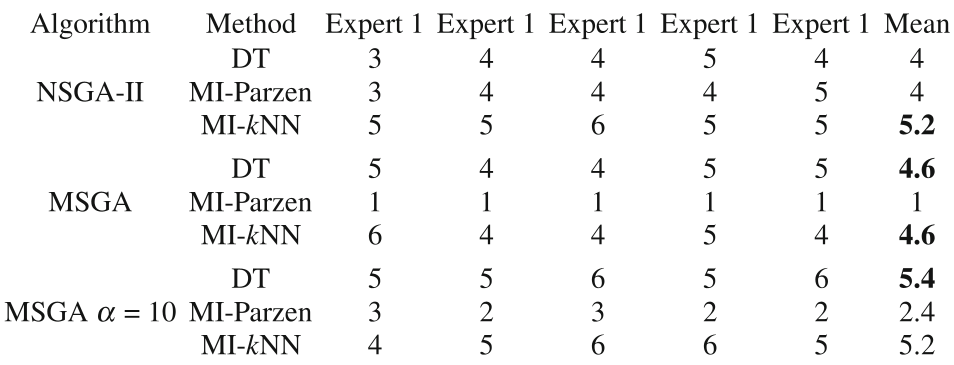 Comparative performance across different algorithms and expert scores.
Critical Insight & Conclusion
The study reveals that trust in e-banking is a "multi-modular" construct. It isn't just about security; it's about the synergy between demographic traits and the depth of the banking relationship (e.g., number of linked products).
Takeaway for the Industry: Data scientists in Fintech should move away from single-objective "accuracy" metrics. Using MSGA-like approaches allows for Strategic Interpretability—creating models that banks can actually explain to their stakeholders and use to build long-term customer loyalty.
Limitations: The study is based on Spanish banking data from a specific period; global variations in digital literacy and cybersecurity infrastructure might alter which variables are most predictive in other markets.