
MOGA-TFP: Balancing Expertise and Cohesion in Social Network Team Formation
A multi-objective formulation of the team formation problem in social networks: preliminary results
This paper introduces a multi-objective formulation for the Team Formation Problem in Social Networks (TFP-SN), optimized via the NSGA-II framework. The method simultaneously maximizes collaborative density and the expertise ratio, achieving competitive performance against traditional single-objective heuristics like RarestFirst and m-DensestAlk.
TL;DR
Forming the "perfect" team is more than just picking the best experts; it's about ensuring those experts can actually work together. This paper treats the Team Formation Problem (TFP) as a multi-objective optimization challenge, using the NSGA-II algorithm to balance team expertise with social density. By introducing a new "Graph Density" metric, the authors provide a way to find compact, highly connected, and skilled teams that outperform traditional single-metric heuristics.
The Conflict: Expertise vs. Communication
In any organization represented as a social graph, nodes are experts and edges represent past collaborations. When a task requires a specific set of skills (e.g., 2 AI experts, 1 Database expert), we face two conflicting realities:
- Skill Depth: We want the most experienced people (Expertise).
- Communication Overhead: We want people who have worked together before to reduce "friction" (Density).
Existing solutions often focus on one or the other. Distance-based metrics (like diameter) are sensitive to small graph changes, while density-based metrics often fail to guarantee that the team is even connected.
Methodology: Evolutionary Trade-offs
The authors utilize the NSGA-II (Non-dominated Sorting Genetic Algorithm II) to evolve a population of potential teams.
1. The Objectives
- Objective 1: Collaborative Density (): Unlike previous "subgraph density" metrics, this formula uses a quadratic denominator (). This provides a stronger mathematical push toward smaller, more cohesive teams.
- Objective 2: Expertise (): This measures the average experience level of team members relative to the required skills, preventing the team from growing "fat" with redundant members.
2. Genetic Operators
The core innovation lies in the Feasibility Preservation. The initialization, recombination, and mutation operators are designed to ensure that every "child" team produced still satisfies the skill requirements of the task.
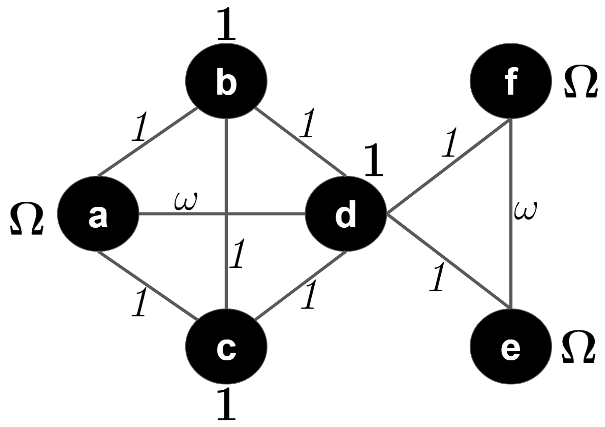 Above: An example social network graph where edges represent collaboration weights and nodes represent experts with specific skill levels.
Experimental Insights
Using the DBLP dataset (computer science bibliography), the authors tested their MOGA against established heuristics like RarestFirst and m-DensestAlk.
Connectivity and Size
One of the most striking findings was that although connectivity wasn't an explicit objective, the MOGA found connected solutions in 14 out of 15 test cases. By penalizing the size of the team quadratically through the Density objective, the algorithm naturally gravitated toward "Small Giants"—compact teams with high internal synergy.
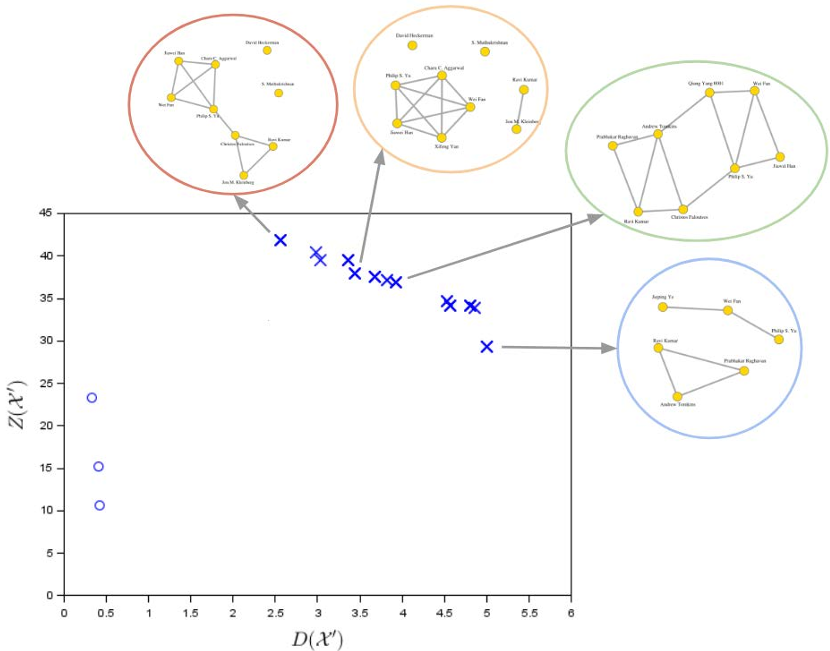 Above: The Pareto front for Test 12 shows the trade-off between Expertise and Density. The subgraphs illustrate how the algorithm finds different topologies, from cliques to more distributed but efficient structures.
Graph Density vs. Subgraph Density
The authors conducted a side-experiment comparing their "Graph Density" with the traditional "Subgraph Density." The result?
- Graph Density: Smaller teams (avg. 8.5 members), higher connectivity.
- Subgraph Density: Bloated teams (avg. 13.5 members), more disconnected components.
Critical Analysis & Conclusion
Takeaway
The study proves that multi-objective optimization is the "natural" way to view team formation. By providing a Pareto Front rather than a single solution, it allows decision-makers to choose between a "Dream Team" of high-end experts who might struggle to communicate, or a "Synchronized Unit" of slightly less experienced but highly collaborative members.
Limitations & Future Work
While robust, the current model assumes past collaboration is the only predictor of future success. Future research could integrate State-Space Models (SSM) or Social Influence metrics to better predict latent collaborative potential between experts who haven't met yet. Furthermore, exploring decomposition-based algorithms like MOEA/D could potentially improve the diversity of the Pareto front in even larger social networks.