
Beyond the First Push: Strategic Multi-phase Information Diffusion in Social Networks
A Multi-phase Approach for Improving Information Diffusion in Social Networks
This paper introduces a multi-phase approach to the Influence Maximization (IM) problem in social networks, primarily focusing on a two-phase strategy under the Independent Cascade (IC) model. By leveraging the Observed Diffusion from the first phase to inform seed selection in the second, the authors propose algorithms like FACE and GDD to optimize budget allocation and timing, achieving significant gains over traditional single-phase methods.
TL;DR
Information diffusion in social networks is rarely a one-time event. This paper breaks the mold of traditional "single-shot" Influence Maximization (IM) by proposing a multi-phase framework. By splitting the seeding budget and observing how the initial "fire" spreads, we can place the second set of seeds much more strategically, resulting in a 5-10% increase in total influence.
Background: The Limits of Static Seeding
In the classic IM problem, we select nodes to start a viral trend. However, social networks are stochastic; just because a node can influence its neighbor doesn't mean it will. Traditional methods ignore the "observed reality" of the spread. This paper asks a fundamental question: What if we hold back part of our budget to see who actually gets influenced first?
The Core Insight: Adaptive Two-Phase Diffusion
The researchers investigate the Independent Cascade (IC) model in a two-phase setting. The process looks like this:
- Phase 1: Trigger diffusion with seeds.
- Wait: Let the information spread for a delay of .
- Phase 2: Observe the currently active nodes () and recently influenced nodes (), then deploy the remaining seeds.
Why this is mathematically challenging
The objective function for two-phase diffusion is neither submodular nor supermodular. This is a major hurdle because submodularity is the "secret sauce" that allows greedy algorithms to provide theoretical guarantees. However, the authors observed through simulations that it behaves locally like a submodular function (diminishing marginal returns), making greedy-style heuristics surprisingly effective.
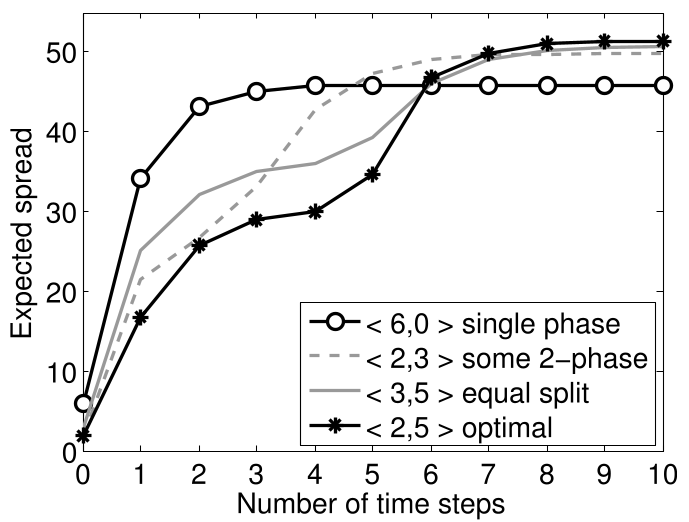 Figure 1: Comparison of budget splits and delay effects on the final spread.
Methodology: Farsighted vs. Myopic
The authors propose two strategic mindsets for the first phase:
- Farsighted: When selecting initial seeds, the algorithm explicitly "thinks ahead" about how those seeds will interact with the second phase's optimal selection ().
- Myopic: The algorithm simply maximizes the spread for the first phase as if there were no second phase ().
Interestingly, the researchers found that Myopic algorithms perform nearly as well as Farsighted ones while being significantly faster to compute.
Experimental Findings
Using the Cross Entropy Method (FACE) to optimize for , , and simultaneously, the study reveals several strategic rules of thumb:
- No Time Pressure: Use two phases with an equal budget split and long delay. The "informed" second seeding more than makes up for the lost time.
- Strict Deadlines: Stick to single-phase seeding. The decay of information relevance (modeled by ) punishes any delay.
- The 10% Gains: Across various algorithms (Greedy, PMIA, GDD), the two-phase approach consistently outperformed single-phase seeding by 5-10%.
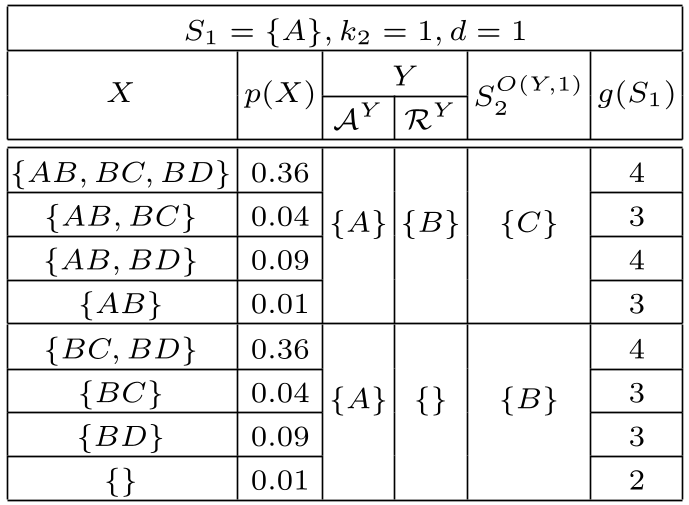 (a) Transition Dynamics: Visualizing how influence builds over time with different delay parameters.
Critical Insight & Future Outlook
This work highlights that the "value of information" (knowing the realized social graph) often outweighs the "value of time" (starting early). However, the current model assumes a relatively simple decay function.
Future research needs to tackle:
- Scalability: Concurrent optimization of seeds, budget, and time for million-node networks.
- Complex Realities: How does this work when competing brands are also seeding the same network?
In conclusion, for any viral marketing practitioner, the message is clear: Don't blow your entire budget on day one.