
SAMPhO: Boosting Mobile Social Network Efficiency through Multi-Phase Routing logic
Multi-phase socially-aware routing in distributed mobile social networks
The paper introduces SAMPhO (Socially-Aware Multi-Phase Opportunistic) routing, a novel protocol for Distributed Mobile Social Networks (DMSNs). It uniquely categorizes the opportunistic routing process into four distinct phases—Ad-hoc, Centrality-based, Copy Spreading, and Probability-based—applying tailored social metrics to each to maximize delivery efficiency.
TL;DR
In the chaotic environment of infrastructure-less Mobile Social Networks (MSNs), traditional "one-size-fits-all" routing metrics often fail. This paper presents SAMPhO, a protocol that segments the routing journey into distinct phases—from global community hopping to local social delivery. By dynamically switching metrics based on these phases, it achieves a 12-13% improvement in delivery rates over SOTA linear models while keeping network congestion remarkably low.
The Motivation: Why "Flat" Routing Fails
Most existing opportunistic routing protocols (like PROPHET or SimBetTS) assume that a single metric—be it "delivery predictability" or a weighted "social tie"—should govern a message's entire journey.
However, the authors argue that routing is inherently non-linear. A message carried by a complete stranger looking for a destination in another city needs a different forwarding logic than a message already within the destination's social circle. Treating these scenarios the same way (the "Flat Routing" problem) results in poor carrier selection and excessive, useless message copies.
Methodology: The Four Phases of Routing
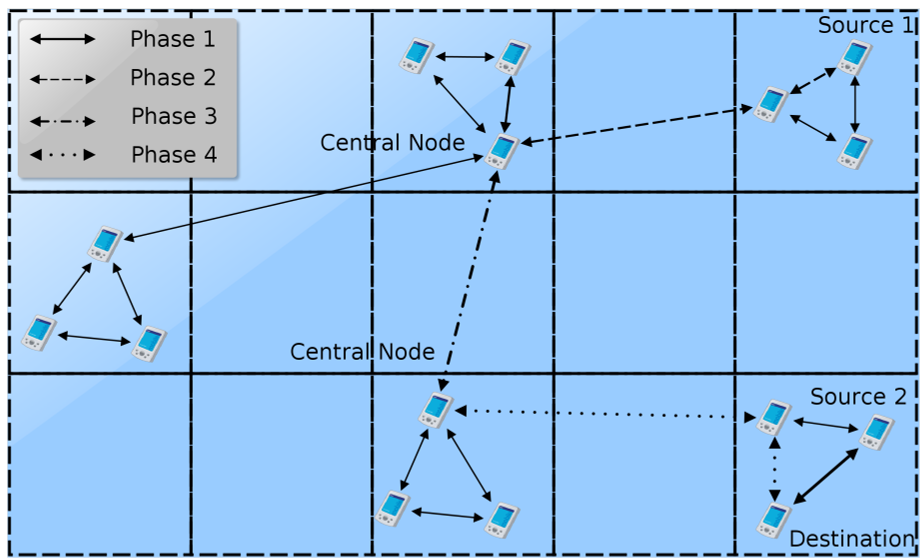
The core innovation of SAMPhO lies in its Phase-Aware Architecture. Instead of inventing yet another social metric, the authors identify four specific phases based on the availability of information regarding the destination:
- Contemporary Ad-Hoc Phase: If a direct path exists, use standard ad-hoc routing.
- Centrality-based Forwarding: If the destination is unknown, move the message to "hubs" (nodes with high ego-betweenness) to bridge different communities.
- Copy Spreading Phase: When a message is at a hub but the destination's community is still unlocated, limited copies () are spread among central nodes to increase the search radius.
- Probability-based Forwarding: Once information about the destination is detected, switch to social-tie strength metrics for "last-mile" delivery.
The Role of Social Sensitivity (SS)
The protocol introduces a "Social Sensitivity" parameter. This acts as a threshold to determine who qualifies as a "social neighbor." By tuning SS, the system can filter out weak, transient contacts and focus on high-probability social ties, which the authors found to be most effective at a 70-90% range.
Evaluation: Efficiency Without the Flood
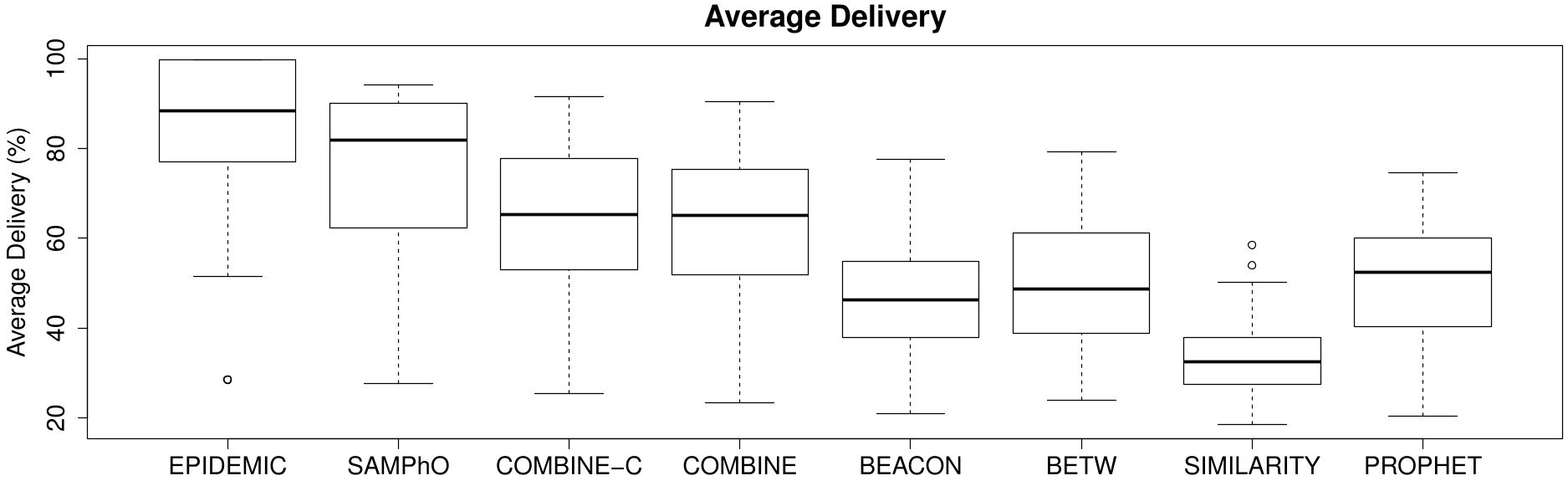
The authors implemented the SAORS (Socially-Aware Opportunistic Routing System) on OMNET++ to compare SAMPhO against benchmarks like Epidemic, PROPHET, and SimBetTS (represented as "COMBINE").
Performance Highlights:
- Delivery Rate: SAMPhO significantly outperformed individual metrics (Betweenness, Similarity) and linear combinations (COMBINE), showing that how you use metrics is as important as the metrics themselves.
- Resource Management: Unlike Epidemic routing, which hits the delivery upper bound by flooding the network, SAMPhO keeps the total message count low—nearly as low as single-copy protocols—while delivering significantly more packets.
Critical Analysis & Takeaways
SAMPhO succeeds because it respects the hierarchical nature of social networks. Most messages in a MSN must first travel globally across communities before they can be routed locally through social ties.
Key Insight: The effectiveness of a routing protocol isn't just about the "strength" of a social tie, but the timing of when that tie information is utilized.
Limitations & Future Outlook
While SAMPhO shows great promise, it assumes node cooperation. In real-world MSNs, "selfish" nodes may refuse to carry messages or lie about their centrality. Integrating incentive mechanisms or trust management would be the logical next step for this research. Furthermore, testing on real-world mobility traces (e.g., Infocom or Reality Mining datasets) would further validate the synthetic model results seen here.
Summary: This work bridges the gap between ad-hoc efficiency and opportunistic reliability, providing a blueprint for distributed social applications where 5G or Wi-Fi infrastructure is unavailable.