
MPACO: Predicting NoC Traffic Trends with Financial "Market" Intelligence
Multi-Pheromone ACO-based routing in Network-on-Chip system inspired by economic phenomenon
This paper introduces MPACO (Multi-Pheromone Ant Colony Optimization), an adaptive routing algorithm for Network-on-Chip (NoC) systems. Inspired by technical analysis in stock markets, it utilizes multiple pheromones with differing evaporation rates to predict traffic trends and achieve superior global load-balancing.
TL;DR
MPACO (Multi-Pheromone Ant Colony Optimization) is a novel adaptive routing scheme that treats Network-on-Chip (NoC) traffic like a stock market. By maintaining two separate pheromone levels—Short-Term (ST) and Long-Term (LT)—the router can identify "bullish" (improving) or "bearish" (congesting) traffic trends. This approach achieves up to a 22.11% improvement in saturation throughput compared to standard routing techniques.
Problem & Motivation: The Lag in Collective Intelligence
As on-chip components grow denser, Network-on-Chip (NoC) architectures face highly unpredictable traffic. While Ant Colony Optimization (ACO) has been a popular solution for global load balancing, it typically relies on a single pheromone value. This creates a "lag" problem: the pheromone tells you where the congestion is (or was), but not where it is going.
The authors observed that pheromone evaporation and accumulation are mathematically identical to Exponential Moving Averages (EMA) used by stock traders to filter noise and identify trends. If traders use crossovers between short-term and long-term averages to predict market shifts, why can't a NoC router do the same for packet traffic?
Methodology: The "Stock Market" of Packets
The core of MPACO lies in its dual-pheromone system. Instead of a single value, each channel tracks two metrics:
- Short-Term Pheromone (): Highly sensitive to recent changes, reflecting immediate local congestion.
- Long-Term Pheromone (): Acts as a baseline or "resistance" level, representing historical traffic averages.
The Four Status Models
By comparing these two pheromones and their rate of change (), the router categorizes each path into one of four states:
- Advance: Traffic is low and improving (Short-term > Long-term).
- Rally: Path was congested but is recovering.
- Reaction: Path is currently clear but showing signs of upcoming congestion.
- Decline: Deeply congested; the "bear market" of routing.
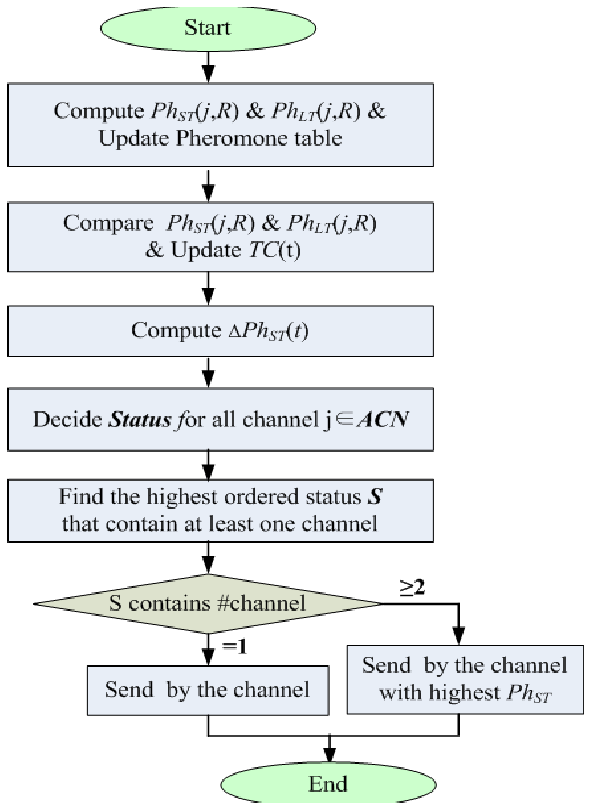 Figure 1: The MPACO system flow utilizing trend prediction for channel selection.
Experiments and Results
The researchers tested MPACO on an 8x8 mesh topology using the Noxim simulator. They compared it against traditional local models like Output Buffer Length (OBL) and more advanced methods like Regional ACO (RACO).
Performance Gains
MPACO outperformed all baselines in saturation throughput:
- +17.54% over Random selection.
- +12.63% over OBL.
- +5.26% over RACO-4 (the previous SOTA).
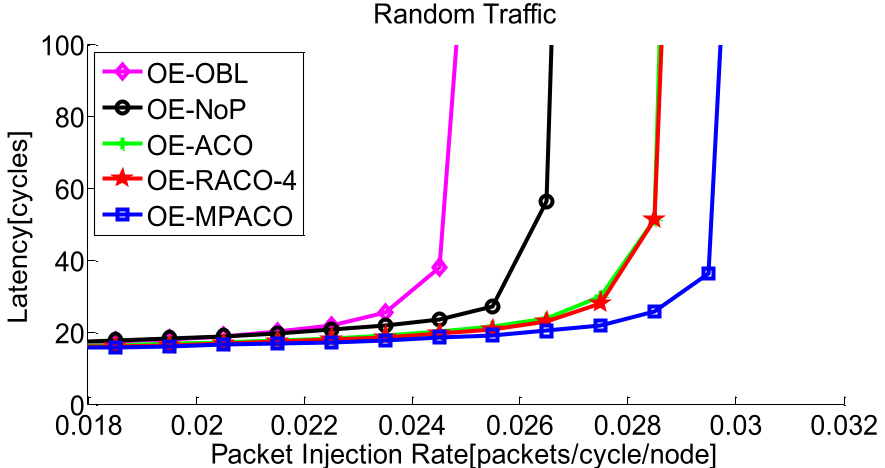 Figure 2: Average latency vs. packet injection rate, showing MPACO's superior saturation point.
Latency Distribution
The packet histogram analysis revealed a "latency shift" phenomenon. MPACO effectively reduces the number of "unlucky" packets trapped in high-latency routes by proactively steering them toward paths in the Advance or Rally states.
Critical Analysis & Conclusion
The beauty of MPACO is that it adds a "temporal dimension" to routing decisions without requiring a massive hardware overhead. By leveraging the Regional ACO structure, it avoids the memory explosion typical of early ACO models.
Takeaway: This work proves that the "predictive power" of a routing algorithm is just as important as its "sensing power." While MPACO currently focuses on 2D meshes, its logic is highly applicable to more complex 3D NoCs or heterogeneous systems-on-chip where traffic bursts are even more severe.
Limitations: The current study relies on synthetic traffic patterns (Poisson/Transpose). Future verification on real-world workload traces (e.g., PARSEC benchmarks) would further validate the robustness of the "financial trend" analogy in practical silicon.