
MPB-ARM: Breaking the Scalability Barrier in Association Rule Mining with Cooperative Intelligence
Multi-population Cooperative Bat Algorithm for Association Rule Mining
The paper introduces MPB-ARM, a Multi-population Cooperative Bat Algorithm designed for Association Rule Mining (ARM). By integrating a master-slave strategy and vertical database layouts, the method achieves SOTA rule quality and significantly faster execution compared to traditional bio-inspired metaheuristics.
TL;DR
Association Rule Mining (ARM) is a cornerstone of data science, yet traditional methods struggle with the sheer volume of modern datasets. This paper presents MPB-ARM, a multi-population variant of the Bat Algorithm. By leveraging a Master-Slave cooperative architecture and a vertical data layout, it cuts execution time by half while generating higher-quality rules than existing bio-inspired competitors like BSO-ARM and ACO.
The Bottleneck: Why Standard ARM Algorithms Stall
Association Rule Mining is essentially a massive search problem: finding correlations (rules) that satisfy minimum support and confidence thresholds.
- Resource Hunger: Classical algorithms like Apriori require multiple passes over the database.
- Local Optima: Previous bio-inspired attempts (like the standard Bat Algorithm) often suffer from a "lonely bat" problem—lack of communication leads to redundant searching and poor global exploration.
- Data Format: Horizontal layouts (scanning rows) make calculating the "support" of a rule computationally expensive.
Methodology: The Master-Slave Cooperative Framework
The core innovation of MPB-ARM lies in its organizational structure. Instead of one large swarm, the population is divided.
1. Vertical Data Layout
Unlike standard row-based scanning, MPB-ARM uses a vertical layout. This allows the algorithm to calculate the frequency of an item-set by simply intersecting two subsets, drastically reducing the computational overhead of the fitness function.
2. Master-Slave Cooperation
The authors implement a hierarchical interaction model:
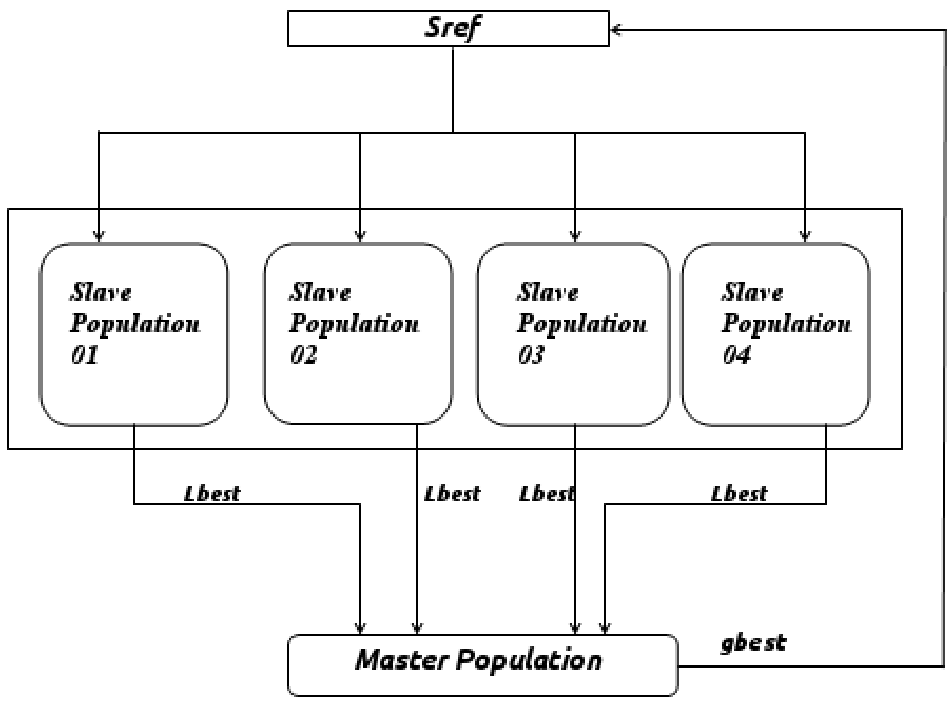
- Slave Populations: Multiple sub-groups of bats explore different regions of the rule space in parallel. Each finds a local best ().
- Master Population: The master collects these and uses the Bat Algorithm's movement equations (Frequency, Velocity, and Loudness) to synthesize a true Global Best ().
- The Feedback Loop: The master then notifies all slaves of this , which acts as a new reference point () for the next iteration, ensuring the entire swarm gravitates toward high-quality rules without losing diversity.
Experimental Battleground
The researchers tested MPB-ARM against a battery of benchmarks (Chess, Mushroom, IBM Quest) and established metaheuristics.
Speed Performance
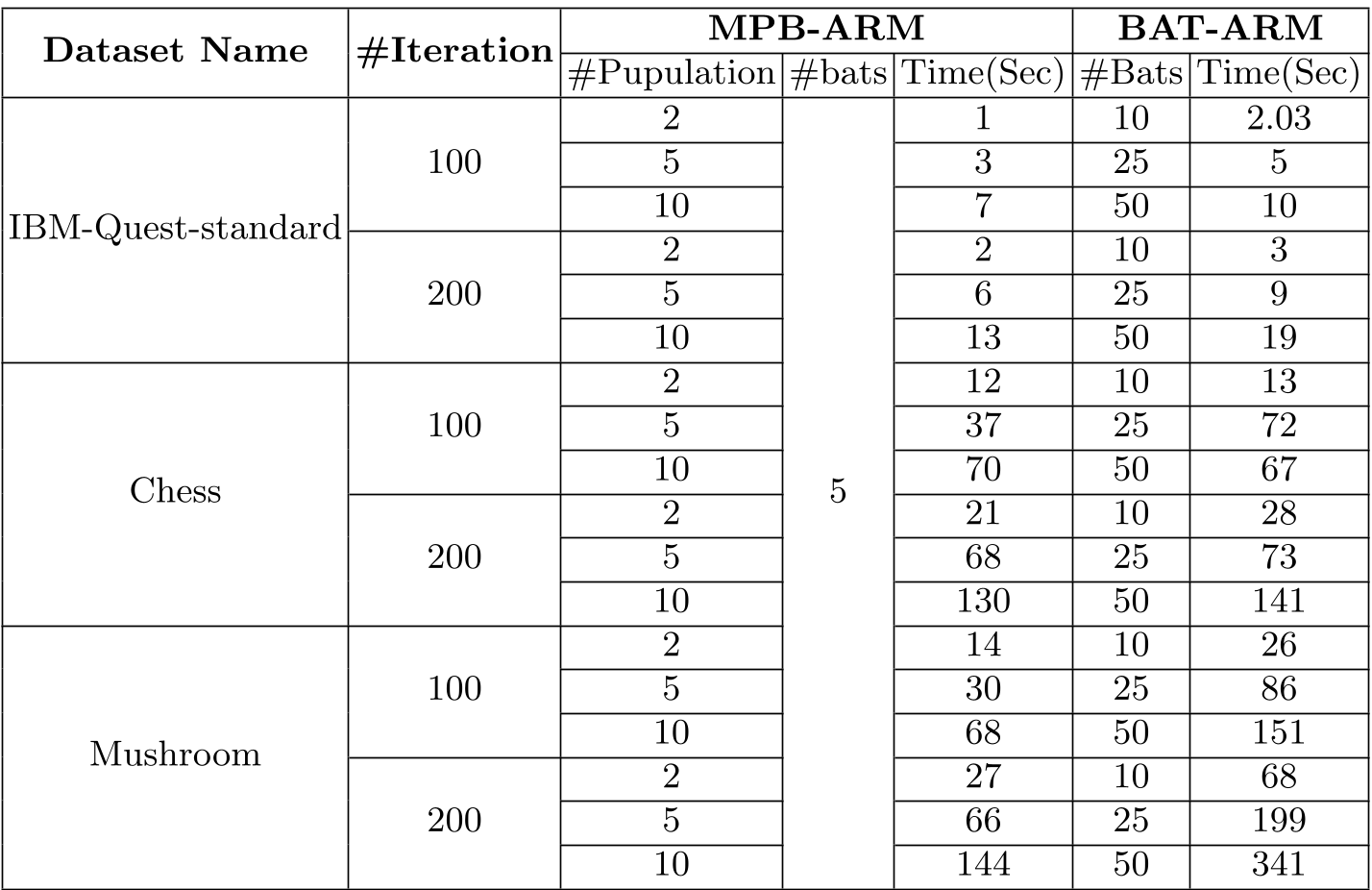
The combination of the vertical layout and parallel-like population structure yielded significant gains. On the Mushroom dataset, the original BAT-ARM took 341 seconds for 200 iterations with 50 bats. MPB-ARM achieved the same with 10 populations in just 144 seconds—a speedup of over 2.3x.
Rule Quality (Fitness)
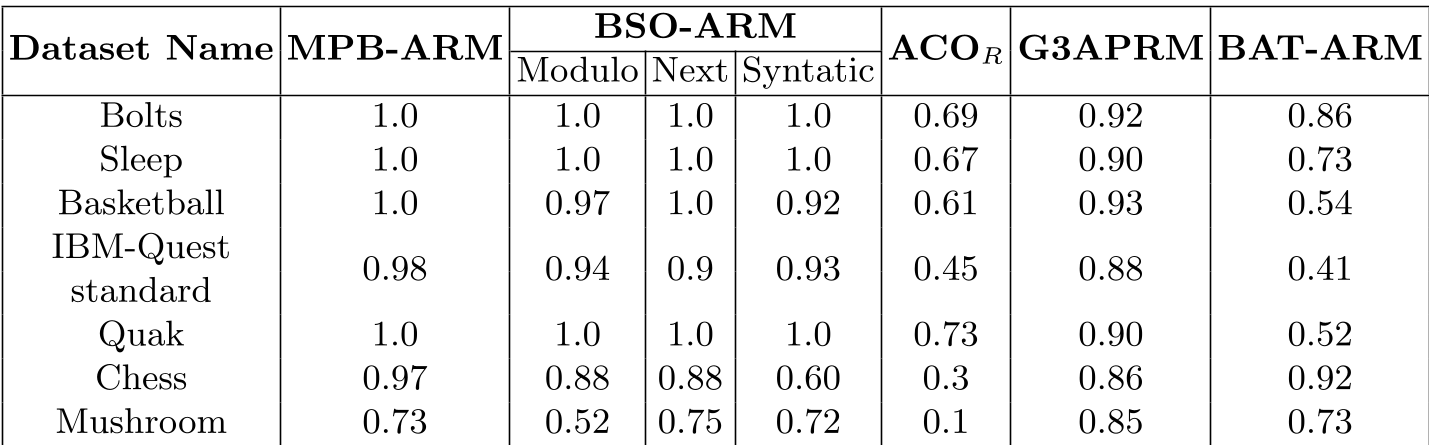
Using a fitness function that weighs confidence and support, MPB-ARM outperformed BSO-ARM, G3APRM, and ACO. In complex datasets like Chess, where other algorithms fell to 0.3 or 0.86, MPB-ARM maintained a fitness of 0.97.
Critical Insight & Conclusion
The success of MPB-ARM stems from solving the Exploration vs. Exploitation dilemma. The Slaves provide the exploration (diversity), while the Master enforces exploitation (convergence).
Takeaway: This work proves that metaheuristics aren't just "random guesses." When structured with proper communication protocols and efficient data structures, they can outperform traditional deterministic algorithms in complex combinatorial spaces.
Future Outlook: The next frontier for this method is Numerical Association Rules and massive "WebDocs" scale datasets. The authors also suggest moving the implementation to GPUs, which could potentially push association rule mining into the realm of real-time stream processing.