
PED-GEP: Breaking the Stagnancy of Gene Expression Programming via Diversity-Guided Evolution
Multi-Population Parallel Genetic Algorithm for Economic Statistical Information Mining Based on Gene Expression Programming 1
This paper introduces PED-GEP, a Parallel Evolution strategy with Diversity-guidance for Gene Expression Programming, aimed at economic statistical mining. It integrates dynamic mutation (DM-GEP) and flexible population scaling to optimize symbolic regression tasks.
TL;DR
Gene Expression Programming (GEP) is a powerful tool for symbolic regression, yet it often hits a "plateau" where evolution stalls. This paper presents PED-GEP, a multi-population parallel framework that uses Dynamic Mutation (DM) and Diversity-Guided grading to jump out of local optima. The results are striking: a 65% reduction in stagnancy generations and an 8% boost in fitness for complex economic function mining.
Background: The Price of Uniformity
In the realm of Function Discovery, GEP stands out by combining the fixed-length linear chromosomes of Genetic Algorithms (GA) with the flexible tree-based phenotypes of Genetic Programming (GP). However, GEP suffers from a fatal flaw: Pre-maturity. As evolution progresses, individuals often become too similar, the population loses its "genetic creativity," and the algorithm gets stuck in a local optimum for thousands of generations.
Method: The "Three-Pronged" Attack on Stagnancy
The authors propose three core innovations to revitalize the evolutionary process:
1. Dynamic Mutation (DM-GEP)
Instead of a static mutation rate, the authors implement a phase-based approach:
- Initial Stage: Stepwise increase of mutation rate () to explore the search space.
- Metaphase: Further increase in to prevent early convergence.
- Anaphase: Gradual decrease in to fine-tune the best individuals toward the global maximum.
2. Diversity-Guided Grading
The paper introduces mathematical definitions for Diversity Measure () and Diversity Entropy (). These metrics act as a "thermometer" for the population. If diversity drops below a threshold, the algorithm triggers changes in population scale and genetic operators to re-inject variety.
3. PED-GEP Architecture
By splitting the population into child-subgroups and evolving them in parallel with different parameters, the algorithm covers more "ground" in the solution space.
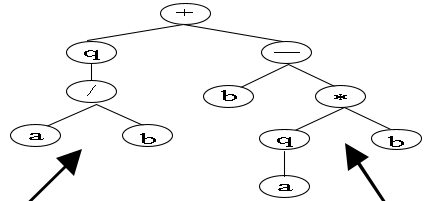 Fig 1. An ET tree of a chromosome made of two genes, illustrating the genotype-phenotype mapping.
Experiments: Performance Leap
The team tested the algorithm against the complex polynomial .
- Convergence Speed: While basic GEP stalled until nearly the 2800th generation, the DM-GEP variant reached the same fitness level by the 920th generation.
- Parallel Efficiency: PED-GEP outperformed existing GEP variants (like VPS-GEP and FC-GEP) in both fitness and time efficiency.
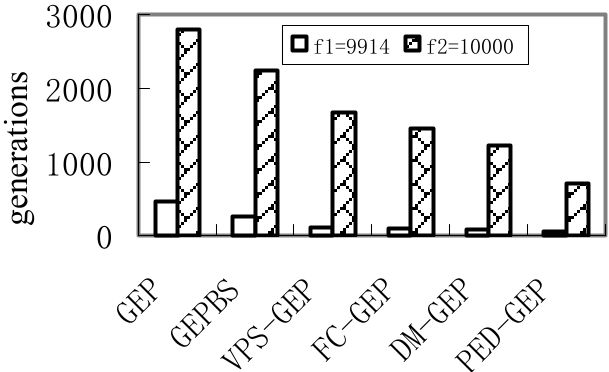 Fig 2. Comparison of average evolution generations. PED-GEP (the rightmost bar) shows the lowest generation count, signifying the fastest convergence.
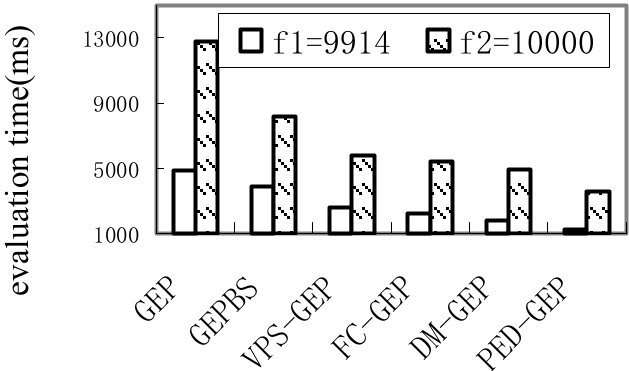 Fig 3. Average evolution time comparison. The PED-GEP approach significantly lowers the computational overhead compared to traditional GEP.
Critical Insight: Why it Works
The brilliance of PED-GEP lies in its Inductive Bias toward diversity. Traditional GEP treats mutation as a random error; PED-GEP treats it as a controlled search pressure. By monitoring entropy, the algorithm knows when to be chaotic and when to be stable, effectively solving the exploration-exploitation dilemma.
Conclusion & Future Work
PED-GEP effectively resolves the stagnancy problem in symbolic regression without increasing algorithmic complexity (). For researchers in economic forecasting or complex system modeling, this framework provides a robust template for high-performance data mining. Future extensions could involve applying this diversity-guided logic to Deep Neuroevolution or Multi-objective optimization.
Final Takeaway
Diversity isn't just a byproduct of evolution—it's the engine that powers it.