
Beyond Reshares: Decoding Multi-relational Influence in Professional Networks
Multi-relational influence models for online professional networks
This paper introduces a multi-relational influence model for professional social networks like LinkedIn, utilizing Hinge-loss Markov Random Fields (HL-MRFs) and Probabilistic Soft Logic (PSL). It jointly models heterogeneous relationships (job changes, skill additions, seniority) to predict pairwise influence, achieving a 20% precision increase over the General Threshold Model (GTM) baselines.
TL;DR
Quantifying influence in professional networks like LinkedIn is far more complex than tracking "likes" on a generic social feed. This paper presents a holistic framework using Hinge-loss Markov Random Fields (HL-MRFs) and Probabilistic Soft Logic (PSL) to model pairwise influence. By integrating professional-specific signals—such as job changes, skill acquisitions, and organizational hierarchy—the authors achieved a 20% improvement in precision over traditional influence models.
The Problem: The One-Dimensionality of Influence
Most academic work on influence maximization relies on the General Threshold Model (GTM) or Independent Cascade Model, which usually treat influence as a binary propagation of a single action (e.g., clicking a link).
However, professional networks are multidimensional. Influence can be:
- Long-term: Seeing a mentor move to a specific company might influence a user to follow a year later.
- Hierarchical: A manager's actions carry different weight than a peer's.
- Skill-based: Adding a new technical skill reflects a different type of professional ripple effect compared to merely joining a hobbyist group.
Existing SOTA methods failed because they could not effectively fuse these heterogeneous edge types and node characteristics into a single, scalable reasoning engine.
Methodology: The Power of Relational Reasoning
The researchers leverage HL-MRFs, a class of continuous graphical models that allow for efficient, convex optimization-based inference. Using PSL, they define weighted logical rules that mirror human professional intuition.
1. Feature Engineering: The Professional Signal
Instead of one propagation graph, they build four:
- Job Propagation: Joining the same company.
- Skill Propagation: Adding identical professional competencies.
- Content Propagation: Standard social interactions (likes, shares).
- Group Propagation: Joining professional communities.
2. Model Architecture: PSL-Combine
The core innovation lies in the PSL-Combine model. It doesn't just ask "Does User A influence User B?" It jointly predicts two things:
- Influence Score: The strength of the directed edge.
- Influential Score: The inherent authority of the node.
 Note: The model uses logical templates (shown in Tables 1-3 of the paper) to relate action propagation, seniority, and influenceability.
Experiments and Results
The model was tested on LinkedIn's vast dataset. The researchers evaluated the models by their ability to predict future user actions (joining a group or following content) based on the inferred influence scores.
Performance Gains
The results were striking. The PSL-Combine model consistently outperformed MLE-based and Jaccard-based GTM models across all metrics:
- General Precision: ~20% improvement across the board.
- Key Players: In a subset of "High Integrity" users (highly influential/influenceable), the precision at Top-15 jumped from ~36% (GTM) to 48.9% (PSL-Combine).
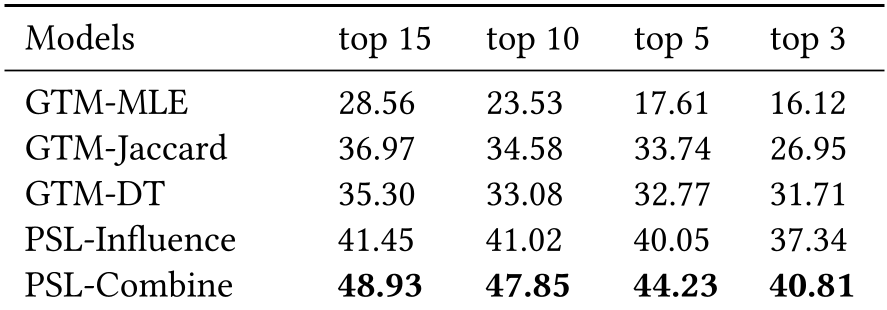 Table: Comparison of PSL models against GTM baselines for group action prediction.
Critical Insight: Who Influences the Influencers?
A fascinating finding in the paper's qualitative analysis: influence isn't just "top-down."
- In 12% of cases, influence flowed from the subordinate back to the manager.
- In 20% of cases, influence was driven entirely by peers within the same organization.
This proves that "Influence" is not a synonym for "Seniority," but rather a dynamic result of active engagement and action propagation.
Conclusion & Future Outlook
This work shifts influence modeling from mere "connectivity" to "relational context." By proving that we can mathematically model complex human dynamics like "influenceability" and "professional reputation," the authors provide a blueprint for more sophisticated recommendation engines and viral marketing strategies.
Future Work: The next frontier is cross-contextual influence—understanding if influence in "skills" translates to influence in "job seeking," or if professional authority is contextually siloed.