
MR-BPR: Solving the Cold-Start Problem through Multi-Relational Joint Factorization
Multi-relational matrix factorization using bayesian personalized ranking for social network data
This paper introduces MR-BPR, a multi-relational matrix factorization framework designed for item recommendation in social networks. By extending the Bayesian Personalized Ranking (BPR) criterion to handle multiple relations jointly, the method achieves SOTA performance in ranking tasks, specifically targeting the user cold-start problem.
TL;DR
Recommending items to "cold-start" users—those with social profiles but zero purchase or view history—is a classic challenge. This paper presents MR-BPR, a method that stops treating social networks and user-item interactions as separate problems. By factorizing these relations jointly using an extended Bayesian Personalized Ranking (BPR) framework, it achieves significant performance boosts (AUC and F1) over traditional sequential methods like ModMax and EdgeClustering.
The Motivation: Why Sequential Learning Fails
In the social media era, we often know who a user's friends are (the Auxiliary Relation) before we know what products they like (the Target Relation).
Prior SOTA methods typically followed a two-step pipeline:
- Feature Extraction: Run PCA or clustering on the social graph to get "user features."
- Classification: Plug those features into an SVM to predict item interests.
The authors identify a critical flaw: this sequential approach is "blind." The features extracted from the social graph are not informed by the actual items that might be recommended. Furthermore, these methods often treat the problem as a classification task rather than a ranking task, which is what users actually experience in a recommender system.
Methodology: The Power of Joint Factorization
The core idea of Multi-Relational BPR (MR-BPR) is to share latent dimensions across different matrices. If a user is represented by a latent vector , this same vector should help explain both their friendships and their item preferences.
1. The Multi-Relational Objective
The authors define a global loss function that combines the BPR-Opt values for all relations:
By optimizing this jointly, the item features and social connections "talk" to each other during the learning phase, refining the user's latent representation to be optimal for both contexts.
2. Bayesian Personalized Ranking (BPR) Extension
Unlike standard Matrix Factorization (which uses Mean Squared Error), MR-BPR uses a pairwise ranking loss. It assumes that for a user, an observed interaction is preferred over an unobserved one. This is far more robust for "implicit feedback" (likes, views) common in social networks.
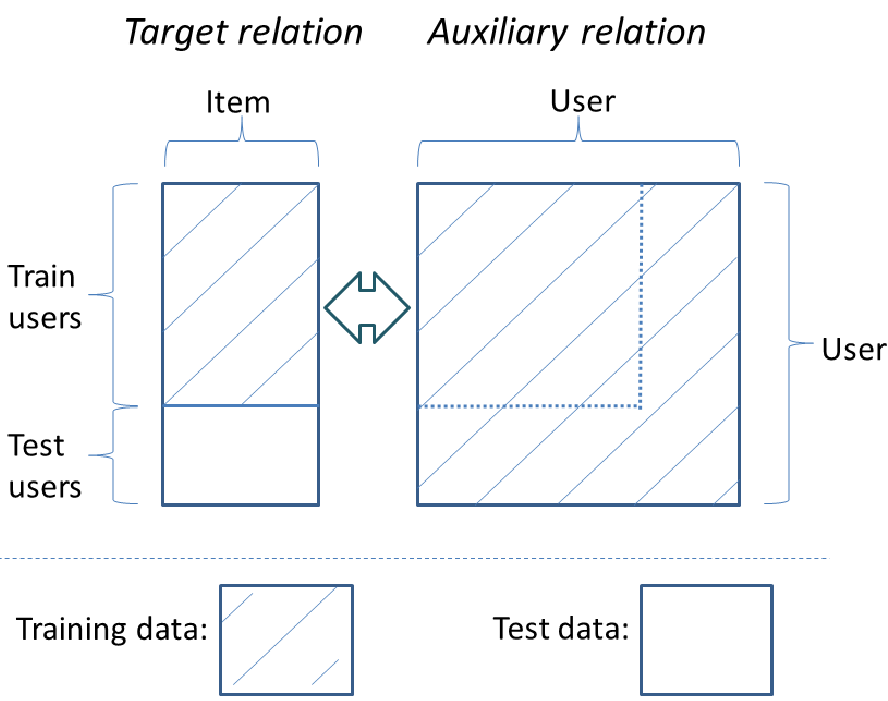 Figure 1: The multi-relational cold-start setting where user latent features are shared across social and target relations.
3. Pivotization: A Dual Perspective
Standard BPR focuses on ranking items for a user. The authors introduce Pivotization, which also ranks users for an item. By alternating between these perspectives (Horizontal vs. Vertical sampling), the model becomes significantly more effective at capturing community-wide item trends.
Experiments and Results
The researchers tested MR-BPR against heavyweights like ModMax and EdgeClustering on three massive datasets: Blogcatalog, Flickr, and YouTube.
Key Performance Gains
- Cold-Start Superiority: Even when training data for the target relation was as low as 1%, MR-BPR maintained high AUC scores.
- F1-Measure Dominance: In terms of Micro-F1 and Macro-F1, MR-BPR consistently stayed at the top of the curve.
- Scalability: Unlike ModMax, which requires expensive eigenvector computations (and failed to run on the large YouTube dataset), MR-BPR’s stochastic gradient descent approach scaled effortlessly.
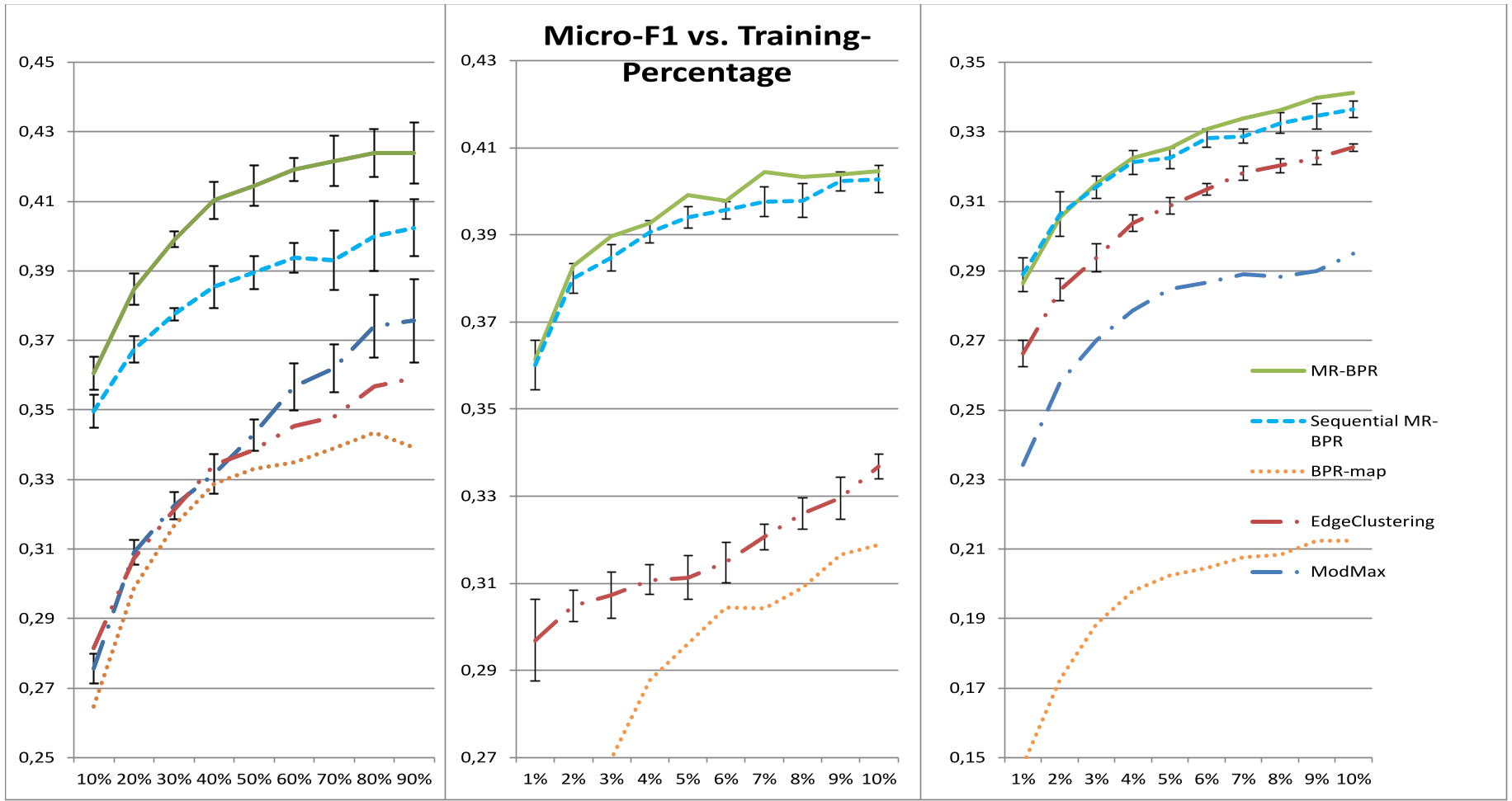 Figure 2: Micro-F1 results showing MR-BPR (top curves) outperforming baselines as training data increases.
Critical Insights & Conclusion
The brilliance of MR-BPR lies in its simplicity and integration. By moving from a "feature engineering" mindset to a "joint learning" mindset, it allows the social signal to directly regularize the item prediction.
Takeaways for Practitioners:
- Don't Pre-process Separately: If you have multiple data sources (e.g., social graphs, user attributes, purchase history), factorizing them in a single shared latent space is almost always better than sequential pipelines.
- Optimize for Ranking: If your end-product is a ranked list, using a pairwise ranking loss like BPR is superior to standard regression or classification.
Limitations: While powerful, the model assumes that social similarity directly translates to interest similarity (the homophily assumption). In networks where "friends" have widely divergent tastes, the auxiliary social signal might introduce noise. Future work involving Social Trust or Graph Neural Networks (GNNs) could further refine these latent interactions.